




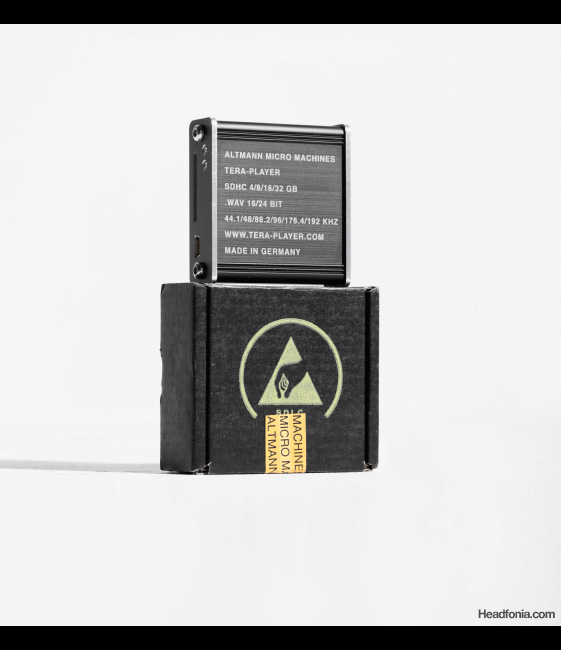
The listening tests were so impressive that at one time I asked myself: “I don’t remember hearing live piano sounding this good!” You know when you go to a concert, your seating position affects the quality of the sound that you hear? Well, the bad news is that regardless of what VIP ticket you hold, your seating position will never be as good as the position of the recording microphone. So, unless you get to sit next to the pianist on a live concert, chances are you’ll miss all that tiny details from the hammer striking the strings.
With a great quality recording, a superb source, and a highly transparent IEM, indeed a lot of details from the piano are reproduced brilliantly, details that you don’t hear even on the live session. The sound of that hammer hitting the strings, the breath of the pianist (yes, no exaggeration there). Of course the live ambiance would never be as clear as a live concert, but those tiny details, the Tera-Player really did an awesome job with them. Non fatiguing detail with crystal clear clarity from the super black background.
Comparisons
I didn’t really do a comparison to the HM-60X series players. I know that it would take the HM-801’s PCM1704 to take on the tiny Tera’s sound quality. And this is what I found: The HM-801 is still the best in recreating a live recording ambiance, and in that aspect it’s much better than the Tera-Player. It’s really good at painting the picture of the whole soundscape, but for some reason instruments and vocals weren’t as distinct nor as weighty as on the Tera-Player. Moving to the Tera-Player, I gained that body in the instruments and vocals, that black background that I get from higher up set ups desktop set ups.
I’d consider the comparison roughly a tie, though obviously I’m not taking into account the size and the battery life of the HM-801 here. However, I also know that the Philips D/A chip used in the Tera is far less potent than the PCM1704 used in the HM-801 (is there anything better than the PCM1704?). And so I went to ask Charles why he couldn’t make a version of the Tera with a PCM1704? After all, he’s used it in the past with his Superlative DAC (check out the picture of the Superlative on the Gallery on the last page). And so I asked him: “Charles, would it be too much work to make a Tera-player with PCM1704?”
And he replied: “the PCM1704 requires 20 times the board space and 10 times the current supply, it needs 4 different voltages, so you would end up in a rather bulky and heavy device with limited playtime and long charge-time. Please take a look at the attached pic: if it would be exercised correctly in order to unleash the full potential of the PCM1704, it would look like this 🙂 With the Tera-Player, I wanted to create a pocket-size player with super-fidelity sound quality and for accomplishing this, I think I have chosen the very best parts available.”
I guess there won’t be a PCM1704 Tera-Player.
Now, continuing the comparison. As I’ve mentioned above, the Fostex HP-P1 and the CLAS Ipod DACs were brilliant DACs, but again it was just not as good as the Tera. For sure, if Charles discovered jitter even when reading from a direct flash memory, all that data transmission out from the Ipod and into the HP-P1/CLAS’s D/A chip would presents a whole new level of jitter sources. From these two DACs, the CLAS had a similar sound to the Tera-Player. It had a good black background and instruments were very distinct. The Fostex on the other hand had a more airier sound, but also lacked weight and the black background.
Day to Day Usability
The lack of features may look bad on a product page, but in reality, I’ve never found a player as enjoyable to use as the Tera-Player.
Have you seen how people carry their HM-801, ipod+CLAS stack or iPod+Fostex stack? Small bags are mandatory, but even then you still have the risk of bumping, dropping the bag, or scratching the players. The spartan build of the Tera doesn’t make for a beautiful photograph. But in real life, it was pure joy to use. I mean, put this next to the likes of a Hifiman HM-801 or a typical Ipod+CLAS+ALO Rx stack, or an Ipod+Fostex HP-P1 stack and you’ll get an idea of why it’s so enjoyable to use. Finally, an audiophile player that fits in my pocket. Personally this was a very big deal to me, since now I always carry the Tera Player anywhere, to places that I normally wouldn’t be able to carry my other audiophile players.
Another aspect that is a killer with the Tera is battery life. You know that the moment you start playing WAV files on your iPod, battery life drops down to merely a few hours? And even if the iPod lasts longer, the Fostex HP-P1 and the CLAS would usually max out at 8 hours. Likewise the Hifiman HM-801. Not so with the Tera. One charge and the Tera plays for 15 hours. And whenever battery is low, USB charging makes it easy to get a recharge.




Don Vittorio Sierra
Seriously though, is the volume even louder than what the e10 can put out? Its sort of a personal minimum requirement for my enjoyment. I don’t doubt the serious sound quality though if someone has really spent the time tweaking the sound to perfection.
Mike
Nope. Not even E10 loud. Strictly IEMs.
Anonymous
I have never gone above setting 2 on the E10 with normal headphones…
Mike
I made a mistake on the volume. Must’ve been playing some very low volume mastered stuff, because with a mainstream recording I can get the volume to a good loudness level even with the HD580 (although maxxed out volume level).
Mike
Yes I can get really loud with the HD25-1.
Don Vittorio Sierra
For the he400 and the hd600, full is not enough for me 🙂
Anonymous
Laptop + E10 + HD650: Volume is at 1.5
Are you deaf? 🙂
Anonymous
Nice write up Mike. Don’t forget that you can ask for more output volume when ordering. He said there was a margin for “more”
Mike
Thanks, L. Yes that’s true. Volume can be louder.
Anonymous
Possibility Mike for Flac support down the line?
Mike
I have just the answer for that, and I’ve updated it on page 3 of the review.
Anonymous
It is a logical answer but only after he chose Wav hehe.. I wonder if he had of started with flac he could have still used a small memory output program and not revert to conversion. I don’t use wav sadly and for CLAS it was a pain redoing flac to alac already lol..
Mike
I don’t know I think FLAC needs a more complex algorithm to play while WAV doesn’t?
Mateusz Ludwin
For FLAC support you will need some additional memory chips for decompression buffers (not to mention many algorithmic difficulties like gapless playback). WAV can be streamed to the DAC unit directly from the memory card.
Mike
Thanks for clarifying that Mateusz.
Anonymous
Wow This is the Hifi ipod shuffle! The price is a little crazy.
Mike
I KNOW!
Only for the discerning ones. 😉
Andrew Smith
Excellent review Mike. I commend your courage for reviewing such an esoteric, quirky and expensive DAP. I’ve been championing the Tera-Player on head-fi as an extremely satisfied owner and have been roundly condemned by other audiophiles who couldn’t believe that a guy in his workshop could make such a sonic marvel. Suffice to say that I feel vindicated by your review and I know that Charles will be chuffed too.
Mike
Oh it was a pleasure to do this review. I really didn’t see it as a burden and I’m loving every bit of the sound.
Now we all want to take a listen to Charles’ other creations… 😉
Don Vittorio Sierra
I wish he makes something with desktop amp power and huge storage. It doesn’t have to be portable
Mike
He can, but I would imagine it may cost $5,000+.
Andryi
The valid point of nonexistent ui and file format support falls short when you actually hear this little thing. You.just.cant.go.back.
Andreas from Greece.
P.S.: good job as always Mike.
Mike
Perfectly said, Andryi.
It’s my favorite player.
Julian Junishev
Such a price requires “i” in front of the name – it should be “iTera”. And the appropriate looks. It’s expensive but yet ugly and without “i” in the name. I won’t buy.
Anonymous
Julian I find the Tera-Player to be aesthetically pleasing and very understated. It’s industrial and robust design is a refreshing change to the flimsy and easily breakable i designs.
Rūdolfs Putniņš
Yay for going back to multipage articles!
Damn, this thing makes even the QA350 look convenient in comparison. However, I’d be happier if they would omit the amplification stage altogether, since it seems that an amplifier is a must.
Mike
In practice the QA350 is a bigger hassle to use. The UI is slow, and the 8-character screen is not very helpful either.
Not to mention that you can’t possibly fit the QA350 into a pocket!
Anonymous
Rudolfs, Mike has stated that his comment about lack of volume was due to playing poorly recorded music files. I have successfully driven my LCD-2 using the Tera-Playerto moderate volumes.
Rūdolfs Putniņš
Good to know. Btw, is there any way to get line-out level signal from it? Because a good dedicated amp not only surpasses the power ratings but also amplifies with less aberrations in the original signal.
Mike
The only way is to take the signal from the headphone out. I tried using the JDSLabs C421 amp from the headphone out (I use the one in the middle) and the resolution is still pretty amazing. The amp was really transparent too and I was able to hear even better micro details.
ramon fernandez
i already have dtr1 and looking for a dap that can be considered upgrade in terms of overall sound quality. i also like uncommon dap and i like tera players look. is it upgrade to dtr1?
DEFAUT Quentin
if the tera is not powerfull enough for the hd25-1, maybe the HD 25-based “Amperior” new sennheiser headphone will do the trick…. looking forward to march
Mike
Actually it’s powerful enough for the HD25-1.
Anonymous
Mike Did you heard the new Amperior? Tyll says they are better than the Beyerdinamic dt 1350. Is my impression or they are smaller than the regular hd25? too sad there is not a black color at the moment (only grey or blue)
Mike
Nope I haven’t heard the Amperiors yet.
The HD25-1 is still the better headphone imo compared to the DT1350.
Marcos Moreira
Too rich for me, Mike. But it sounds amazing (pun intended :).
OTOH, if someone wants to use their Stax Omega or LCD-2 or HD800 on a portable setup, i can see why they’d pay that much for a greap player like this one plus a very good amp, makes sense. BTW, did you compare the Tera Player with any iPod+DAC setups? I know it would win, my only question is about how handily.
Mike
Hi Marcos,
I did make the comparison to an Ipod + DAC setup. Did you miss it on the review? Sorry it’s 3 pages long now.
Marcos Moreira
Right, i saw it. Sorry i wasn’t too specific, i was actually talking about lower end, smaller options, like the C421 or the Fiio E17, mainly because i think the Fostex and the CLAS are a little too bulky to be portable IMO.
Mike
So like a Tera-Player vs Ipod + C421/E17?
Marcos Moreira
Yeap. I know its not very fair, but i just wanted to know if there’s any aspect in which they would be able to keep up
Mike
Yes I think it boils down to this: the Ipod set up would have a better amplifier, but what we’re talking about here with the Tera is a first class source quality.
Shaun Chong
If the Tera Player had line-in then I would definitely buy one. I really want to use the Tera Player as an amp/DAC combo for my computer while at home.
Mike
That would be convenient wouldn’t it? But again I think the Tera is very good because it sticks to one simple function: WAV player.
Mike
I took the Tera-Player to a local headphone meet today and everybody who had a listen to it were very impressed.
Jerry Szprot
I’d be very interested to see how the Tera player’s performance rates based on scientific measurements. With these ‘high-end’ players, it seems like the companies really like to rip-off rich audiophiles who are fooled by the placebo effect. The Hifiman players are good examples of this as their measured performance is sub-par compared to the ‘lowly’ Sansa Clip…
In the end, what you want from a player is a ruler-flat frequency curve and an amp that has as low output impedance as possible. Things such as 24bit playback etc. have been proved scientifically to offer no audible improvement over good old 16 bit Redbook audio.
It would be really great to see some blind tests of these players compared to cheap players such as the Sansa Clip….
My honest guess – the Clip will most likely sound just as good.
Mike
Jerry,
When you’ve been into audio long enough, you would know that there is a lot of things that the measurements don’t tell. That Sansa clip vs Hifiman HM-801 comparison being one of them.
But it’s entirely up to you who you want to trust.
Jerry Szprot
It is indeed entirely possible that something sounds subjectively better while measuring worse than some other device. However, your argument from authority notwithstanding, a device that measures better is always the better choice. One can always degrade the signal in a ‘pleasing’ manner using EQ or DSP, whereas a device that measures badly is forever flawed and this cannot be fixed.
Mike
Tell me how you can tell a good soundstage reproduction from looking at a chart.
Joshua Akagos Yeo
Phase response is used to predict soundstage in amps at least, less error = less altered soundstage and spatial cues, just fyi 🙂
Jerry Szprot
Soundstage is hugely dependent on the shape of our ears and ear-canals… What sounds like a huge soundstage to some might be very narrow to others. This is also the reason why S-Logic has such inconsistent results amongst people. Besides, the fact that we currently can’t measure soundstage reproduction as well as other aspects of a headphone does not mean that we’ll never be able to. I sure hope this advance is right around the corner since that will definitely improve the soundstage in future headphones.
Mike
“Besides, the fact that we currently can’t measure soundstage reproduction as well as other aspects of a headphone does not mean that we’ll never be able to. I sure hope this advance is right around the corner since that will definitely improve the soundstage in future headphones.”
So you have admitted that not everything in audio can be measured by graphs.
Mike
Joshua,
If you try measuring the phase response of tube amps, I’m sure they will measure worse than solid state designs. But take a listen to them and you’ll discover that the majority of tube amps have much better soundstage performance.
Taking measurements to judge sound is like grading wine with electrical probes.
Anonymous
Sorry Jerry, but stating that “A device that measures better is always the better choice” is just a load of old horse manure. Those of us that own tube gear, quirky audio products and other left field items know that scientific measurements are somewhat redundant when musical enjoyment is considered, as the perception of immersive involvement cannot be scientifically rationalised.
Jerry Szprot
Once again, I am not arguing that equipment that is faulty in some way can sound subjectively better – tube amps are probably the best example of this. Nevertheless, they are still faulty in some way and I think buying such products when it is possible to buy a much cheaper product that measures better is just… strange. I’d like to see some blind listening tests between a real (expensive) tube amplifier and a cheap but better-measuring solid state amp with some tube-amp DSP activated. Wonder what the results would be…
Joshua Akagos Yeo
Jerry,
Though sansa clip measures well, there are still a few areas of improvement to make with whether be its DAC section or HO. That being said, though Charles did not provide any specs. If you dig around deeper, you would see that he is not just any audio manufacturer, he developed the Tera with proper equipment as he already has them.
Jerry Szprot
This is why I’d like to see some non-partisan entity measure the Tera Player’s performance. If it indeed turns out that it performs far better than any other player out there, its high price might be justified…
Still, it has been already proved by rigorous scientific tests that already most differences between modern audio players are inaudible. So I still wonder if there is any reason to buy an expensive player like the Tera Player or the Hifiman or Colorfly, other than to basically use it for showing off. It is far more probable that any sonic differences that these players might have are inaudible, while people who claim that there are huge differences simply fall prey to placebo, confirmation bias etc.
Mike
Again your demands on measurements is based on the premise that everything in audio can be described by graphs.
Human sense may be capable of making mistakes, but in many cases human senses can discover a lot of things machines are incapable of judging. Tell me how you can measure the flavor of a good wine for instance.
Anonymous
Jerry, not everything that is deemed as ‘audiophile’ can be scientifically quantified, thus look at the measurements from bespoke tube amps, which measure horrendously yet ‘sound’ utterly sublime. I own both the Tera-Player and Sansa Clip and there is no comparison whatsoever, the Tera-Player is more dynamic, analogue and involving in a way that the Clip could never hope to emulate.
Mike
And everyone I know who’s heard both the Clip and the HM-801 simply can’t fathom how deaf the guy who started that thread was.
Jerry Szprot
People say the same thing about the Hifiman and that player measures worse than the Clip. Are you aware how powerful the placebo effect is on our hearing? You could just be imagining that this player sounds so much better than the Clip just by the price alone…
Anonymous
Jerry, suggesting that Mike, I and other people who eulogise about the Tera-Player are suffering from the ‘placebo effect’ or some other mass delusion discredits your other more rational observations.
Mike
Why do you always place the burden of proof on our side?
Where is the scientific proof that what we are hearing is just placebo?
Kunal Raiker
Guys guys, calm down here ok.
There is nothing called as Portable Audiophile, does not exist!
End of Story.
Andrew Smith
Kunal, I beg to differ, as the the Tera-Player truly encapsulates what can be described as high end sound and is undoubtedly of `audiophile’ quality.
Mike
So you’ve listened to the Tera ?
Mike
“Things such as 24bit playback etc. have been proved scientifically to offer no audible improvement over good old 16 bit Redbook audio. ”
Where is this proof?
Mike
“With these ‘high-end’ players, it seems like the companies really like to rip-off rich audiophiles who are fooled by the placebo effect.”
It seems like you’re basing your entire argument on something that’s not scientifically proven either, Jerry.
Perhaps you can start by giving us proof that these so called companies really are fooling audiophiles.
Richard
Simple questions: how would this work with high res sources like HDTRACKS.com.
You explain that the upload is fast but it is not viewed via screen. Correct? How many songs would you port into this environment? How do you edit down songs to make room for new ones?
Mike
Richard,
What you need to make sure is that the files from HDtracks to come in .WAV or be converted into .WAV.
What about the upload again?
Basically the whole song moving thing require you to copy your song files into an SD-card, similar to how you would copy your other files.
Mike
Anybody who wants to continue the discussion started by Jerry, please take your discussion to this page:
http://www.headfonia.com/on-sound/
Finn Christensen
Thanks for you review. I enjoyed it. It is truly not a unit for the mainstream crowd, but more likely a “designer” item for those who are willing/can pay the price. Yes, some are willing to spend $1000+ for customs IEM’s, but will complain if the price of their source are above the level of a Sansa Clip, doesn’t really make sense to me. I have no doubt about that it sound wise outperforms the Clip. I can’t afford it, but for those who can, why not go for it! No one is forced to buy it, right?
Mike
Yes, Finn.
You know I am not exactly a rich individual (ask Lieven he knows). But I don’t go to a boutique and start getting mad at people for selling really expensive clothing.
I think it’s very childish for the folks who come in here without even the slightest appreciation to Charles’ work (and mine too) and start attacking both of us for what we try to do.
I am not perfect and neither is Charles. But we try to make something good. We don’t force people to buy the player or to visit the site. They have no obligation whatsoever. Yet they come here with such hate.
And it’s disappointing to see that. And I was really tired yesterday, having to reply to all those attacks.
I can take the easy way and press the “close thread” button. But I want to keep the space open for other people who have something positive to contribute here.
Thanks, Finn.
2xdaaim pp
mike, as you well know, I have a good 10 days experience with this player, and I have to say that it is a good player. for the price though, I think I will keep my money for something else. Having said that, I have to support my decision with a few qualification; 1. I have most of my collection in FLAC format, and I don’t think I want to bother myself converting them to WAV, 2. I have several comparably good players which I enjoy very much, 3. I like to select specific songs to play, and the lack of UI in Tera is one factor that turn me off
Mike
Thanks for sharing your thoughts in a civil and polite manner. 🙂
Mike
Thanks for sharing that my friend.
Erwin Anciano
Hilarious, 1k for a player with no screen, WAV only, and a measly 15 hours battery life?
No offense but people like Charles whose greed in creating rip off products like this, and bloggers like yourself who sound pathetically silly trying to drum up hype for such under performing trash, are what is wrong with our hobby.
Seriously, anyone with half a brain should see how stupid a product this is but that’s the sad thing about this industry, there are actually fools with too much money willing to buy junk like this because of the marketing bloggers like you generate.
Personally I’d like to see bloggers with the balls to pan something like this as a public service. You people aren’t helping this hobby, you’re just justifying highway robbery and making it legit.
Frankly, I’d sooner buy the High sound Audio Studio V before this, it has all the features this player has and then some… at a far cheaper price… but still about $400. I thought that player was a ripoff, guess what I think of this one? I don’t even need to hear this one to know it’s nowhere near worth its price tag.
I urge people interested in a player like this to check the Studio V if you’re so against the iPods of this world. At less than half the price, it has the same small, rugged build, fantastic sound, more than double the piddly battery life of this player, and a far a better amp that can actually drive headphones, unlike this joke that can’t even drive an hd25.
Mike
You are just sad, Erwin.
You come in here, start attacking people who’s put in a lot of hours in designing a player, writing a review..
To everybody else:
Guys, let’s hope that Erwin will get better as he grows up. People who can’t create a good product tend to behave this way, attacking people who’s actually done solid work.
Yes, limited functions. Tell that to the formula one teams. No A/C, only takes one seat, can’t drive in the winter, cost expensive as hell. What a ripoff.
Eugen
Did you just give a F1 car as an example of simple design Mike? Think some more about it …
Mike
Not simple design, but the lack of convenience features.
Eugen
Like what, air conditioning? Satellite navigation? 😀
Mike
Cup holder of course.
Anonymous
Erwin, you’re entitled to your own opinion, but that doesn’t mean you should call the owner of the site “a marketing blogger”. We’re not telling you that this is THE player to get, we’re just giving our idea. Have a chill pill (not he blue ones)
In that aspect I like what Finn wrote: “I can’t afford it, but for those who can, why not go for it! No one is forced to buy it, right?”
L. aka The Easygoing half brained Headfonia reviewer
Mike
Awwww.. c’mon L. If you’re the easygoing one, what does that make me? 😉
Damn I must be the hot headed one.
Jerry Szprot
I think it does, as you banned me for posting something that was not nearly as offensive as Erwin’s post….
Really, all I wanted to do was to advocate that the Tera Player, just like any other player (regardless of price) should be measured using scientific methods. This will give us a better idea of its performance and will help us determine if the high praise it received in the review on this website is accurate or caused by placebo effect. I wanted to engage in rational discussion on this topic as I do believe it is very relevant to evaluating this player, or any other player out there. As consumers we should strive to accumulate as much information as possible about the products we buy.
The Tera Player might not be a rip-off product that exploits the average audiophile’s propensity to fall for the placebo effect. It might indeed be the “Formula 1 of the audio world”. We won’t know this till we measure its performance using means that allow for valid comparison between other players. At the moment, what we have is the subjective view of one person who may or may not be falling for all of the psychological traps that are so common in the audio world. A review like this certainly is not devoid of value and it has been an enjoyable read for me, and it the reason why I read the reviews on this site at all. Nevertheless, it behooves us to investigate further, for the sake of this audio hobby of ours.
Instead, my attempts at rational discussions were met with outright aggression and arguments based on logical fallacies. If this post will get me banned again, I shall return no more.
All the best,
Jerry
Anonymous
I don’t see why this should ban you Jerry. The thing is we are a review site using our ears and not mesurements. It’s a bit like the whole Nwavguy story on Headfi actually.
I respect your point of view on things but you also should accept that we give our personal opinion in reviews. If you can’t accept that then maybe Headfonia is not the review site for you. But I personally hope you will stay and contribute to the community (without arguing). the mesurement discussion can be continued in the new topic “On sound”
regards
L.
Mike
Maybe I was a little hot-headed there, Jerry. But you never had a logical argument. You keep on pressing on your points regardless I’ve replied and shown where the logics in your argument fails.
I realize that you would be back with more comments like that and I just had to stop it.
Anonymous
Discussing things online is tricky.You sometimes find yourself arguing with 10 years old.
I hope it is not the case here.
You have the right to express yourself but it has to make sense. It must meet some minimum standards of civilized conversation too.
“I don’t even need to hear this one to know it’s nowhere near worth its price tag.”
This is really ignorant statment and just summarize your whole post. Voicing your opinion based just on the player price is kind of like saying that you do not like sun because is too bright. Makes no sense. This guy Charles can charge 5$ or 5000$ for his product. You don’t have to buy it. I think Tera player is very expensive and I’m not buying it. But does this give me right to bash it?. No and it doesn’t give you this right either. Buy yourself Sansa Clip and be happy.
Andrew Smith
Erwin, why are you so vitriolic and dismissive of a DAP that you’ve not even heard?!? Your disingenuous comments are fatuous and quite bizarre as they’re based on conjecture and pure supposition. People qualified to comment, i.e. folks who have listened to the Tera-Player, appreciate it as a sonically superb DAP. So please take your nonsensical bile elsewhere.
Darmawan Hadisuryana
great review!!
would love to try and hear this 😀
Darmawan Hadisuryana
great review!!
would love to try and listen to this 😀
David Kay
I could live with WAV only, there are a few other audiophile DAPs that are also limited to WAV. FLAC takes a lot of processing power, and it’s ultimately detrimental to sound quality. No screen is a lot harder to swallow. It might make the player “tougher” but my HM-801 feels plenty tough. My Cowon S9 with its Gorilla Glass screen has fallen on the floor many a time, and it doesn’t have so much as a scratch. It also drives the HD25 without any issues, and my HM-801 drives any headphone I’ve thrown at it.
This is the biggest problem I have with this DAP. Nearly $1100, and the headphone amplifier is so weak that it can’t even drive headphones that wouldn’t stress an iPod? If you’re stuck with IEMs, why wouldn’t you just use a JH-3A and skip this thing altogether?
Mike
David,
In regards to comparisons to the JH3A, it still would not give you a great quality source.
And as many have pointed out earlier, the lack of screen may be a problem to some (I pointed that out in the review anyway), but the moment you listen to the Tera, you don’t worry about the lack of screen anymore.
Yulianto Iskandar Zulkarnain
EUR840, and still not a good enough source for JH3A?
mike, i think your last comment just concluded itself that altmann tera is not a really good player for the price..
*just my 2 cents
Mike
Dude you are such an idiot.
Anonymous
wow..why such a strong remarks, mike??
Patrick Wong
I am seriously considering buying one. I am not looking forward to the purchasing process, which I have not seriously look into . Plus now I have to convert a good portion of my music to Wav files. Yes it’s expensive and it does hurt my pocket book , but there is once fact that make me want to buy it. I love his comment if his FAQ that when it come time to update the DAP software, that it has to ship back to him because this will prevent the Chinese from stealing his programming if he does it online and preventing cheap knock off with in weeks. This will be a gigantic pain in the ass for us customers but it some thing that I seriously respect him for doing. As a Hong Kong born Canadian, I have no problem paying a premium on products that is not made in China.
Finn Christensen
There’s another thing that needs to brought into perspective, no offence, but just a fact.
If you are a purchasing a European, in this case German, designer product with or without a high quality sound, but still unique on its on terms.
The price will as for now be way above mass produced Chinese products, Walmart pricing or what some Head Fi sponsers will offer you!
Because it’s very simple, to manufacture a pure European product you have to add in that the average hourly income, or total average yearly income, is way much higher than in China or even the US. Yes, it is for the few, no reason to get mad about this on this thread, blame someone else!!
So, personally I have no issues with the pricing level of the Tera player. I actually do believe that it may worth its price. Once I paid for a $4000 vinyl spinner, many years ago, but I didn’t complain about changing albums every 20 minutes!
These days I can’t afford the little Tera player, because my wife have dedicated our relative small budget towards buying designer clothing and shoes, but I don’t yell at her!!
Just wish I could afford a Tera Player 🙂
Mocha
Thanks for banning me from the site Mike, I know I came strong but I’m glad to know that you can’t take the heat and criticism and have banned me from posting further. I suppose I did deserve it for lambasting you and your site, but kudos for not deleting my post and leaving it here for people to see.
I find it sad though that people (such as Mr. Christensen here) are fine to take it up from behind and actually want to pay these exorbitant prices for so much less. I don’t care what the sound quality is, it’s plain ridiculous.Anyway, to the comment that FLAC takes a lot more processing power (and thus battery life): well what does that say about the Tera Player, which is WAV only but can only do 15 hours, whereas something like the Studio V can play FLAC for 40 hours? And we’re not even using a powerful amplifier in the Tera, whereas the Studio V has a very powerful amplifer. Obviously, Charles skimped out on the battery quality in this player. This is what you people are willing to (or want to) pay $1000 for. To the point on European products being more expensive than Chinese products, yes.Wages in Europe are generally higher. But this doesn’t really apply that much here with the Tera — the Tera is built by one person. It’s a one man operation! There are no workers being hired to pay higher wages to. This argument does not apply.-Erwin
Anonymous
Erwin, why do you persist in making detrimental remarks about the Tera-Player? Do you have a personal grudge against the manufacturer or are you just a belligerent dumbass? Democracy ensures that audiophiles spent their money however they wish, so stop decrying people for purchasing an expensive DAP, as your fatuous comments have become boring and repetitive.
Niko Adrianus Yuwono
Listened to this yesterday, paired with SE215 and I think the sound is very nice despite the very bad UI. Very clean,black background and detailed and it came from this tiny DAP that even smaller than your palm it’s so simple, so you don’t need to bring your portable amp and the mini to mini or your big sized DAP anymore.
“Simplicity is the ultimate sophistication” – Leonardo da vinci
Adhya Kumara
Noticing Pic # 5.. You have a crazy lab mike! haha.. i see voltage generator, turntable .. what else??
Andrew Smith
Hi Adhya, photo 5 is actually a picture of Charles Altmanns workshop. The wooden plinth with components mounted on it to the left is the BYOB Amplifier and the two large black `boxes’ comprise the Altmann Superlative D/A Converter.
Irvin Smith
Well I’m a sucker for Mike’s reviews and I ordered a tera player. The conversion to wav is quite easy with dBpoweramp batch converter. I was a bit concerned about the volume issue and spoke to Charles about it and it turns out there is a lot of leeway with setting the gain, right up to about 15X the volume of an iPod. Mine will be 5X iPod volume. It is expensive but still less than a pair of JH 16pro’s. I also like the idea of listening to whole albums-I’m getting a bit tired of random shuffles.
Anonymous
Irvin, purchasing a Tera-Player you will be richly rewarded with a sonically sublime DAP capable of reproducing subtle musical nuances with an unfatiguing and naturalistic soundstage. You are joining an elite group of audiophiles privileged to own a quirky, bespoke and beguiling music player. Enjoy!
Erik Wijnands
This better be sarcastic, otherwise you just posted as the pinnacle of audiophile stereotype. 🙂
spudgered
Erik, what’s wrong with being an audiophile stereotype?!? I was being serious and stand by everything that I’ve written.
Anonymous
That’s nice to read! Enjoy your new DAP and keep us posted 🙂
Yohanssen Pratama
Nice review Mike’s.. hope i can try this extraordinary player someday.. maybe it’ll be great to be paired with my jh11..
Rian Kurniawan
I was discussing abut this during a local gathering and the simplest explaination we came up with is: It is not meant to be sold, Charles wanted to make a simple, small and good-sounding DAP without carrying bulky setup. He achieved it thru Altman Terra and would like to share it with the world.
other than this, one of us mentioned about modern art, where a simple blue and black squares are worth thousands of dollar and still there are people buying them.
Mike
Thanks, Rian.
Rudolfs Verdins
I was looking for a DAP for a while, and yesterday I finally ordered Tera Player.
Why this one?
I ruled out QLS QA350 as not portable + difficult/ limited warranty, left HiFiMan as last resort for the bulk (+warranty), — which left me with iPods. Closed devices with limited (and expensive) memory. Or a micro HDD… I thought I’d rather stick to my Sansa Fuses.
It was a bit annoying to know the introductory price, which I obviously missed – but Charles was kind enough to offer some discount.
I will report back on my impressions (let’s see whether PortaPro will indeed prove to be better than V6, HD 25-1 II, DT 1350, T5P or Edition 8).
Rūdolfs Putniņš
Es skatos, ka neesmu vienīgais Dievzemītes austiņu cienītājs.
Rudolfs Verdins
Nē, nēesi vis 😉
Bet es jau bezmaz 8 gadus pamatā mītu ārpus Latvijas (pēdējie 7 gadi Briselē). Trimdā… nu, toties varu atļauties nopirkt austiņas ;-)))
Rūdolfs Putniņš
Nū… Arī šeit nav tik traki, ja esi pareizajā robā. Bet līdz Ed 8 vēl tālu, hehe. Man HD25-II ir pilnīgi pietiekami sēdēšanai autobusā, varbūt augstāk pakāptos nopērkot kādu labu IEM.
Nu žēl, ka Briselē. Domāju jau vienubrīd rīkot kaut kādu LV austiņu audio tikšanos. Gan jau tāpat vairāk par pieciem cilvēkiem nesavāktu.
Rudolfs Verdins
I have it for some 6 days now.
It is capable to drive Ultrasone Edition 8, beyerdynamic Tesla T5P and DT 1350, as well as Sennheiser HD 25 Adidas. Or Denon D-2000, and even Sennheiser HD 600. It cannot drive AKG K 701, and I did not even try beyerdynamic DT 880 which I have in 600 Ohm version. In a word sound is very good. I’m still getting used to it and forming my opinion.
L.
Great! Keep us posted 🙂
Ieva Verdina
DEL
Rudolfs Verdins
Time is ticking, and I use my Tera-Player daily. I mainly use it with Ultrasone Edition 8, occasionally I go back to beyer T5P, which definitely is better with classical, — but as I stick to Ed. 8, I listen more to rock and pop. I listen to quite a few things which I did not find very exciting on my speakers (e.g., Queen and Queen II – great records, just somewhat boring on Lowthers). I do prefer speakers, but I must admit that Tera-Player + Ed. 8 gives the best overall quality that I have ever experienced with most of the material. I tried HD 25 Originals and PortaPro with Tera-Player, and [again] Ed. 8 with Fuze; that is passable, even fine, but it seems pointless to go back once you have heard something which is clearly better…
I remain thoroughly satisfied with the player.
Anthony Tumiwa
Mike, Sem said that there are 2 version of altmann player, one with green bolt/screw, and the other one is red bolt/screw, can u give us more information regarding the difference between these 2?
Mike
Just difference on gain levels, nothing more.
Rudolfs Verdins
When you order one, you can ask Charles for V0 or V1 – regular gain or high gain. Charles said that there is noticeable difference with ~300 Ohm cans, but almost none at all with 32 Ohm cans. That made me wonder about output impedance of Vo and V1 (If gain is adjusted by feedback in the end stage, I would expect VO to have less output impedance), and I ordered V0.
V0 is barely loud enough for HD 600, and just a bit better with D-2000 (although its control of the usually booming bass registers of D-2000 is remarkable), but it drives Edition 8, HD 25, DT 1350 and T5P loudly and proudly.
vertskyline
There’s definitely an ease + effortlessness to playback on this DAP, that I assume is due to lack of jitter and distortion. I’m not thrilled with the navigation, but it’s similar to playing USB sticks on the Naim DAC – another very low jitter setup.
vertskyline
In fact, it’s easy just to kick back, relax, and enjoy the music. Many times I forget the music’s playing because there isn’t distortion capturing my attention.
Mike Roderigo
Mike, I hope you still have your tera player on hand as I’m really looking forward to you impression on how the tera player+hd700 combo sounds like 😉
Kindest regards.
Mike
I didn’t pair it directly as I find the Tera to lack punch when driving full size headphones. However I often use the Tera player as a high quality source with a good headphone amp.
Mike Roderigo
thanks mike but there is something I might be missing. If the standard Ipod drives the hd700 fine, can’t the tera player do much better?
Mike
Mike,
The portable players can drive the HD700 to sufficient loudness, but they can’t deliver sufficient impact.
Rule #5 from A Guide To Headphones: http://www.headfonia.com/a-guide-to-headphones/
“The rule that I use is that the bigger the size of the headphone, the bigger the need for amplification. Of course factors like driver sensitivity and impedance will matter, but the general rule of thumb is, use a dedicated headphone amplifier for a full size headphone. Even a portable amplifier can be enough, depending on the type of the headphones. Also remember that open back headphones usually require more amplification power.”
mike roderigo
thanks for the clarification mike
I guess something like the forthcoming amperior will be a better fit?
kindest regards.
Mike
Sorry for the confusion, mike. 🙂
Mike Roderigo
ps: what are those on picture 5/6
mike roderigo
One more thing mike, what kind/level of desktop dac would you compare the dac part of the tera player? sometinhg like fiios (e10 -e17) of more like centrance dacport lx/hrt streamer II+? or above ? burson / audio-gd higher models?
I’m asking it cause I was wondering if I could use the tera as a high quality source with my speaker amp ?
kindest regards
Mike
Okay perhaps better than the $300 DACs but not quite $1,000 DACs level.
vince h
The Tera is in a league of it’s own. Don’t even compare it to the portable DACs you mentioned. In fact, it’s so unfatiguing and enjoyable that I was surprised it replaced my home setup.
Mike
The Tera is just so nice.
vince h
It is very nice. It still surprises me everyday how good it is.
mike roderigo
hey mike, did you prefer the shure se215 over the jh5pro with the tera player?
kindest regards
Mike
The JH5Pro is more impressive overall, but there are things about how a dynamic driver that I just can’t get with a BA. 🙂
mike roderigo
coherence maybe 😉
thanks for the reply
kindest regards
Ronizam Idderis
Mike, I own a Hifiman 801, would the Tera player be something of an upgrade or should I just wait for the hM-901?
Mike
I wrote a brief comparison to the HM-801 and it was a plus-minus situation in terms of sound quality.
However, the real difference is in the day to day use. The Altmann Tera is very small and is build very tough, you never worry about it getting scratched in your pocket and such.
Mohammad Ashraf
Everyone needs to realize this is Mikes view of the product and that is all, he has the right to express them and you guys should be thankful for his services.
Would I buy this, no simply because it lacks many features that i am accustom to, for the very reason I never bought any ipod shuffle this product at this price range is not going be suitable for me. However having said that who is to say it cannot sound Good?
I am sure if the people who made this unit had an effective way to mass produce this the price would be considerably lower.
I never thought of myself buying a hisound DAP 2 years ago! I actually laughed at anyone who bought it, but now I actually own their BA Hisound and respect it greatly.
Wish the price margin was lower so I could give them ago, but as far as the price goes I dont think I will ever risk buying something with this design, this amount of feature with that price tag.
Mike
Thanks Mohammad.
Some products are not meant to be mainstream and this is one of it.
Mohammad Ashraf
My view is that if this unit was to be mass produced its cost would be way cheaper. Lets not forget guys the high cost is mostly to a)create prestige to this and b)has to do with the fact that Mr Altmann is hand assembling it. So we are paying for the product design, cost, and hand production from the designer.
It is just a shame that he is not mass producing his unit, I dont think I will ever be able to try it at this price tag. Not even if I had the money as the risk is too high, and sometimes the convince of lack of UI would make the SQ excellent not worth while.
Андрей Фалеев
it is so strange situation in Measurementes of tera player desribed below from head-fi.org member “Skamp”:
“I contacted several TP owners in private a while ago. One of them (who shall remain anonymous) seemed quite motivated to have the Tera Player measured, to satisfy me and the other sceptics. I asked if he would publish the measurements even if they turned out to be bad. He assured me that he would, as he believed it wouldn’t mean anything to the TP owners, who know “how good it really sounds”.
Several weeks passed without any news, so I inquired about it. The TP owner dismissed my inquiry without any explanation.”
hic, nihil verum est
Just to keep everybody happy. Whenever you review ‘audiophile’ DAPs such as this one, why don’t you simply do a blind test. Say use a clip as a comparison point as it graphs amazingly! If the Tera comes out on top, then nobody can really complain can they?
Erwin’s comments are indeed vitriolic but one can never discount the incredibly powerful effects of placebo in audio.
nbarnard36
Mike, I own a pair of UE 10 custom iems and their impedence is rated at 13 ohms. Do you think there is a good chance that these headphones would sound great with the Tera? Or do you think that the impedence would be too little to match up well?
STARSTERN
mike; you reviewed the tera player in light and shadow of the hifiman 801
but we have two more top end colleague to these two ;
the meizu
the sony
Mike
Sorry I haven’t listened to either, but the Altmann and the 801 are still better than the ak120
STARSTERN
how about the HM -901 ?
Mike
Likewise. I think rhe 9 is a step down from the 801. Pcm1704 is still the best chip in the market
STARSTERN
pcm1704 is the best now adays ?
I see sony is using something else ;
Further, can you please confirm what type of DA converter is used inside the sonyPCM-M10? Is it a mutlibit, R2R ladder DAC (like PCM1704) or delta-sigma design (like CS4382)?
–> PCM-M10 is using “delta-sigma design” DA converter.
Vlad
this is crazy, f.cking tera player costs aroung $3000. who buys it?
dale thorn
Assuming it’s still for sale, I see a big problem with maximum 32 gb SD card support.