




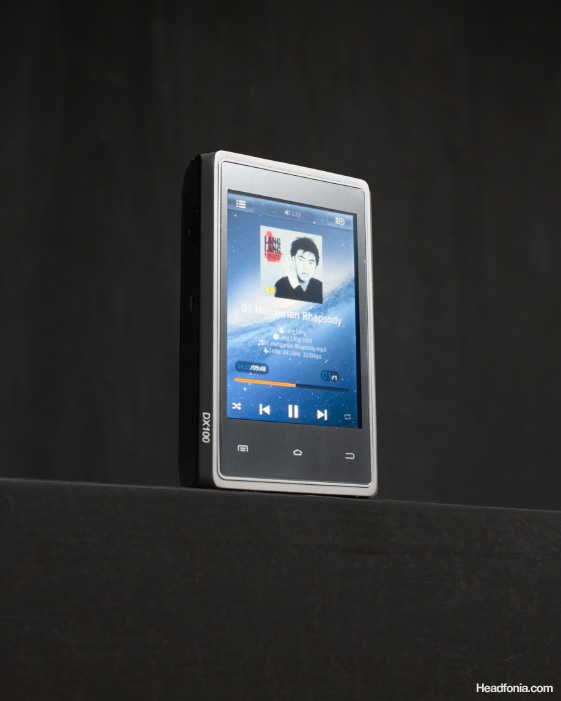
Disclaimer: The DX100 unit for this review was generously loaned by Indonesia’s Ibasso importer, Don’t Blame Your Ears.
The era of high end audiophile DAP’s first introduced by Hifiman’s HM-801 has been taken to the next step by the release of Ibasso’s DX100. The huge touch screen interface to the Android-powered device is a huge selling point in a market where all the other players seem to be limited to archaic display screens or even the lack of screen on Altmann’s Tera-Player. As much as I love the Tera-Player, it can’t be denied that the majority of people out there would rather have the large touch screen of the DX100 (while Hifiman’s HM-801 screen stands somewhere in the middle).
Having been used to the Tera-Player’s more pocketable size, I sort of looked down on the DX100’s much larger size. It was not until I started comparing the DX100 to the Hifiman HM-801 that I started to appreciate the dimensions of the DX100. Both obviously falls into the large category, but the slightly narrower width of the DX100 fit very perfectly on my hand, while the Hifiman HM-801, though roughly the same size, is just slightly too wide to be held comfortably with one hand. That may seem like a minor point to some, but from that small detail, something tells me that Ibasso has put some really serious design process into the DX100.
First Class Design and UI
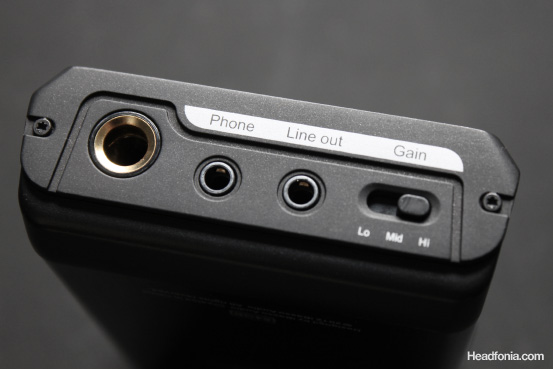
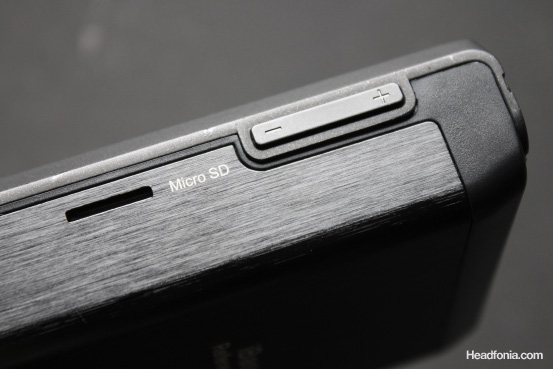
The more I examined the build of the DX100, the more I appreciate what Ibasso has done with the product. The conviniently placed volume button on the side, the three position gain setting switch, the power button, all these small details are done so well. No longer do we have to put up with sub-standard user interface on our audiophile players in this age of touch screen cell phones. The availability of both 1/4″ and 1/8″ headphone out is a brilliant thing since a lot of people these days use full-size headphones with their DAPs (the DX100 itself is a brilliant pairing with the Audez’e LCD-2). Not only that but you also get a good old analog line out for pairing to an external amp), and both Toslink and Coaxial S/PDIF out, as well as Micro USB slot for extra storage.
What else can you ask for in terms of interface, from a portable music player? On the back side of the player I noted the printed “Ibasso Reference DAP” writing and the 64GB mark indicating the size of its internal memory which is the biggest I’ve seen so far on audiophile DAPs — though still expendable through a Micro SD slot. Most of all, what really caught my eye is the small print stating “Created in China”. We’ve seen a lot of “Made in China” these days, but the Ibasso DX100 really put a lot of quality and that makes me respect that statement more than ever before. Good job, Ibasso.
Monster Amplifier
Ibasso’s pedigree in building headphone amps haven’t been left behind with the DX100. While it may not be the most refined portable amplifiers around, clearly it’s number one in terms of power output, at least among all other Digital Audio Players. This player is able to drive the hardest headphone to drive today, the Hifiman HE-6, and though not as authoratively as monster amps like the RSA Dark Star or the Burson Soloist, it’s strong enough to put even a lot of desktop amplifiers to shame. I had to use the high gain setting and max out the volume level, and while I won’t make the DX100 a permanent solution for the HE-6, it was a pretty amazing feat for an audio player to be able to drive the HE-6 straight out of its headphone out. A more realistic day to day use for the DX100’s monster internal amp is for driving the two relatively easy modern orthos: the Audez’e LCD-2 and the Hifiman HE-400.
The Ibasso pairs very well with the LCD-2 and the HE-400, making the two a combination that I can enjoy for day to day use. Dynamics are good, there are plenty of headroom, and tonally they seem to be a good match. With the Hifiman HE-500 I was less satisfied as the dynamics got compressed even though the Ibasso managed to push a good loudness level. I was really surprised in hearing the HE-400 and Ibasso combo though. So good was the combination of the two, I don’t remember the last time I heard an amplifier that matches so well with the HE-400. So, for those of you orthodynamic owners: the LCD-2 and the HE-400 on the Ibasso DX100.
Dynamics are far easier to drive, and I’m driving the 300Ω HD650 Sennheiser using only low gain! However the texture of the Sabre DAC (more on this later), was more evident on the dynamic Senns, and though tonally the DX100 pairs well with the HD650, I really didn’t enjoy it as much as say out of the Hifiman HM-801.
The extremely powerful amp would be a double edged sword had it not be for the superb digitally controlled volume level that gives precise 255-steps volume level control over each gain settings. While other devices like the Fiio E17 have implemented this sort of a control as well, I must say that the DX100’s control is so far best in terms of tactile feel of the button, positioning of the button, and the up/down speed of the volume level. Here it is, another strong point of the DX100 and while volume control may not sound like a big deal in a review, in day to day use it is one of the things I love most about the DX100.
Continue to the next page…




Michael Julius
Great review, thanks Mike. I also thought it was a great combination with the LCD2 ( ugh…) and the HE500. Moderate square stage headphone types seem to go well with the Ibasso.
Mike
Thanks, Michael
Eric Thompson
You went in to detail on the sound stage differences but how specifically is the low level detail retrieval compared to the 801? Its is just a little less in one area like highs, mids or lows or is it just flat out less all around?
How big of a card will it take 64gb or only 32? And did you ever try using one? I am wondering how it works, some of these players that use expandable cards the track names and info get all messed up when playing off the card.
Mike
Sorry if the review is missing some detail. Low level detail is better on the HM-801.
I don’t understand your 2nd question though. Mind rephrasing?
Card, the largest I tried was 16GB.
Eric Thompson
Hmm I to will have to wait for the 901. The DX100 will probably be better for me with the PRaT but I really like detail as in hearing things that you just don’t hear with lesser setups.
When you look at songs in your library on the devise it is as should be but when you look at a songs in your library that are stored on the card they will start or end with numbers or be tossed into a “various artists” or ” untitled” folder. I have noticed this with some older android phones and Sansa Players.
Il have to look on iBassos site and see if I can find the card capacity with 128GB of storage I could possibly go to Loss-less (currently at 320kbs MP3 on my Ipod Touch) and still fit every thing.
Eric Thompson
Oh and another question I couldn’t find on iBassos site. What is the screen resolution?
Mike
Sorry Eric, I don’t know what the screen resolution is.
Erwin Lee
From Head-Fi its 320×480 3.75″ screen.
Mike
Thanks, Erwin
Mike
In regards to detail, it ultimately depends on what you’re listening to. A lot of mainstream recordings actually don’t have that much detail in them and something like the DX100 is revealing enough for the majority of recordings out there.
Osiris Walstra
64GB µSDXC’s formatted to FAT32 work. I use a Class 10 SanDisk in mine.
The content of the card gets added to the music library already present on the DX100, and the information shows up in same way.
Trent_D
Isn’t that SABRE chip the same one they used in the ODAC? The soundstage and ambiance weren’t too impressive on that, so it wouldn’t surprise me.
Mike
I actually don’t know what chip the ODAC uses, Trent.
AnakChan
DX100 – ESS 9018
ODAC – ESS 9023
Difference: http://www.esstech.com/index.php?p=products_DAC
In short, the ESS 9018 is a reference DAC & the better one. This is the same DAC used in really high end SACD players (but they use many of them whereas DX100 uses only one). See the new Hifiman HM-901 which supposedly uses 2xESS 9018.
Note it’s not just the DAC chip but the circuitry around it that matters just as important.
Mike
Thanks for looking that up for us AnakChan.
The 9018 is the same one used in the Buffalo DAC
http://www.twistedpearaudio.com/digital/buffalo.aspx
ryan
hey mike, how would you compare ESS9018 to the Dacport Lx? which is better?
Mike
I’m not a big fan of the ES9018 to be honest…
Trent_D
Thanks for that. I was just saying that the ODAC had the sound that Mike was describing.
Spencer Chan
How was the battery life; that’s the one aspect that keeps me away from these PMPs. I’m to addicted to the iPod’s 30+hour battery life.
Mike
I managed to get 9 hours mostly with an IEM.
Erwin Lee
You’ve commented on the Sennheiser HD650’s on low gain, would it be reasonable to say, Ibasso DX100 can comfortably drive the HD800’s on high gain?
Eric Thompson
They can drive the HE6 lol
Mike
Erwin, the HD800 is easy for the DX100.
Danny Utoyo
Sorry for my silly question Mike…what about the “synergy” factor when driving HD800 directly via HO between HM801 vs DX100?
Mike
I would go for the HM-801 by quite a margin.
Gary Friderichsohn
$900 and a one year warranty. That seems wrong.
Jordan Ingram
“with their pop and electronica genres” – This made me chuckle 🙂
Kelvin King
what firmware did you used? Owners vouched that 1.1.7 is better that 1.2.3 in terms of SQ.
Osiris Walstra
http://ibasso.com/download/DX100+V1.2.7.zip
FW v.1.2.7 has just been released.
Jonathan Yeung
mike should i go ipod classic+fostex hpp1 or ibasso dx100? or wait for hifiman hm901? and whats the memory for hm901? smaller than 64gb internal memory and im probably not very interested… also i hear something about iriver has some new dap coming out? any info on that? unlike headphones im probably only going to have 1 good portable setup and thats it so i wont be switching around and have multiple portable setups… the dap will also be the core of my home setup so it should also allow lineout to external amps and i need to make a very wise decision. price can be somewhat no object since im only having 1 portable setup. no i dont mean like a 2k dap though (if that ever exists)… but im currently using ipod classic+fiio e17, and im ready to upgrade!!!
Mike
Jonathan,
I’m just going to try to help you decide here.
The DX100, you get a very good UI in a one box set up (unlike Ipod + Fostex).
The Ipod + Fostex, I still think gives you the best UI in the business.
The HM-901, will have to wait until I get it.
The iRiver Astell & Kern, again will have to wait until I get one for a review.
Jonathan Yeung
Mike how about the sound though? Do you have preference of what you prefer over the other for the dx100 and hpp1+ipod? When will the hm901 and iriver come out? Thanks and appreciate your help.
Mike
I really am not a big fan of the DX100’s sound. It’s a good player and the sound is clean with good instrument separation, lively and exciting as I’ve written on the review, but I really can’t enjoy it for too long. I’ll take the HP-P1, CLAS, Altmann Tera, or HM-801 over the DX100.
HM-901 they say is november. iRiver should be out already in Japan and perhaps Korea. Not sure about other countries.
Cheers.
Jonathan Yeung
Thank you very much 🙂
Jonathan Yeung
Hey Mike, I just talked to a headfier that claimed that the latest firmware for dx100 is very much superior to the earlier ones. Did you get to hear the dx100 with the latest firmware?
Michael Amouyal
Hello Mike, I usually really appreciate your reviews, but here I am wondering what you really think about the DX100. In the comments you say you DO NOT LIKE THE DX100’s sound, whereas you mostly praise it in your review. Given the fact that many people will buy material partly based on such reviews, I think you should say in the review that although you think it performs well technically, you do not like the iBasso DX100’s sound, and that in fact you prefer ALL OTHER HIGH END PLAYERS over it. Thank you in advance for reading me. And thanks again for your efforts.
Mike
I don’t know why you look at that way. I didn’t want to go at lengths as to why I don’t like the player, I just wanted to focus on describing the DX100 sound and not let my personal preference get in the way. If I did write a long bit on why I don’t like it, then someone else would say that the review is contradictory.
Jonathan Yeung
mike how do you line out from the dx100? what cable do you use? rca to 3.5mm cable?
Mike
I didn’t use the line out, Jonathan.
Jonathan Yeung
ok thanks, its just that i would like to know because i would likely use it to experiment with different amps if i purchase amps in the future
Jonathan Yeung
Hey Mike I heard there’s a loud pop when you turn the player on, is there any way to fix this? Also I have also heard 1 member from headfi mentioned that if there’s no music playing and the screen turned off, there would be a cracking or popping sound every minute or so. Did you experience this as well?
Mike
Jonathan, I don’t remember hearing any popping sound on turning on the player.
As for the cracking sound when there is no music playing, I don’t know I don’t normally wear the headphones when there is no music playing.
How to fix the pop sound, if there is one? Usually you just have to live with it.
Jonathan Yeung
Thanks for the information mike
ertai
Dear Mike,
Could you shed more light on the word ‘timbre’ because I heard the DX100 sounds more natural than HM801 however you have felt differently. And also when you said better ‘soundstage ambiance’, what did you really mean? The reason I ask is because I could not understand that part. Did you mean soundstage width or depth? My audio description is limited. But thanks in advance!
ryan
Got the astell and kern this morning…haven’t got the time now for serious listening…first listen using shure 535 and wasn’t impress at all
Mike should have the astell and kern, are you going to review it? Some comparison with dx100
Mike
It’s not looking very good Ryan. Got my sample last week and I talked about it briefly on facebook. (https://www.facebook.com/media/set/?set=a.496328543745181.122380.145341288843910&type=1)
Left it at the store for people to listen to.
Jaben also have a unit on the local hifi expo last week.
I haven’t met one person who’s listened to the AK100 on those two instances said a good thing about the sound.
A pity, since everything else about it is the best we’ve seen in a DAP so far.
Yes a review is coming.
ryan
I was figuring what I could do with the optical output…
What about by passing the internal dac and amp….just using the ak100 as a transport….feeding the optical out to the matrix mini portable…if you have both of those, you could probably test them out….I would like to know how it sounds
Jonathan Yeung
mike, thanks for the review, i just ordered it 🙂
Mike
You’re welcome!
Jonathan Yeung
mike, i will be using it with my sony z1000 which i like very much. do you think they go well together?
Mike
I think so yes the Z1000 is among my favorite and even though the DX100 is not particularly my favorite, the Z1000 is among the better pairing I’ve heard.
Jonathan Yeung
listening to sony z1000, driven by the ibasso dx100, i dont know why but it doesnt seem to wow me. z1000 used to wow me when i was driving it with my ipod classic with fiio e17 amp. i guess maybe i set my expectation too high or i need to let the dx100 burn in like 1 headfier said. also did some listening with my beyer dt990 with the dx100, the combo was fatiguing
weekian
Thanks for the great review Mike!
If you have to choose only one ultimate portable player to use for day in and day out which would you choose?
The tera player, hifiman 801, or the ibasso dx100?
Luke Ma
hey mike,
what sounds better, a portaphile 627 and an imod or a dx100 alone? or is thats hard to say, what are the differences?
Mike
Source quality, the Imod can’t match the DX100 and its a pretty big gap.
Amp quality, the DX100 can’t match the 627.
Ed Leinheiser
I own a X3, I’m going to upgrade I hope and get a DX100, DX90, X5 or AK100. I started thinking DX90 then saw some “for sale” ads for used DX100…….Now we’re talking as I’ve heard Sabre equipped stuff but never could afford my own. Then a few ads popped up for an AK100 with these 1st three all being less than $40 apart, I love Fiio stuff and the X5 needs to be considered.
Question is simple pick which one you’d choose???? I’m not playing the synergy game so please don’t either….which one do you suggest, just one not 1,2,3 just ONE….LOL….Love your stuff folks keep on keepin on!!!!!
Going looney trying to decide…….aaahhhhhh
Ed
nang
I own a set of dx100. Modded with opa 627 , lme49990 and blackgate caps, using hdp r10 firmware, playing dsd files the sound is jawdroping. Gone the boring and placticky sound. The sound is more clear and the soundstage is doesn’t feel artificial anymore. And more importangly.. it sounds musical now instead of it original flat and boring sound. If you can find second hand dx100, I reccomend you to try it.
Konrad Argasinski
I would love to hear it. Where are you from? May I ask who did the mod?