




I don’t particularly have anything against Op-amp based amplifiers, but all discrete is cool both for bragging rights and for sonic reasons. Burson Audio is a big fan of fully-discrete, and the Burson HD-160 is an all discrete headphone amplifier equipped with Burson’s discrete op-amps as well as Burson’s own stepped attenuator unit.
The HA-160, which sells for $699 (and less if you live in Australia), is actually a very good value for money in terms of solid state amplifiers. I’ve been enjoying the sound of the Burson with both the Sennheiser HD800 and the Beyerdynamic T1 headphone, and I truly think that it’s a great amplifier that can compete with amplifiers priced upwards of $1,000.
Operating the Burson is fairly simple, as you basically have one sets of RCA inputs at the back, and two headphone outs at the front. The left headphone out is for high impedance headphones, and the right headphone out is for low impedance headphones.
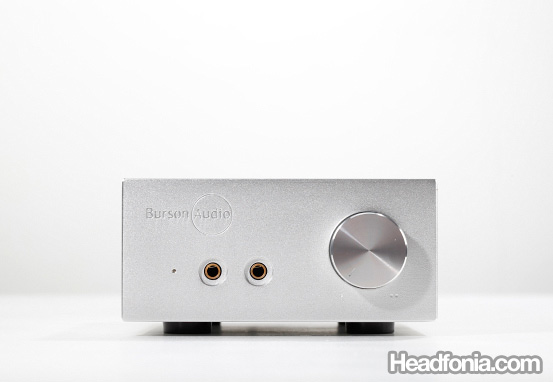
Hi Z output on the left, low Z output on the right.
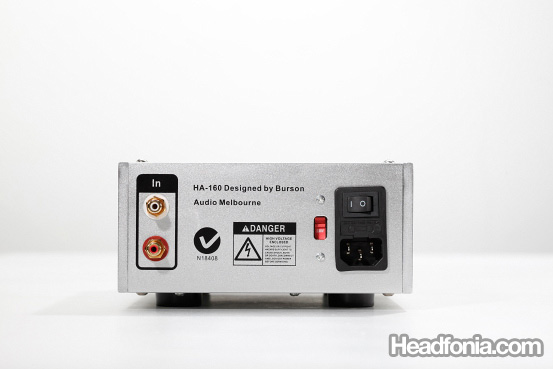
One pair of RCA inputs, and an AC input.
I’ve been very impressed with the Burson HA-160, and I think that my freshly built 2-ch Beta22 looks like a good benchmark to measure the Burson HA-160 against. The Beta22 is equipped with the same Burson Stepped Attenuator that is used on the HA-160. The Beta22 also gets a nice treatment of Whiplash Audio’s SCSCAg wire for the input signal, WBT silver solder, and high quality 18AWG Japanese copper wire for the power and output wires. The Beta22 is built using the recommended AMB parts supplied by Glassjar Audio. To avoid damaging the output mosfets, the value of R34 and R35 has been changed to 1Ω, following AMB’s recommendation, using high quality Kiwame resistors. The Burson HA-160, on the other hand, is fully stock. Although I’m itching to do some parts upgrades for the Burson, I really have to wait until the review is finished before I can do that.
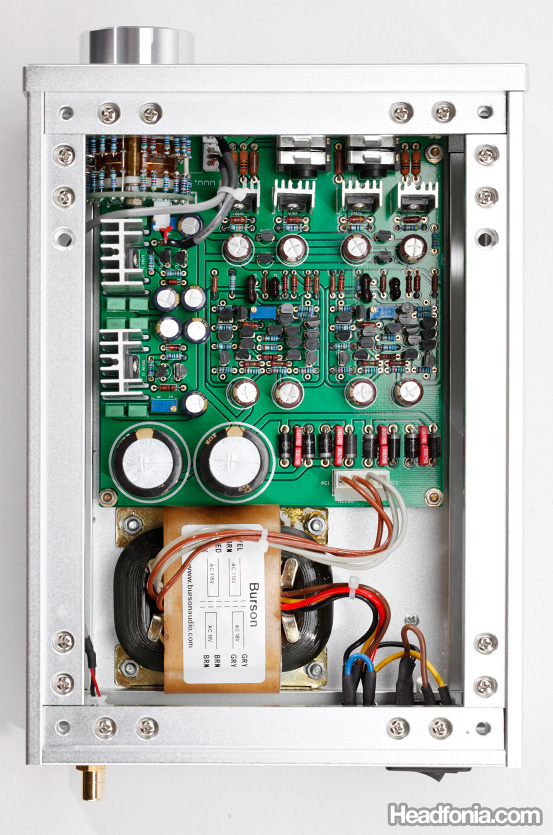
The internals of the Burson HA-160.
The system used for the comparison is an Onkyo ND-S1 Ipod transport, Grace m902’s DAC, and the headphone used is the Sennheiser HD800 using a single ended Whiplash TWAg cable terminated in 1/4″ Viablue connector, as well as a Beyerdynamic T1 headphone.
One of the reason that I pitched the two amplifiers together is because the Beta22 has been my long time favorite amplifier. Another reason is how similar the two amplifiers cost. The Burson HA-160 costs $699 shipped to the US. The 2-ch Beta22 build is the cheapest configuration, and depending on parts and enclosure used, would roughly end up costing about the same amount of money.
Of course $700 for the Beta22 is for a self-built amplifier, because a professionally built single ended Beta22 would cost upwards of $1,000. On the other hand, I do think that the Burson HA-160 is a good value at $699, and it would still be worth the price at $1,000 (don’t tell Burson I said that).
The Burson is overall a very nicely built amplifier, and no DIY effort can ever match the quality of the enclosure of the Burson amp. That by itself is a very good selling point, because case work is a very challenging part of a DIY amplifier project. I probably spend more time fabricating the half naked case of the Beta22 than I do soldering the parts on the PCB.
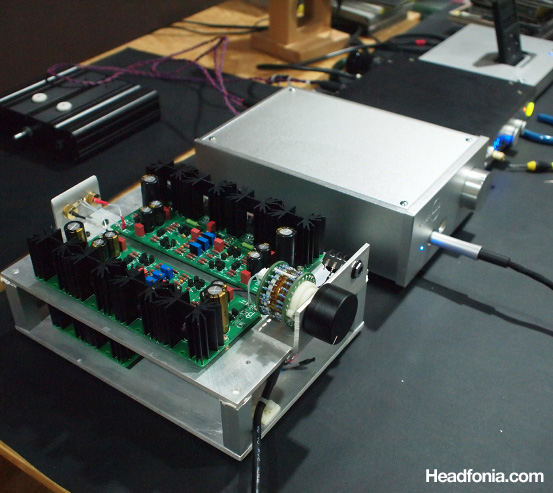
My half naked 2-ch build. I didn’t have time to build a proper case for the Beta22 for this review.
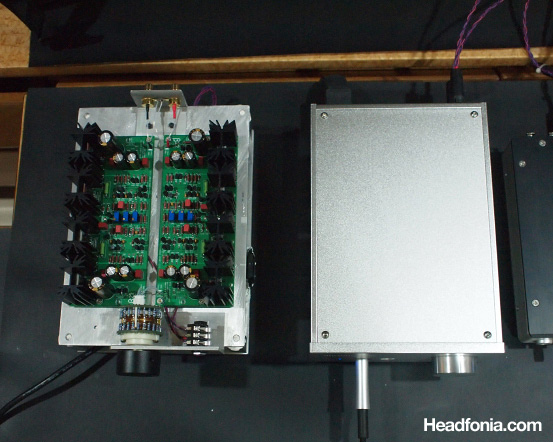
The 2-ch Beta22 next to the Burson HA-160.
There are also other factors that come into mind in terms of convenience of use. The Burson comes with two different headphone outputs, where the Beta22 only comes with one. One of the biggest worry in using the Beta22 is everytime I want to plug and unplug the headphone. The high power output of the Beta22 makes the output Mosfets liable to damage everytime you slide the headphone jack in and out the socket. Scary stuff, I know. The Burson HA-160 is much more convenient to use on a day to day basis, since you’re never scared that the output Mosfet will blow when you’re evaluating different headphones and need to plug and unplug the headphones frequently.




Jose
Hey mike,
Long time since last time I wrote something here, although I always read. I have been waiting for the EF5 review for maybe a month now, and I hope it is coming soon. A nice thing to add would be to further compare the HA-160 with the EF5. Cannot wait to read it.
Jose.
Mike
Hi Jose,
Sorry for the delays. We've been having a lot of delays lately. 🙁 Anyway the EF5 is roughly half the price of the Burson, and has better synergy with the HE5. I don't think you need to wait for the review to make the decision. 🙂
Blake
Really nice review! Seems like a very good value amp.
Jimmy
Hi Mike,
I just read your review of Woo6 Sophia, and I found this Burson.
You said that Burson is warmer sounding, better midrange and upper bass body, a smoother midrange, and a less tiring treble, energic and impactful as well.
Do you think this amplifier reminds you of Woo6? Same musicality & less fatigue?
Could you please explain your terms of "the soundstage is very coherent"? Do you mean 3-dimension, deep, and good separation?
Actually I own Sennheiser HD650, but I'm not interested in building Beta22, especially after you said that it wins on technicality but not musicality.
Sorry for my bad english.
Thank you.
Mike
Hi Jimmy, thanks for the questions. I really need to a Woo6 & Burson head to head to be sure, but the bottom line is that the Woo still sounds more like a tube amp where the Burson still sounds like a solid state. Yes, sometimes unfortunately we're limited to use the same adjectives (i.e warm) but without an indication of how warm the sound really is (with a numerical scale, perhaps).
HD650 is quite a dark headphone, and the Woo6 leans a little to the dark side as well. Without going too deep into technical explanations, I feel that the HD650 would be better paired with the Burson HA160. The Burson is also more aggressive and forward, which should complement the HD650 nicely. But that's just my personal taste. Some people pair the HD650 with a mellow and laid back amp and are happy with the combination.
Anyway both amplifiers are very good, with the Woo6 perhaps being slightly more expensive when you factor in the Sophia Princess. I don't really have the Woo6 with me anymore, so I'm just extrapolating from memory here.
About a "coherent soundstage":
Sometimes you have a good and big soundstage size, but there may be gaps and blankspots in the soundstage. Most often the center soundstage, the area in "front" of you, between the left and right soundstage, is missing soundstage information. In another word, the left and right soundstage exist by themselves, and are not unified. A coherent soundstage doesn't have this flaw and the soundstage blends very well from left to right.
Alex
Hi Mike,
Great review! I currently own the HD800s but I have not had the opportunity to audition many amps with them. I am temporarily driving them out of the RSA Hornet M while looking for an amp to match them. The Burson is one of the amps that I am considering, and my question is: Will the Burson bring out the most in the HD800s? Or will I have to look at more expensive amps to really hear what the Hd800s are capable of?
Thank you,
Alex
Mike
I think the Burson is good enough for something like the HD800. The key, of course is finding a good synergy between your music, your source, your amp and the HD800. The HD800 is not an easy headphone to get "right". But when you get it right, it can be very rewarding.
Jimmy
Thank you Mike,
Sometimes people associate that aggressive and forward amplifiers are "into your face" sounding and have bad soundstage, but you said that this Burson is coherent soundstage.
I got your points of wide soundstage from left to right. How's its layering and separation Mike?
It is unfortunate that this Burson is not balanced while many people said that Sennheiser HD650 benefits greatly from balanced. I have not heard balance before, what sounds I might miss if stay single ended?
Do you think I need to pair the combo of HD650+Burson with a warm musical sounding DAC as tone control and better midrange/vocal, or just go with neutral, transparent, dynamic DAC to further exploit its traits?
I'm afraid that the transparent dynamic will bring bright, harsh, and fatiguing sound, too much of good things I guess.
Thank you.
Mike
Layering and separation is great on the Burson, I don't think you would find it a problem. The HD650 does improve greatly from balanced amplifiers, but I was using a balanced Beta22 then which is far beyond the league of the Burson. I think the Burson is great for the price it's selling for.
As for DAC pairing, it depends ultimately on your taste and music. I personally would not like a warm or dark source with the HD650, but some people apparently do. I really don't think that pairing the HD650 with a neutral DAC would give you a bright or harsh sound, unless you are listening to some over-boosted treble recordings.
Jimmy
Thank you Mike.
I mostly listen to today’s music, the mainstream pop, rock, punk, R&B.
I hope that vocals are good in this Burson.
You stated that “HD800 and Burson sound more musical and easier for long term listening, while brighter Beta22 would do better with something like the Sennheiser HD650”, I’m confused and afraid whether Burson is good or not for my HD650.
Any comments in comparison to Lehmann Black Cube Linear and CEC HD53N amplifier?
Thank you.
Mike
Hi Jimmy,
Burson is not a vocal specialty, if you want to go that direction, try the tube amps like the EF5 or the Woo6. As for the Beta22 and Lehmann BCL, they're both fairly neutral amps. For vocals, you want something warmer like the HD53N.
hfan
forgot to mention
which amp should i buy for best(bigger) hd800 soundstage?(600$-700$)
Mike
hfan,
I personally don't think you should look for an amp that specifically enlarges the HD800 soundstage. It already has one of the biggest soundstage to begin with, but instead of soundstage, it needs other things to shine. This ultimately depends on your music, your personal preference, your source, and there is a lot of variable in the equation before you can say "the Best amplifier for the HD800".
The HD800 is not an easy headphone to match components with, and you should look into other things in the amplifier's character and decide what particular character are you looking for in an amplifier. Perhaps the HD800 is too hard of a headphone for someone with little experience in amplifiers to really get the matching right.
Anyway between the Burson and the Lehmann, both amps have roughly the same soundstage size (as far as I can remember). And again, based on the majority of people's preference and music genre, I would say that you'll be happier with the Burson than with the Lehmann.
Jimmy
Hello Mike,
Burson is not good with vocal? I thought you said:
– it has body on the sound: it was full and solid
– better midrange and upper bass body, a smoother midrange
– warmer sounding Burson is more pleasing for mainstream recordings
I'm sorry if I'm mistaken your words.
Don't you think tube amps and HD53N are too slow, laidback and less impact for my preference pop, rock, punk, R&B, hip-hop, trance?
Thank you.
Mike
Hi Jimmy, I believe I was comparing the Burson with the 2-ch Beta22, and those comments were made in that context.
I never said that the Burson is not good with vocals. I just said that vocals are not the Burson's specialty. And I said that because you seemed to be concerned with vocal performance:
I hope that vocals are good in this Burson.
Tube amps can be slow, but you said you wanted good vocal performance. To use an automotive analogy, you can't have good handling and ride comfort at the same time in one car. So is the case with amps. High end gears can be very specialized, and what's great for one genre can be very weak for another.
I really wish I can give you a one-solution-for all answer here, Jimmy. But such things don't exist in the audio world.
So, back to your needs. I believe the HD53N would be the best all around compromise for vocal, pop, rock, punk, RnB, hip-hop, and trance.
hfan
hi
i have just bought hd800 . i am looking for ss amp price range at 700$
burrson ha-160 vs lehmann cube? or any other suggestions?
thanks.
Mike
Blindly guessing your music preference, I'll recommend the Burson over the Lehmann. The Burson helps a lot with the HD800's semi-relaxed performance and bass punch.
The Lehmann cube is very transparent and require a very good source to shine.
Jimmy
Thank you for the answer Mike.
I will consider HD53N, it is balanced as well. Hope it is a great amp.
So what is Burson specialty? Instrumental?
For a future planning, do you think it is better to buy combo HD53N+Burson or Woo6+Burson? Maybe if I get some more cash I could afford 2 amps for different purpose and music.
Thank you again.
Mike
Jimmy, IMO the Burson is fairly neutral overall, but is especially good with energetic and aggressive music. Anything from Rock to Electronica to Symphonies. Anything that requires a lot of impact, punch, slam, energy, whatever you want to call it.
About your future amps, I suggest you buy one amplifier first, listen to it, then decide what's missing from that amplifier. Then you can decide where to go from there. It's like buying a car. Start with an entry level Civic, then decide if you need more power (get a bigger engine), more comfort (move to an Accord), more seats (get the Odyssey), higher ground clearance (get an SUV), or something else (a Ferrari). 🙂
Jimmy
I forgot to write this:
or maybe combo of all around HD53N+Woo6?
Sorry Mike, I incidentally pressed the submit button. Thank you.
Jimmy
hfan
thanks mike
it was really helpful and detailed.
i listen to all genres like trance,pop,rock,..excluding jazz,classical,rnb
i want my hd800 sounding a little warmer
Mike
@hfan:
Okay, trance and rock requires moderately fast transients and tight punchy bass often found on solid states. A warm sounding amp is usually a little mellow and not so energetic. You can get the Burson, it's just a little warm and should work well with Trance, Pop, and Rock. Or if you want to lean more to the warmer side, get the WooAudio6 (preferably with the Sophia Princess), but lose some of the speed and energetic sound.
Fabio
Hi Mike,
I’m on the same field as Hfan and Jimmy.
Just wondering why your recommendation is different for each of them although their musical preference quite same (pop, rock, trance)?
You recommended CEC HD53N for Jimmy and Burson for Hfan. I guess HD53N couldn’t catch up the dynamic and transient.
Thanks buddy.
Mike
Fabio, thanks for asking. Hfan was already looking at either the Burson or the Lehmann. Jimmy asked about the HD53N and the Woo6. 🙂
Chuong
How would the burson compare to a wa6 with pdps and sophia tube. wa6 is slightly more expensive, but would they both be just as detailed?
Mike
I think both should be roughly the same detail level. The question here is not detail level, but finding the right sound signature for you. 🙂
Alex
Hi Mike,
Thanks for your response previously. I finally had the time to head down to Adelphi and try out 3 different amplifiers: Lehmann Black Cube Linear, Burson HA160 and the Meier Concerto.
I found your description of the Burson and Lehmann to be very accurate, with the Burson having a better bass punch, and the treble to have a very slight tube-like quality to it.
The Lehmann was leaner, and the transient response was probably the fastest I've heard. Very extended treble with no hint of sibilance.
But overall I was the most impressed with the Meier Concerto, it seemed to have the blackest background, and it was easily the most detailed out of the 3. Bass control was more similar to the Lehmann, but treble was a little more prone to sibilance than the Lehmann and Burson. Transient response was faster than the Burson, but maybe just a tad slower than the Lehmann.
This was based on audtion of about an hour with each amp, playing vocals, pop, rock and jazz and blues out of an ipod as I decided not to lug my DAC out. As you can already guess I walked away with the Concerto 🙂
Thank you for your great reviews Mike!
Alex
Mike
That sounds awesome Alex. I really have to listen to the Concerto now. 🙂
Fabio
Mike, thanks for the reply. Well, so Hfan & Jimmy asked for different suggestions.
In my case, over the Burson, Lehmann, HD53N and Woo6, which one do you think will suit my preference recordings of: Michael Jackson, Bon Jovi, U2, Beyonce, Mariah Carey, Celine Dion?
Balanced Beta22 is not an option.
My cans are Sennheiser HD600 currently but I'm in process of buying HD650.
Recommendations of 2 distinctly different amps for different genre that could complement each other would be appreciated as well; as I could shape my decision better.
Thanks Mike.
Fabio
Mike
If there is one thing that your playlist share in common, is that most of them requires good tight punchy bass. I think the Burson would be perfect for that. The Woo6 has good bass as well, but it'll be too thick on the bottom with HD600/650s.
The Lehmann is more neutral, you may not like it too much, and HD53N is more relaxed, would be better suited for accoustic or Jazz stuff.
Fabio
Great answer Mike, thanks.
Is this amp really dynamic and aggressive so that it sounds forward while collapsing soundstage & separation? In my experience, most of aggressive amps do those traits
Have you listened to this Burson with HD650?
Some people in Head-Fi said the bass will be too boomy if paired with HD650, while this amp better suits AKG K701/702. The nature of HD650 and HD800, the one you used for this review, themselves are different.
Did that happen to you?
Thanks Mike.
Fabio
Mike
Fabio, I don't think that having an agressive presentation will necessarily collapse the soundstage and separation. At least if the design is good, in which the Burson is. Also keep in mind that when the Burson is agressive, but not in the sense of Grado-like presentation.
Yes, I've listened to the HD650 with the Burson, and I think it would be a better pairing than if you went with the Woo6. Both Woo6 and Burson have "strong" bass, but in different ways. The Burson doesn't add bass body/quantity, only stronger bass punch. The Woo6 adds more weight on the bottom and more bass quantity as well. I think it will be an overly weighty bottom with the HD650. Please keep in mind that the Burson is mostly a neutral amp, without no heavy coloration anywhere.
With the K701/K702, I'll probably recommend the Woo6 over the Burson.
Steve
Mike, I also got HD650 here, the sounds are shy, dark(relax) & veiled, would this Burson lift the veil and create lively/life-like presentation & imaging? I meant involving sound and toe-tapping experience.
How's their synergy?
Replacing my HD650 is not an option unfortunately.
Regarding your reply to Fabio, you said that this amp is not Grado-like presentation. So this is not "in your face" type of forward sounding amp?
Thanks buddy.
Mike
Steve, while the synergy is quite good between the HD650 and the Burson, it really won't lift the "veil" if you feel that there is one. I don't consider the HD650 to be veiled, it's just that the dark presentation tend to put people off if they've been used to a brighter sounding headphone like Grados. The dark presentation also tend to hide the ambiance details, and although the Burson is good with soundstage performance, I think what you really need is to get another headphone with an overall brighter sound like the Hifiman HE5, Grados or Audio Technicas.
The Burson is a bit forward, but not Grado forward.
Steve
Nice explanation & recommendations Mike, but I think I'll keep my HD650 and maximize its capability first, before moving out for other cans.
In your opinion, what traits this Burson brings in combination with the HD650 sound quality/sonic signature wise?
I couldn't get the points since in your review it was paired with fairly neutral HD800 (different characteristics compared to HD650), moreover you stated "the brighter Beta22 would do better with something like the Sennheiser HD650" which confused me even further. But price & efforts wise, I prefer the Burson.
Did you miss the balance enjoyment of the Sennheiser HD800 and HD650 when listening to this single-ended Burson? In what sense? Many people said that going balanced are the way to go for both cans.
Thanks buddy.
Steve
Mike
Hi Steve, if you own the HD650, then yes the Beta22 would be a better combination as its brighter presentation will help to overcome the HD650's darkness. The tighter bass control of the Beta22 will also do a better job with the HD650's low end. But most people don't have the skills to build a Beta22, and so the Burson is quite a close alternative for roughly the same price. The Burson is slightly less bright than the 2-ch Beta22. It's main sonic signature is full of PRaT and great bass punch.
The HD650 really shines with a balanced Beta22, but for the HD800, while the improvements are there, I don't think it's nearly as important to go balanced. Two of the improvements from going balanced is improved bass response and soundstage information. The HD800 already has passed those two areas very well even with an entry level amp.
I really don't miss having balanced drive at all. Between single ended and balanced Beta22, sure the balanced is better. But the options of a balanced amplifier is far more limited, and it's more important to get a good amplifier matching with the headphone and music than having balanced drive but missing on the synergy aspect. I've sold the balanced Beta22, but I don't really miss it after having the Zana Deux around.
So back to the question, the Burson would do more than an adequate job for your HD650, even though it's not balanced. I've used that amp with the HD650, the HD800, the HE5LE, the Audez'e LCD2, and many other headphones with great satisfaction.
Radek
Hello all,
I use Burson HA-160 with HD650, source is NAD C565BEE. I always felt (even with Burson) that HD650 are too bassy for me, then I put Meier Corda Cross-1 in the way and situation changed dramatically. Now I have less bass but with the same perfect trebles and mids for me. I also tried HD600 before, they have less bass then HD650, but trebles were too agressive for me. I have to note, that Corda Cross does not cut low frequencies, it just puts them in the soundstage in more natural way, which makes them less noticable. I have not noticed any sound quality degradation with Corda Cross-1. Perfect solution for few money. I´m happy now.
In my opinion HD650 seems to be veiled as they have not so bright trebles as other headphones, but bright trebles as in HD600 are too fatique for me for long listening.
Radek
Mike
Hi Radek, thanks for sharing the Corda Cross-1. That’s the first time I’ve heard of anyone mentioning that product. Yes, the HD650 is not veiled at all. It just have a dark sound signature.
Jack
Have you honestly never tried the Corda Cross-1?
It is a very essential component of my head-fi set-up.
Some recordings downright demand the use of a proper crossfeed.
I will gladly borrow you mine if you want to give it a try.
Mike
Hi Jack,
I haven't tried the Corda Cross-1. I believe my Grace m902 has a crossfeed circuit which is licensed from Dr. Meier. I've also had the chance to review the SPL Phonitor which is the pinnacle in Crossfeed technology. I agree, some recordings (and also some headphones) demand crossfeed more than others.
Thanks for the generous offer. Shipping is not going to be cheap you know? 🙂
Nico
Hello Mike,
Do you think that Burson has tendency to boost treble? I read some user reviews & they said that it's a bright amp. Did you find it that way?
So, Burson has good bass punch & impacts, but not great control over it & tight bass?
FYI, I just found out that Burson recently released HA-160D which includes DAC and pre-amp within.
Thanks Mike.
Mike
No I don't think that the Burson is a bright amp.
About the bass control section, please don't take the review out of context. I wrote that in comparison to the Beta22. Does that mean that the Burson has lousy bass control? Of course no.
Thanks for the news update.
Pete
Hi Mike
Great review thanks. I'm considering getting one of these (actually the version with dac). Did you try it out with any of your IEMs? I am thinking of switching from the hd800 to something like the acs t1 (as I am not finding the hd800 vivid/lush at all, and also find myself avoiding a lot of recordings that aren't well recorded). Of course, if the volume is stuck around 8am then I can turn down the volume at the computer (but that may resample it to 16-bit or something – not sure).
Pete
Mike
I did try them with the JH16s. But just to be sure, I'll give it another try and get back to you.
Pete
Yes please. I think I will get the H160D anyway, but of course will have to be careful to get an IEM that isn't too easy to drive maybe. The Shure se530 (the only IEM I have at the moment) is 32 ohms so I imagine that won't be a problem…
Mike
Actually, you can always turn down the volume through Itunes and get more control over your IEMs. The Itunes volume control is very good and I can't hear any degradations in the sound quality.
Roman
Hi Mike.
There are a lot of good reviews and opinions about the Burson HA-160 Amp, but one thing bothers me badly. There are guys on head-fi complaining about the T1+Burson synergy. They say, this is one of the worst High-End bang for buck combo.
At the moment I am planing buy the HA160D for my T1, as I think the cheap LittleDot MKIII+Audinst Hud MX1 combo isn't the proper chain for beyer's flagship.
What are your ideas about their synergy ? Do you agree with these statements? Is HA-160 and T1 far not the best combo for the money ?
Mike
Hi Roman, synergy depends heavily on music and recording properties.
If I was to choose, let's say a T1 + Zana Deux (tube amp) to a T1 + Burson combo, it would depends on the music that I'm listening to. The Zana is more romantic sounding with a sweeter midrange, and it would be better for Jazz, Vocal, Acoustic. The Burson has better bass, overall a more solid-state sound, and a better ability to carry beat and rhythm.
Hope that helps.
M Hussam
Great review, Sir
I really like your reviews and how responsive you are. I'm really glad you shared your experience with us.
I know what I'm about to ask is really really a lot, but you would be literally saving me.
I was thinking if you can pair the K701 with the Burson HA-160 and give me your full impression.
I read your review about the K701 and saw that you really didn't like their sound mainly because of the resonance in the upper mids that caused what you call a plasticy sound, the very wide but not deep soundstage, and lack of proper imaging.
Since the Burson has more midrange to mid bass body and a soundstage that is very coherent along with good imaging, I thought it may be perfect for curing the K701 flaws.
Also, fogs on Head-Fi always tend to recommend this specific amp for the K701.
I'm also very interested in a comparison to the WooAudio6 when paired with the K701 and who suits it better.
Again, I fully understand that I am asking a lot but I'm really desperate here and I really could use some help cuz people opinions are very different and I trust your opinion.
I don't own the AKG K701 but I have $1200 now and I'll make a purchase very soon.
I have the (HRT Music Streamer II) + (HA-160 or WA6) + (K701)
I really appreciate the refined sennheiser sound but I always loath for that extra sparkle so I thought of the K701. (I like the sound of Etyomotic ER-4).
I also liked the Sennheiser HD598 though I heard it un-amped while I couldn't enjoy the HD600/HD650 sound.
Thanks in advance and sorry for the hustle.
Mike
Hi M, thanks for writing.
The Burson doesn't really have enough "mid orientation" to boost the K701 there. I don't think that the K701 needs a midrange bump, as it has enough mids as I see it. At least that's not where I think the main problem with the K701 is. The thing with the K701 is that amplification doesn't seem to fix its soundstage problem and the lack of proper imaging. I've paired it with the Zana Deux which has the best imaging out of all the amps I own, and still the K701 doesn't respond positively. In this sense, the K701 doesn't scale up to good and great amplification as good as the Sennheiser line.
What confuses me is that you haven't even own the K701 and you're already planning a system around it. At least you need to hear it and live with it a while and decide in the process what you like and don't like from it. You told me you have $1200 in mind. With that kind of a budget, I think you should look into other headphones. Back a few years ago, the choices were severely limited. Not now. If you like the ER-4, you can give the Hifiman HE-5 or ATH-AD1000PRM a try, or for more money, the Beyerdynamic T-1. I think ER-4 fans would like the sound of those headphones. They're also a much better headphone to start with.
Also, if you're an ER-4 fans, you should look into the Electrostatic set ups.
Here is some entry level ones: http://bit.ly/ibdvXk http://amzn.to/gPSGpv
BTW I just noticed that a few of my electrostatics articles are missing!
M Hussam
Thanks so much for the quick reply.
and thanks for your advice so much though I was hoping if you could pair them cuz fogs are really recommending this particular setup. They fsay it fixes a lot of the flaws with the K701 and also they say the K701 doesn't pair well with any tube amp.
I will really consider "Hifiman HE-5" and "ATH-AD1000PRM " and take a look at the electrostatic setup.
As for the T1 and HD800. I'm sure they're brilliant but I can't afford them
If I get any of those I will have no money left for a DAC and An Amp.
Mike
Hi M, I don't think the Burson, as great of an amp as it is, fixes the flaws of the K701. You'll be better off starting with a newer, better designed headphone.
M Hussam
Sorry, I meant to say "I have the (HRT Music Streamer II) + (HA-160 or WA6) + (K701) in mind"
Peppe
Found a mod that Ti from AMB labs recommended for a Beta22 with TRS jacks that will not be used for speaker duties: http://www.head-fi.org/forum/thread/375627/let-s-…
"For β22, rather than adding any resistors, you could simply increase the resistance of R34 and R35. This has the benefit of keeping the increased resistance within the global feedback loop, so the closed loop output impedance is not adversely affected. However, it will affect the maximum output voltage swing into low-Z loads. Hence, I would recommend this mod only for 32 ohm or higher headphone loads, not for speaker loads.
How much more R34/R35 resistance? Probably 1 ohm is enough (the M³ has 1 ohm output resistors and I haven't heard of any similar damage). You may want to go as hgh as 2.2 ohms to be extra sure. Note that increasing the value of R34/R35 will impact your output stage bias adjustment. Ohm's Law says V = I * R, so if you want 120mA of quiescent current, and R is 1 ohm, then you need to adjust VR2 to get 120mV across R34 (and R35). "
I personally would still add the protection at the TRS jack and leave the amp circuit stock, but I probably don't understand everything that is going on 😛
Mike
Thanks, Peppe. Comments are automatically approved, unless the spam filter somehow sees it as spam. 🙂
I'm aware of the solution posted by Ti Kan. Thanks. 🙂
I actually posted this on the article, on the fourth paragraph, but it seems you've missed it:
"To avoid damaging the output mosfets, the value of R34 and R35 has been changed to 1Ω, following AMB’s recommendation, using high quality Kiwame resistors. "
Peppe
I think i commented the first time because of how you ended the first page concerning your fear when you use the beta22. Made it sound like an active problem/concern.
Hopefully the mosfets haven't blown since you made the changes? Takes some courage to test I imagine.
Mike
Peppe,
The thing with the resistor mod is that it still doesn't guarantee 100% from blown mosfets. For the average user with 1-2 headphones, that's fine. But for a reviewer like me, man I can plug/unplug a headphone for so many times in an hour, and that's just plain scary. 🙂
Also I often have friends visiting do do some comparison with their amps, or with a new headphone they'd just bought, and on those moments, people can plug/unplug a headphone many times in a short period of time.
Is this going to be an issue for most people? Probably not. But for a review, I need to make known every fact I know about the product.
Peppe
I agree that is scary and anyone using a beta 22 should be aware of the issue. I have my eye on a beta 22 build sometime this year, so I have been reading up on it and I know my friends and family will destroy it unless I make it user proof. Which is probably how your review came up in a search.
If it was a commerical amp to be used by the general public it would probably have 120 ohm resistors on all TRS jacks. I wonder what the minimum safe value is so you could have a safe, but still low Z out. Since it is DIY I am planning to have either multiple jacks or switchable output impedance since headphones in the Beyer line reportedly sound better with 100-120 ohm output impedance amps.
Anyway, glad a stumbled on this site I've read through a few reviews and like your format.
Mike
Hi Peppe,
I honestly don't see amp manufacturers taking the 120 ohms output impedance seriously, and so there is little point in holding to a standard that nobody seems to follow anymore.
I also don't think you'd want to add the 120 ohm on the TRS jacks. Did you talk to Ti about this? I talked to my friend psychaudio about this and according to him, the placement of the resistor on the TRS jack will only form to make a divider of the amplifier output, not to create the supposed 120 ohm output impedance that you wanted. I think you should just stick to the 1 to 2 ohms at R34 and R35 as Ti mentioned.
Adding a resistor to the TRS will have an effect of attenuating treble areas, according to Meier. http://bit.ly/ei8MfU
Peppe
Agree, 120 ohm is no longer a standard. Believe the IEC or whoever it was said manufacturers can specify whatever they like for their product, but some companies like Beyer and I think AKG still tune their headphones or at least the high impedance ones to a 120ohm output.
Ti's recommendation was to increase those resistors and if you still want to change the impedance do it with an adapter on the other side of the jack. I guess to pair adapters with headphones that respond differently to the amp output. My concern is still durability, so I will probably try understand more if those resistors can/should go higher or add a series resistor outside the amp circuit.
I bought a sample set of resistors across the CPF 2watt line up to 120ohm to test with my current amp, CK2III, to see how it changes the sound. Many forms warned me it will change the sound for better/worse depending on your other gear. From the chart on Meier's site 150 looks like a noticeable impact and 470 looks un-listenable, so I am glad i didn't go beyond 120.
The minor attenuation of say a 5ohm or 10ohm resistor on each channel at the jack is not going to going to have an noticeable impact on sound, while making the amp if not immune to the TRS jack short highly resistant. If the Beta 22 can drive 4 ohm and 8 ohm speakers without blowing itself up a 4ohm resistor should keep it alive during the TRS short.
What is the divider affect psychaudio mentions? Some threads mention the maximum voltage swing is reduced by the ratio of the resistor to the headphone impedance. Not sure if the current is also divided. It may be a reason to only use a 4 ohm resistor or have an impedance switch /adapter or parallel output to high and low z jacks.
Mike
Peppe,
I really don't think you should be adding resistors at the TRS jack. The best way is to do it like on my friend's built. Power button on the front panel. This way, you can easily switch it off everytime you want to unplug a headphone.
I happen to be working on a review of the Fiio E9 amplifier. They've added a 33 Ohms resistor on the 1/8" output jack, where the 1/4" jack is left without the resistor. I can tell that the 1/8" side has some attenuation on the high treble frequencies.
guanchiang
hi mike, i recently got myself an lcd-2, which you have reviewed soem time back. right about now, im considering an amp. would you say the meier concerto or the burson to be a good amp with it? (:
Mike
To give a short comparison, the Burson is fuller sounding and has a more powerful bass, while the Concerto is leaner on the mids and lows, and isn't as powerful in the bass. I personally will go with the Burson, as I just love the bass that comes out of that combination. Tight and powerful bass that's probably one of the best in the industry right now.
guanchiang
that being said, burson doesnt produce vocals as lush as concerto, if the concerto was even lush at the very beginning?
Mike
I don't think the concerto has a lush vocal. It's character is mostly similar to the AD797 opamp that it's based on. Good clarity and articulation, but quite slim on mids and lows.If you want lush vocals, I think tubes are the way to go. The Burson is good for its PRaT and bass impact.
Mike
guanchiang,
I'm just wondering, do you own the Concerto, or did you get the impression from a friend?
guanchiang
hi i own neither and have heard neither. im just planning to buy one of them. (: or do you think a tube will go better with the lcd-2?
Mike
Hi guanchiang, It all depends on your music.
If what you're after is vocals, tubes would probably be best. But in the case of the LCD-2 I much preferred the Burson amp from my Zana Deux (which is a $2,000 tube amp http://www.headfonia.com/living-legend-the-zana-d… as it really gives the punch and the articulation on the bass section.
One of my friend used to own a Concerto, but now he's using the Beta22 that I built for his LCD-2.
guanchiang
i understand what you mean, and i believe getting the burson shouldnt end up as a wrong choice (: if it does, i definitely should go tubes. thanks load mike.
Mike
You're welcome.
For most people, we don't listen to just one type of music (i.e Vocals), and so a good all-rounder would be a better choice than an amp that's really good in vocals, but not so with others.
Solaris_61
Hello,
Excellent review!
I’m thinking in buying a very good offer of HD800 + Musical Fidelity M1HPA but i haven’t find any review about this amp. Have you tested the M1HPA or do you have any info (even third party ) about its performance? How M1HPA compares with HA-160 or even with M-Stage (in a lesser level)?
The HA-160 and M-Stage are the other options if finally I won’t buy the M1HPA.
I’ll be very glad if you can tell me something. If not, thank you very much too! 😉
Anonymous
Hi Solaris, sorry I’ve never had an experience with the Musical
Fidelity, nor do I know anyone who has tried it.
Solaris_61
Hi again,
Thanks for your answer!
At the end, I have bought the Burson HA-160 ;-). My main headphones are the K701 and I have to say that this combo is amazing, at least compared with the amp of the Asus Xonar Essence STX soundcard. Now my System is: Xonar (line out) -> HA-160 -> K701, and it is far far better.
What I specialy like about the Burson is its PRaT, its punchy bass, and at the same time being neutral, perhaps only just a little warm. I listen energetic music, from rock, hard rock and similar genres (symphonic and ghotic metal, etc) to symphonies and original soundtracks. The amp of Asus Xonar is more analitical (a little more detailed), and much more brighter and drier (harsh) than Burson, whith less bass quantity and slam. It was not the ideal partner of the K701.
Thank you very much for this great review. It has helped me very much to choice an amp.
I’m thinking in buying the HD800 in few months, but now my next purchase will be a DAC to replace the Xonar and to use it with several sources.
My question is: wich DAC is a good match to the Burson (in sound and quality)? Considering that I have the K701, I will buy the HD800 and my budget is around 400$. I don’t know about DACs so I’m choosing only between Cambridge Dacmagic and Matrix Mini-I. I prefer a DAC that have good synergy with the Burson (neutral but energetic) and I afraid that the Matrix could be too much warm and mellow (tube like). Perhaps the Matrix will worsen the good things of the sound of the Burson. I don’t Know.
Do you think this could be a good system: DacMagic + Burson HA-160 + HD800?
Any other suggestion?
Thanks!
Anonymous
Solaris,
Glad to hear you’re enjoying the PRaT of the Burson. It is so far unbeatable in that category.
Now, already thinking of DAC and Headphone upgrades?
DAC:
Between the Matrix Mini-i and the DacMagic, I think it’s the DacMagic that will suit you better. Actually, you should’ve bought the 160D as the internal DAC matches the character of the HA160D better (in terms of bass articulation, PRaT) than any of the ~$300 DACs I’ve tried. But since you’ve gotten the HA160D, then .. between the two above, go with the DacMagic.
Headphones:
I wouldn’t recommend the HD800 for your music. It’s either going to be the Beyer T1 or the LCD-2. If you love the bass, then LCD-2 is best. But since you’re using a K701, then you might find the dark tonal balance of the LCD-2 a bit of a transition, and for that the T1 would be a good headphone to try as well.
The HE-6 is great, but I don’t think it matches very well with the Burson.
Personally I would go: DacMagic + Burson + LCD-2.
Solaris_61
Thanks for your suggestions,
The HA-160D is very interesting. I can still send the HA-160 back for change it for HA-160D. But the problem is that in Europe it’s overpriced. The HA-160 costs €495 Euro ($699 USD) and the HA-160D price is €980 Euro ($1385 USD). A big difference of $686 USD, twice the price! So I have to consider the DAC section of HA-160D in the price range of around $700 and not of $350, and I don’t know if it worth that price.
I can buy the DacMagic, the Mini-i or even the Yulong D100 ASRC for much less money. I have to consider the price-performance ratio.
But if you say me that the DAC section of the 160D is the best DAC (with the best sinergy) for the Burson amp section in the price range of $700 USD then I’ll send back the HA-160 and buy the HA-160D instead. If not, wich DAC do you think could be the best for Burson amp (HA-160) in the price range of $700 USD? I can stretch my budget looking for the best synergy.
On the other hand, the HD800 are my wet dream since its release 😉 and I will use it primarily for classical, acoustic, symphonies and OST’s. The T1 are in my dreams too, but in my country it’s 200$ pricier than HD800 (LCD-2 is pricier too). And I have other headphones more suitables for agressive genres, like Ultrasone and Grado.
I like PRaT and punchy bass, not bloated or boomy, coming by default from the source (DAC and amp), without being dark and without compromise the soundstage and clarity. That is for all genres. Then I will play around with different headphones for the better match for particular genres (HD800 or K701 for classical, OST and similar; Ultrasone or D2000 for pop/rock, Grado for rock/metal…)
Regards.
Anonymous
If the cost is too high, I’d suggest you go with the DacMagic and not worry about spending more (up to $700). The Yulong may be good as well, but I haven’t reviewed the D100 model, so I can’t say.
The HD800 should be a great headphone for classical, symphonies and such.
I’d save up any remaining cash for another $1k headphone, that way you can cover more genres.
P. J.
Mike I have an unusual question; Have you tried plugging two headphones in the Burson at the same time? Not sure if that’s a good thing to do, you will probably know better. If it doesn’t harm the amp it would be nice to make a direct comparison between two headphones.
Anonymous
Yes, I’ve tried plugging two headphones at the same time. What’s the
question here?
NeoDiNardo
Question (sorry if double posted)
Can you convert Optical to Coax with an adapter so I could use my PS3 with this amp? I like the 160D a bit more than the DACmini, but I may have to go with the DACmini due to it supporting Optical inputs.
Anonymous
Yea, I’m afraid you’ll have to get the DACmini.
NeoDiNardo
sorry, wrong review, nevermind on this one. I’ll repost in the right one.
Tommyru
Hello.
I’ve got a DT990 (600Ohm) + ESI Dr.Dac Prime. I would like to add a decent amp that would not additionally emphasize high trebles and would not hurt the recessed mids of the Beyr. HA-160 is very tempting because its 500Eur price is lower than Lehmann BCL (700Eur). Another option is Graham Solo SRG II. Not sure if I would like to switch to OTL amp like WA3. I mainly listen to pop,rock,latin. I would truly appreciate your opinion on HA-160 suitability for DT990?
Anonymous
Hi,
In this case I would recommend the Graham Slee Solo SRG II over the Burson.
The Burson would have a better pace and bass punch, so it’s very good for Rock. But the Graham Slee would match the need to balance out the thin mids on the Beyerdynamic better than the Burson. The Lehmann is very flat and linear, so it’s not going to help you in this case.
Anonymous
No offense but I think you’ll be better off getting a different headphone and sticking to the ESI Dr. DAC Prime as the amp. The recessed mids of the DT990 is just a character of the headphone, and rather than creating a set up that tries to reverse that, I feel that you’ll get better results by getting a headphone that suits your preference better. You can try the HD600 Sennheiser for a start. .
Joel
hi mike, how would the burson pair with a dacport as a dac and an alessandro ms2i? thanks!
Anonymous
Should be good, Joel. I’d go with the DACport LX instead of the DACport though.
Anonymous
Should be good, Joel. I’d go with the DACport LX instead of the DACport though.
David
Hi Mike, If I had a chance to get a 2 channel b22 or a burson 160 at the same price, which one would you choose and why? Thank you.
Anonymous
David,
The B22 is a king of technicalities, but as I’ve found after living with it for a long time, I think the Burson’s slightly less technical sound is more fun and engaging.
David
Basically I can’t go wrong with either one.
Anonymous
Yes
Joel
hi mike,
do u think the burson and a he500 would be a good pairing?
Thanks!
Anonymous
Hi Joel,
It does, but personally I enjoyed the Graham Slee Solo SRG II more with the HE500. http://www.headfonia.com/graham-slee-desktop-amps-novo-solo-srg-ii-solo-ultra-linear/
itineranti
Hello Mike,I have thoroughly read your review on the Sennheiser HD650/Beyerdynamic DT880?AKGK701, and although the AKGs are well critiziced, I happen to own a pair of K702s, and I’m not yet prepared to get rid of them and buy new a new pair of cans.I have been trying to read my way to the better Amp to drive them, capable of enough current and voltage to get the very best out of them.As far as I have been able to read and ask around, the Amp that keeps appearing in relation to the K702s, is the Burson HA-160. I don’t know If you could give me some advice here.I have also thought about the Centrance Dacport LX as a suitable DAC to pair with the Burson, using Centrance’s Reserve RCA interconnect cable, and taking advantage of Centrance’s superior DAC technology.My second option would go for Centrance’s Dacmini and get more DAC quality and versatility for the money, and obviously including the 1 Ohm mod that they offer.As usual, we head-fiers are faced with the problem of buying equipment that you can’t audition anywhere and taking a pretty big risk. It is of course not a great feeling to spend your money in such a blind way, and we are all thankful for good reviews and advice.I hope you can give a couple of good leads here, since among the reviewers I respect (NwAvGuy, Srajan Ebaen from 6moons and you), you are the only one I had not written to yet.Thanks in advance for your help.Best Regards,Camilo
Mike
I’m not too familiar with amplifier pairings for the Ultrasone Pro Signature sorry
其軒 李
hi mike do you think the combo burson ha 160 +HDP +HD650 could be a good one , or Corda Classic+HDP+HD650. By the way, Metal&hardrock&pop are what I always listen to…
Mike
What’s the HDP?
其軒 李
Nuforce icon HDP
Chris
Hi Mike,
Is this amp is still worth it? Do you think it would pair well with HE-400 and HE-500?
Thanks.
Mike
The HE400, I think the Soloist pairs better.
Chris
But do you think they’re a bad pairing or it’s just that Soloist does better with the HE-400?
Mike
Chris,
the second one. I think the Soloist pairs better
Chris
Thanks for the reply, Mike.
I was a little afraid it wouldn’t have enough power to drive the HE-400s and HE-500s, but looks like it won’t be a problem.