




Australian manufacturer Burson has done well when they introduced themselves with the Burson HA-160 headphone amplifier last year. But the trend these days is to have a good source quality alongside a great amp, and so Burson took the HA-160 amplifier back to the design room, and out come the Burson HA-160D which is basically the HA-160 amplifier with a DAC in one box. It may seem like a trivial thing to add in a DAC circuitry, considering that you can buy DIY DAC kits on ebay for little money. But not for Burson. Five power supply circuits for clean and regulated power. Two transformers makes sure that the DAC and amplifier section will get all the power they need. Burr Brown’s PCM1793 D/A chip, coupled with fully discrete stages right from the DAC output section to the headphone jack generates the signal that will eventually be converted to sound waves by the headphone’s drivers. And knowing that everyone plays music out of a computer these days, Burson also added a USB digital input that supports up to 24/96 resolutions.
The HA-160D’s resume doesn’t stop there. Carrying on from the HA-160, the HA-160D also comes with the same amplifier circuitry and Burson’s signature 24-steps volume attenuator. Brand name components in every section. Input has now been expanded to three analog inputs, two digital inputs in coaxial and USB, and they even throw in a pre-amp out too! Relays are used selecting the inputs, a much classier way than the usual click-click mechanical selector. The enclosure gains size too, and since they retained the same thick panel made of pure solid aluminum, weight has gone up considerably. Of course, this is all good, as it gives you that high-end piece of an equipment feel. And you can plug and unplug headphones with confidence because the Burson will stay put in its place. Every single detail of the HA-160D brings out good feelings in me.
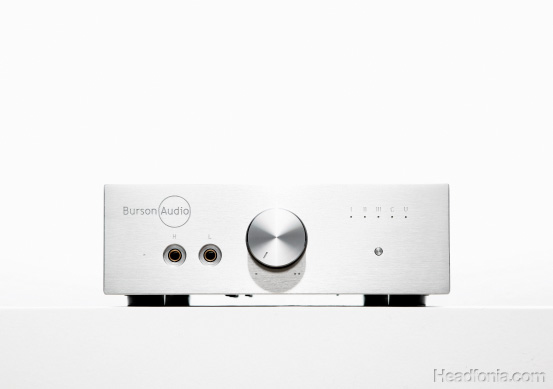
Looks good on the outside.
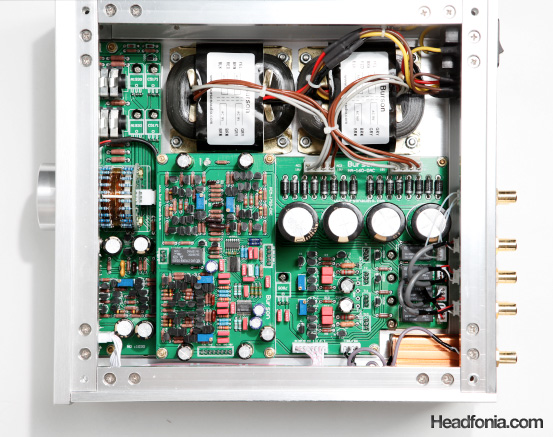
And looks good on the inside.
THE DAC SECTION
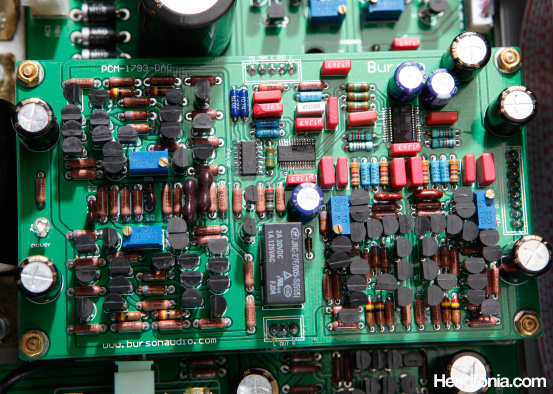
PCM1793 DAC section.
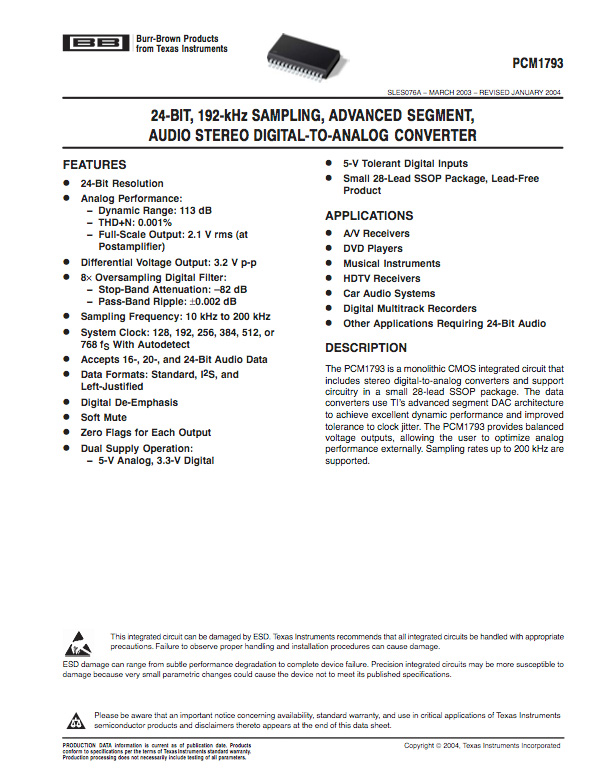
PCM1793 Datasheet
The DAC section is very good, and while it won’t be stealing customers from high end DAC companies, I truly enjoy the sound of the HA-160D DAC I’ve used it for pairing to different amplifiers through the pre-amp out: to the Zana Deux tube amp, the Beta22 balanced solid state amp, or the Kevin Gilmore Electrostatic Headphone amp. Burson adds roughly a $300 premium for the “D” model over the plain HA-160, and so I was mainly looking for DAC competitors in the $300 range. Well, everyone knows by know that I’ve been recommending the HRT Music Streamer II+ to everyone, and since it conveniently falls in the $300 price bracket, why not pitch it against the Burson DAC? The Grace m902 is also another DAC-Amp box that I’ve used very much, and so I’ll be sharing my impressions of the Burson HA-160D to the Grace m902.
If you’ve heard the Burson HA-160 amp before, then I can say that the Burson HA-160D section carries the same sound characteristics as the amplifier section. Perhaps it’s due to the similar discrete stages used on the amplifier, or perhaps it’s because the people at Burson tunes their gear to be carry the same Burson signature. Here is what I’d say about the Burson HA-160’s DAC:
- The Burson HA-160D DAC section has no tubey sound or anything like that.
- The DAC sounds very solid state, but not the harsh, dry, unmusical, treble happy, digital sounding, or any other nasty adjectives you normally associate with solid state. Like the Burson amp, the sound is generally full sounding without being fat or bloated, or slow or muddy. There is a good deal of transparency going on, but without nasty treble-boost tricks. The sound is full, but well controlled.
- Fast transients makes for a superb articulation. Moderately short decay.
- Awesome bass section. Very good articulation over the bass. Powerful punch with very good control. Excellent PRaT. Combined with the amplifier section, it’s No.1 recommendation for Rock and Electronica.
VS HRT MUSIC STREAMER II+
The Music Streamer II+ is a gear that I love to use very much. It does have two shortcomings for my use: the lack of an S/PDIF input for my Onkyo Ipod dock, and the lack of a headphone out on the output side. Well, I’m being a little unfair for the second one, as the HRT is a pure DAC and so I can’t blame it for a lack of headphone jack. Neverthless, one of the reason I enjoy the Burson a lot is since it pairs beautifully with the Onkyo ND-S1 which sends out digital data in the S/PDIF format. Between the Music Streamer and the Burson DAC, there are several win/lose deals that I’d probably end up rating both of them as equal but of different taste. However, depending on your music application, you’d probably prefer one of them over the other.
Compared to the HRT Music Streamer II+, the HRT is slightly warmer and has more midrange body, which is nice. It has less control over the bass, however, and it’s also less punchy than the Burson. The transients is also looser, less articulate and less precise with the HRT. The HRT’s soundstage, however, is quite a bit better in size, depth, and ambiance. Overall, the biggest difference that stands out during most of my listening is how the HRT is warmer, looser sounding and less precise, while the Burson is great in those sections and added with more punchy bass section. For slower music where transients and articulation is not as important, the HRT with its warmer tone and better soundstage presentation is a better fit. For fast paced music, I’d definitely go with the Burson DAC.
VS GRACE M902
I’ve also compared the Burson DAC section with the Grace m902 DAC (which I’ve upgraded using Burson HD opamps). Again, the character is quite different here. The Grace has a more audible low to mid treble while not being as full in the mids. Very mild V-shape curve on the Grace, while the Burson is quite the opposite. Low bass is more present on the Grace, and bass slam is also better on the Grace. However, the bass section is not as articulate as the Burson, and heavy bass passages sound better with the Burson. Soundstage is very wide on the Grace, but the Burson has better depth and imaging coherence. The Grace has a cleaner sound and is less grainy than the Burson or the HRT. I won’t say that the cleaner sound is always better. Sometimes the little bit of grain on the Burson creates a more analog sound than the Grace, and I definitely prefer listening to Rock with some of that grain in the sound. I would say that both DACs are quite comparable, with the Grace DAC with its very wide soundstage and tonal balance being better for classical orchestras, where the Burson is still the king for PRaT and impact.
OVERALL SOUND
The voicing of the DAC+amplifier combo stays loyal to the same Burson sound that I first heard in the HA-160 amplifier. The tonal balance is slightly mid-centric, which gives it a full and weighty mids in comparison to popular solid state amps like the Meier Concerto or the Grace m902. The treble is also not as emphasized as on the Concerto, Grace, or even Beta22. Nothing veiled or dark here, just slightly less pronounced treble. As a result, the Burson may not give you the wow effect on the treble as with the other amps, but it’s far more friendly with the majority of modern mainstream recordings that tends to be treble happy. The bass is very punchy and well controlled, but I wish I could’ve gotten more low bass presence like what I’m hearing on the Grace m902 or the Beta22. Among all the solid state headphone amps, however, nothing can match the PRaT factor that the Burson gives. And when I’m trying to listen to rock through the Sennheiser HD800, the Burson is the pairing that I’d go for.
Vocals performance is very good for solid state standards. Full and weighty mids always translate to good vocals, and the Burson’s soundstage image also put a good center focus on the vocal. I know that some people prefer vocal presentation with the mellow and romantic full-tube flavor, while some other prefer a more straightforward weighty vocal. The Burson will appeal to the second group, but not the first. Although I do think that the Zana Deux does midrange and vocal with more magic than the Burson, but I believe the comparison is rather unfair due to the price difference and the fact that the Burson is tuned to achieve a different kind of sound than the Zana. Compared to the Beta22 and the Grace m902, the Burson is definitely better than the Grace on the midrange, while the Beta22 still has a little more weight on the vocal which I like.
The awesome PRaT is mostly a function of the bass performance of the Burson. The bass is so good that it even translates to better thumps on piano listening. Every strike of the hammer is well felt, and the relatively fast transients gives a clear definition on each piano note. However, the decay is a bit on the short side, hence I often send the signal out through the preamp out to the Zana Deux tube amp, which gives a much more natural decay for instruments. For electronic bass and electronic music in general, however, the Burson’s fast transients and decay has a far better agility for resolving fast bass passages than the Zana.
OPERATIONAL
The amplifier behaved very well in many different situation/set ups that I used it with. Perhaps the two controls I use the most is the volume and the input selector. The Burson attenuator has always been on the stiff side, but paired with the big knob, I think the amount of force needed to make a turn is just right as it never felt too light to turn. I heard complaints about some noises in between clicks, and though I was able to simulate the situation, it doesn’t really happen on a day to day use. And since the highly rated DACT attenuator also behaves the same way, I’d sort of think that it’s just the case with the mechanical switch design of stepped attenuators.
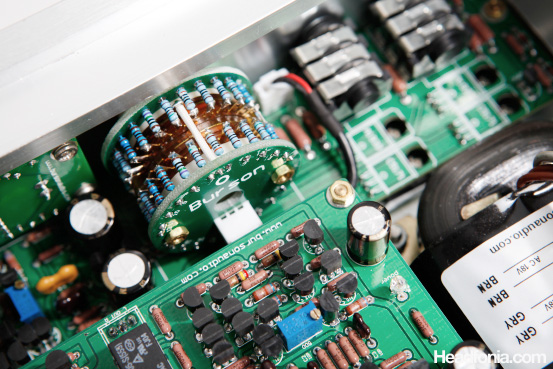
A stepped-attenuator volume control is a mechanical switch with different resistor values. Hence the click-click sound it makes when you rotate the volume knob.
Having multiple inputs is a big plus. It may not seem like a big deal, but not many amplifiers actually come with multiple inputs. A light touch on the button toggles between inputs and lit up a blue LED to indicate the active input. Relays are used to switch between inputs, and it’s better in quality than regular switch-type input selector. One of our reader commented that he didn’t really like having to go through all the inputs choices as it rotates through I-II-III-C-U, but I don’t personally feel that to be a big problem as the relays have a fairly fast response time.
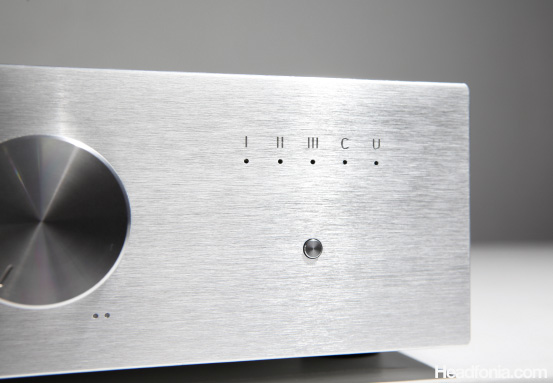
The small button will toggle through the different inputs in this order: Input 1, Input 2, Input 3, Coaxial, USB.
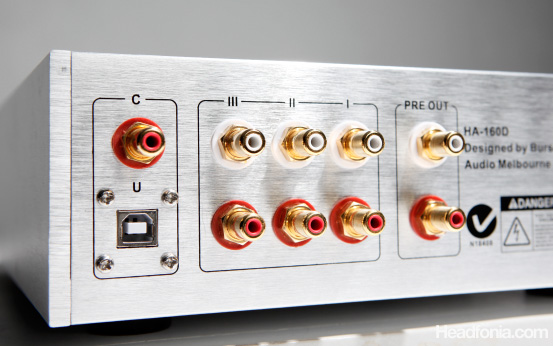
Left to right: Coaxial and USB digital inputs (C and U), three sets of analog out (III, II, and I), pre-amp out.
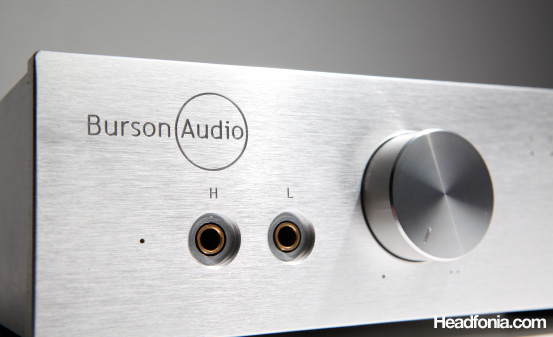
Low and High Gain Headphone outs. I only use the High Gain with Hifiman
There were some complaints on early versions of the HA-160 amp that the gain is too high for some headphones. Apparently some changes have been made to this version, as I get a solid, usable range of control with an IEM, a low-impedance headphone, to a big 300 Ohm full size. As I mentioned earlier, 10 O’clock with the ultra sensitive JH16Pro gives me about 8-9 clicks from zero volume to moderately loud listening volumes. And that’s with mainstream Rock recording, which gives me another 2-3 clicks for classical recordings. With the big Hifiman HE-6, I use the high gain headphone out, and my listening volume is roughly between 1 to 3 O’clock on the volume knob. Onwards from 3 O’clock, however, the volume increase is very slight, and with some classical recordings, I can’t get ear-shattering loudness at maximum volume.
OVERALL IMPRESSIONS
I’ve used the Burson with so many different headphones that I really won’t give my comment on how the amplifier sounds with every one of these headphones. I particularly enjoy the Burson with the Audez’e LCD-2, as the Burson’s bass section complements the awesome bass of the LCD-2. With the HD800, the Burson is not quite as good compared to the pairing with the Beta22 or the Zana Deux, but the combination is definitely a good one. I also enjoyed using the Burson DAC section with the Stax O2 set up, as the signature of the DAC section helps add a good pace into the Omega2 headphone. I even enjoyed the Burson with the lower-tier headphones such as the Audio Technica M-50, AIAIAI’s TMA-1, or with custom IEM like the JH16Pro.
I think the main selling point of the Burson HA-160D is that it gives you an entry level-high end sound in a simple one box solution. The tuning of the Burson gear puts them in a very special position as I haven’t found quite another gear that does PRaT as well as the Burson. And looking at the majority of mainstream music, I think the Burson is an awesome combination with these music. Adding a built in DAC with 24/96 USB certainly has scored big points in my book because I value simplicity very much. No more external DACs and interconnects and additional power adapters. Yes, there is a certain fun in having multiple boxes set up that you can customize to make sure that every component is to your liking. However, often I just don’t have the space for all those big DACs and amps, and with the Burson HA-160D, one box is all I need to enjoy high quality DAC and amplification alongside my computer. There were many one box solutions other than the Burson, but so far, none has been able to match the Burson in terms of overall sonic performance.
Gears used for review:
Headphones: Hifiman HE-6, Audez’e LCD-2, Sennheiser HD800, HD650, Audio Technica M-50, AIAIAI TMA-1, V-Jays, JH160Pro
Amplifiers: Burson HA-160D, AMB Labs Beta22 (4 channel), Eddie Current Zana Deux, Grace m902
Source: Burson HA-160D, Grace m902, HRT Music Streamer II+, Onkyo ND-S1




Chuong
Great review as always Mike
Mike
Thanks, Chuong 🙂
Joe-Siow
Oh, to think I just requested for this review just 6 hours earlier.
Mike, u rock!!!
.Sup
Thanks for another fantastic review Mike. Also great photos!
Vitalie
Uber review! Thanks again Mike
Mine should be here this week, Yay! ^_^
Mike
Thanks for the kind words, guys. 🙂
Earfonia
Nice review as always! 🙂
donunus
I will stay away from these tempting toys for now while am enjoying my E9. Once I listen to this, I might not want to use the E9 again and I might jump back in the audiophilia nervousa bandwagon again hahaha
Mike
Hahahah lol. I've been listening to a Superlux HD651 these few days, direct out of an Ipod. It's a $30 basshead headphone that's surprisingly a lot of fun with the right music. And I'm also writing an article on the Edition10 at the same time!
esanthosh
Nice review as always, Mike! I already see the Burson and LCD-2 sometime in my future (and an empty wallet as always :D)
Mike
That sounds like a very good system. 😀
Windsor
Hey Mike,
Thanks for posting the above review. 🙂
I'm currently have a FiiO E7/E9 combo and am considering buying the Burson HA 160D but haven't heard it. How would you describe the difference in audio quality between the HA 160D and the E7/E9 combo?
Windsor
Mike
Hi Windsor, the Burson HA-160D is a big upgrade over the E7/E9. Briefly:
– Burson has far more punch, I can feel the amp getting a really good hold of the drivers.
– Burson has better resolution, better articulation, blacker background.
– Burson has more mid body, but this is a matter of sound signature.
Cheers. 🙂
donunus
You are an evil man Mike LOL RUN WALLET RUN!!!
Mike
Don, you shouldn't be hanging around this thread man.
donunus
hehehe ok anyways in case my wallet isn't afraid any longer, do you sell any of the items you review by the way and ship worldwide? 🙂
Mike
I've never done that before. But shipping is very expensive from here. 🙂
Eric
Nice review, Mike!
Any thought upon Burson compared against Ray Samuels?
Both of them seem to be warm-sounding amps and their bass performance are the main spotlight.
I guess you are familiar with several RSA portable amps, anyhow they should carry similar housesound with the upper-tier desktop amps IMO.
Many thanks 🙂
Mike
Hi Eric,
Good question, but I have never auditioned even one of RSA's desktop amps.
Compared to the RSA portable amps, briefly, the sound signature differs as such:
– RSA is warmer, darker, and thicker at the bottom.
– Burson is more neutral and less dark.
– RSA's pace is just moderate, perhaps not the best match for fast-paced music.
– Burson carries a better pace for fast music.
Eric
Thanks Mike 🙂
So RSA is more into adding bass quantity while Burson has better bass PRAT, am I right?
Do you think RSA has good impact and punch?
I hope that RSA is not slow, mellow, romantic. Those would lead me to boredom 😀
Mike
Yes, more or less like that, but I'm comparing desktops to portables there. 🙂
The RSA has good impact and punch, but the Burson is stronger in punch, and the bass is tighter. Added with a more forward presentation and a fast pace, this is what makes the Burson has such a good PRaT.
The RSA still has a fairly good pace, although it's more laid back and is slower than the Burson, but I don't think they're boring.
Justin
Hi Mike, thank you so much for writing this review!
I'm thinking should I buy the 160 instead of 160D, since I already have the Apogee Duet as a dac.
what do you think mike? do you think the dac in 160D has much difference vs the Apogee Duet?
Mike
Whoa, I can't say cause I have no experience with the Apogees. =/
But just go ahead and go with the 160 version, I wouldn't want the nice Apogees not get used. 😀
Kelvin Ang
Mike, I guess this is one of the reviews I've been waiting for in a long while.
So I gather it won't do very well with Sennheisers, then?
Mike
Huh? Why won't it do well with Senns? It's a very good match with Senns. 🙂
Kelvin Ang
Oops. Apologies. I was kinda skimming through the article quickly and I saw the statement about the pairing of the amps instead.
"With the HD800, the Burson is not quite as good compared to the pairing with the Beta22 or the Zana Deux…"
Anyway, I'll probably take the rest of this discussion over to the Headphonia Lounge message board as there seems to be a rather interesting new CEntrance "one-box" option like the HA-160D that will be launched in stages this year.
But very briefly, how would a HD600 sound like with this "one-box"? Are there any other similar devices that it can be compared with? So far, I can only think of the Nuforce HDP (which isquite unfair considering the price) and Lehmann BCL-US for consumer DACs or the "professional" DACs like Benchmark USB and Lavry DA11. How do these stack up against the Burson?
Mike
Hi Kel,
The Burson is very appealing because it is a high quality one box solution that you can use for just about any headphone. Of course synergy is still important, hence the Burson would be good for some music and not so with others.
The Lavry DA11 is quite comparable to the Burson HA-160D. I haven't done a direct A-B, but I can say that the Burson is tuned for music listening, while the Lavry for monitoring purpose. The Lavry is more accurate, but I prefer the Burson's mids and bass.
Pavel B. Mishurov
Is the DAC in this device better or worse than the PCM1798, that is installed in Dr.DAC2 DX?
I want to get an AMP to Dr.DAC2+Senn.HD600 and thinking whether it is wise to buy Burson HA-160 with or without the DAC inside? HA-160D is $500 more then just "HA-160" version.
Any advise? And thanks for interesting article!
Mike
I haven't been able to compare the DAC section of the Dr. DAC with the Burson directly, so I really can't say. But the amplifier section is definitely more potent on the Burson.
Curt Weill
Any chance to try it with the T1s? Seems like a very nice pairing potentially. Nice review!
Mike
I tried it with the T1 (actually I tried it with the HA-160), and I think the pairing is indeed very nice.
The Burson is the amplifier I used for this article: http://www.headfonia.com/hd800-t1/
prtuc2
hi Mike,
I read many of your great reviews on this site already. I was wondering how does the HA-160D amp section compare to Woo Audio 6 w/ sophia princess tube?
Mike
Hmmm… different character primarily
The Woo6 has a smoother and cleaner sound, and with the right tube, it has one of the best treble I've heard in an amplifier. The HA-160D has more mids body, a faster and punchier bass, and the best PRaT I've heard. The HA-160D is definitely my choice for fast rock, while the WA6 would be a better choice for instruments, jazz, classical and such. Both amplifiers are also pretty good with pop.
fire
Hi
I ordered a Denon AHD2000 and am looking for a DAC/amp that would drive it, I will use it with my PC for music and such
I am looking at 150$ or so, the only output I want is a headphone output
Can you please recommend me one?
Thanks
Mike
Fire,
The Audinst HUD-MX1 is quite popular for such applications. It's slightly over your budget at ~$180, but I think you can expand the budget a little.
http://www.headfonia.com/audinst-hud-mx1-dac/
fire
Thanks for the reply Mike
The thing is, won't it be better if I invest that kind of money into better headphones? I don't mind paying 180$ but I feel the premium for the price compared to the gain I will get are unbalanced and I heard some people consider the AHD2000 low end audiophile headsets which aren't worth amplifying that much
I never owned an amp before so if I said anything stupid please correct me
Mike
It's hard to say, really. Going to say a D5000 will give a different kind of upgrade than if you spend the money on a DAC + Amp set up. Say you own a car, getting better tires doesn't mean you don't need shock absorber upgrades.
fire
If you could chose an upgrade would you get a D5000 with no amp or invest in that amp and a D2000
Mike
I'd probably get an amp. I'm so used to amps I can't listen to a headphone without them. 🙂
fire
Thanks for the help, I really appreciate it
I will wait for the AHD2000 to arrive and test it, if I see room for improvement I will order the amp you suggested Audinst HUD-MX1
Thanks again
fire
Would you recommend the Audinst HUD-MX1 over the uDAC and music streamer?
Mike
Yes, I'd recommend the Audinst over the uDAC. The Music Streamer is a pure DAC and doesn't come with an amp. But if you're just looking for a DAC, I'd definitely recommend the Music Streamer over the three.
Vitalie
Hey Mike I recieved my HA-160D 3 days ago, listened it for the whole weekend,
Sincerely it's the best thing ever happened to my HD800. And I am coming from a WooAudio WA6 SE with Sophia which was a nice combo but strangely was on the bright side of things. Burson have an AMAZING bass and speed, listened to some very old rock recordings and some newer ones, stunning detail retrieval, soundstage and body. What struck me it that it didn't sound like a 100% SS amp, more likely like a hybrid SS/Tube amp, it's fast, punchy like a SS amp, but in the same time with good body and midrange without beeing harsh or sibilant, a Nice accomplishment I can say ~!
Kudos to Burson and to Mike !
PS: Started to save some money for LCD-2 "evil smile"
Mike
I know. The bass is truly awesome. I brought it to a meet last weekend, and everybody was listening to RATM, Prodigy, Massive Attack on the Burson with the HD800. Wait until you pair it with the LCD-2. World class bass on headphones. B)
bx24
Hi Mike. I'm new here but very good review- hope to read more of 'em in the future.
Mike
Thanks!
Evan
Any impressions of the device with HD650s?
Currently running my 650s through either a NuForce HDP or HRT II+ to M^3. Debating whether or not I want to spend the money to see if the Burson is a significant upgrade to my current set-ups. Very satisfied with both, but simply looking for a bit more detail retrieval and transparency.
Mike
The Burson is more natural than say the Grace m902 amp. So you're not
going to get the treble boost that many people seem to look for pairing
with the HD650. Having said that, I think the Burson is a beautiful
match for the HD650. It makes the HD650 more aggressive and less mellow.
Though the HD650've always had a good bass presence, sometimes it's not
punchy enough and the PRaT is not very good. With the Burson, punch and
PRaT is all there.
I can't say on how the Burson compares with the M cubed or Nuforce,
cause I haven't listened to any of them, but I did compare the Burson
with a 2-ch B22, and while the Beta has better low bass, the bass was
not as "fast" as the Burson, and the PRaT was not as good as the
Burson.
If you listen to Rock, the Burson is one of the best amp around.
Everyone who's heard it can attest to it. Last weekend me and my friends
had a small meet, and we were rocking with progressive, punk and
electronic through the Burson and HD650 combo.
Mike
Oh, to add,
I think the Burson have a very good detail retrieval and transparency as it's one of the amplifiers I use for DAC testing. However, the Burson doesn't have a prominent treble. Sometimes people confuse transparency with treble presence, and so it's important to differentiate between the two.
Evan
Thanks so much for the reply!
I’m actually very sensitive to upper treble presence, so I might be one of the few HD650 owners that isn’t out for that criterion in a pairing haha. Have never found the phones to be veiled in any way and I also own grado phones.
Not sure if I’d classify any of my music preferences as straight out rock haha, but I listen to a ton of electronic based music (experimental/jazzy hiphop, jpop/kpop, idm) as well as ambient, jazz and classical.
Anonymous
Awesome. Then you should be okay with the Burson’s treble.
It is not the best amplifier for classical (for that I’d still prefer the Zana, B22, or Grace), but for the Jpop stuff, Hiphop (WTH is jazzy hiphop?), experimental, anything progressive, and ROCK, I think the Burson is good.
Evan
haha well to clarify, jazzy hiphop would be stuff like atcq, camp lo (‘uptown saturday night’ is a must for any music lover), dj unwind, fat jon the ample soul physician, nujabes, etc.
It is essentially just as the name describes where you have jazz sampled beats (it is sometimes abbreviated as jazz-hop).
Anonymous
I get it. I think the Burson would be fine with those. 🙂
MAGIKEN
Mike, have you ever heard any of Audio-GD’s headphone amplifiers or DACs products? If so, can you give a brief sound signature difference to Burson? Audio-GD is known for good price per performance. Thanks.
Anonymous
One or two years ago, when Audio-Gd released the Compass DAC/Amp, some members of our local forums bought them, along with the Moon/Earth/Sun HDAMs. All of us who got to spend some time with the compass were totally underwhelmed with the sound. It has this dark, muddy, sound that I am not even sure what to make of. Changing HDAMs didn’t help either, other than tweaking the tonal balance to be brighter, or darker depending on which way you’re going. A few DIYer friend of mine also installed the HDAMs on the amplifiers that they were building, and none of them got very good results — in fact they all went back to using chip opamps. After the Compass, no-one in our local forum was quite brave enough to try out the newer offerings from Audio-Gd.
Needless to say, we’ve been quite wary of Audio-Gd products ever since. I know they have a huge following in Head-Fi, but as you know, a product with a huge following isn’t necessarily a great product.
MAGIKEN
Mike, thanks for your honest and open answers. I always trust your impressions to help me and others on purchase. Yes you are right about there is big followers in head-fi for Audio-GD. I read lots of good reviews from others too. If you ever have a chance to check out their new headamp such as NFB-12 or NFB-2 using the dual WM1741, keep us updated. I still have two months to decide on my upgrade. I just hope I will get a chance to audition some of Audio-GD gears to get a feel of their sound signature.
Anonymous
Sure thing. I’m still waiting for an opportunity to listen to the new Audio-Gd stuff.
JJ
Hi Mike, based on the review it seems like HA-160D is a good combo for the LCD-2, especially for rock music. What would you say for other genres like jazz, classical etc. Also, have you recabled your LCD-2? I’m thinking of going with ALO Audio’s new version but wondering if you have any opinions. Thanks for the great review.
Anonymous
The Burson is a good all rounder, and having a neutral tonality, it
works well for Jazz and Classical.. but specifically speaking, there are
better amplifiers for Jazz and Classical than the Burson. For instance I
like Classical better on the Zana and the B22. For Jazz, I also like the
Zana better.
You can try out the Jenalabs cable for the LCD-2. My friend used that
cable with good results. I haven’t quite tried ALO’s newer cables.
JJ
Thanks for the info. I’m contemplating what to pair the LCD-2 with these days. I know there is no one trick pony ( I listen to various music including jazz, classical, rock etc) and looking for something that will give decent performance with the LCD-2. I guess I need to decide if I want to go SS or tube altho SS seems to be the better option to satisfy my needs. BTW your site is amazing and keep up the great work!
Anonymous
Not a problem! Take your time, coz amplifier shopping is a fun time!
Anonymous
By the way, the Zana is probably the best all rounder amplifier I have.
But it’s kind of pricey, and it doesn’t match very well with the LCD-2
for some reason.
Mark
Have you any thoughts how the 160D compares with the CORDA CONCERTO + CORDA STAGEDAC combo?
Anonymous
Hi Mark,
I’ve never had any experience with the Corda Stagedac. However, compared
to the Concerto, the Burson has a fuller mids and low body. PRaT and
bass punch is also better in the Burson.
Cheers.
Reg
“The DAC sounds very solid state, but not the harsh, dry, unmusical, treble happy, digital sounding, or any other nasty adjectives you normally associate with solid state. ”
Hello Mike,
I do appreciate your comment above, but would like to know if you could elaborate on the “DAC sounds very solid state” part of your statement. Do you think the DAC section sounds a bit ‘hard’, mechanical, or synthetic in its presentation…just enough to remind you that you’re listening to SS?
Also–if you’d care to speculate–do you think the Burson would perform well in a non-headphone setup, in a DAC/preamp capacity? I know it would be a guess but based on your experience, I’m curious about your opinion.
Thank for a comprehensive and very down-to-earth review.
Anonymous
Hi Reg, sure thing.
What I mean by solid state is that it has all the strong points normally associated with solid state:
– Bass control, bass articulation
– Speed/pace
– Straightforward sound, less colored.
Yes, I guess I can say that the sound is a bit mechanical, in a sense that it is not the mellow or smooth kind. If you’re used to tubes, then you would probably find the sound too mechanical or to stiff. But for fast paced songs that needs good articulation and PRaT, I think the Burson is excellent. My friends who are into fast Rock, Progressive and Metal stuff all prefer the Burson to say my Zana Deux.
As a preamp, honestly I havent tried it since my speakers got damaged. I think ultimately the deciding factor is whether character and sonic signature of the Burson matches the signature if your music.
Hope thst helps.
turt
Great review! thnx!
I was just wondering… can I get Burson HA-160 and plug it in with Music streamer II? would that be a good combination? The reason I’m thinking of doing that is that HA-160 is considerably cheaper than the HA-160D.
Anonymous
Yes, of course you can do that.
kenny
hello mike, how would you compare the DAC section of the 160D with the DACMagic? thanks!
kenny
to clarify, i’m wondering whether to get the HA160D as a one-box solution, or to get the HA160 to add on to the DACMagic I currently have. space isn’t a constraint, sound quality is my only consideration. i would really appreciate your help here (:
Anonymous
Hi Kenny,
Both DACs are comparable within their own differences. I would get the 160D for its simplicity, but if you don’t feel like having to sell the Dacmagic (if you get the 160D), then I’d get the 160 with no DAC.
Cheers.
Anonymous
Hi Kenny,
Both DACs are comparable within their own differences. I would get the 160D for its simplicity, but if you don’t feel like having to sell the Dacmagic (if you get the 160D), then I’d get the 160 with no DAC.
Cheers.
Anonymous
Briefly, they are both good. The character is different. Would you mind reading the Dacmagic review under “Desktop Source”? It’s hard for me to recap their differences as I’m typing from my phone.
Anonymous
Briefly, they are both good. The character is different. Would you mind reading the Dacmagic review under “Desktop Source”? It’s hard for me to recap their differences as I’m typing from my phone.
Scytus
If one wanted some heavy volume bass with a headphone as, lets say a PRO900, would the HA-160D be a good fit?
The farther you go up the headphone/amp spectrum, the more neutral you get. The mids/highs & soundstage are always fantastic, though the bass is left lacking. This is typical and without problem for most users, as it is great for analytical uses, but those desiring a more theatrical & immersive experience are kept wanting.
Anonymous
Good question.
I am not quite sure what you mean by heavy “volume” bass. When people want more bass, they can either ask for more “bass quantity” (or bass presence), or they can either ask for more punch. The Burson will give you more punch, and at a great articulation and pace. In terms of quantity (or presence), it is quite neutral.
I would look into the RSA desktop amps for more bass quantity.
Scytus
I’m sorry I just realized that I didn’t express myself exactly correctly, I’m really looking for significant body and impact on the bottom end without any distortions.
Just for reference I went down to Best Buy lately and checked out the XB500’s that a fellow head-fier raved about in terms of bass (of course, as in the name itself it’s called “Xtra Bass”). I was surprised to have actually become fond of the bass presence & vibrations during the intense moments of certain tracks (though the mid/highs & soundstage were total garbage), it felt all the more captivating, and made my other headphones seem anemic in comparison.
I’m not looking for the same bass power, but something comparable, and was reading that this Burson produced a slightly warmer signature, which helped the LCD-2 really shine. I was thinking of pairing the Burson HA-160D with a Pro900.
But to be honest I still haven’t decided between the PRO900, Thunderpants or Darth Beyers in terms of headphones, which I hope some day Headfonia would do a comparison of. As previously mentioned and as we all are aware, sound gets more neutral, more analytical the higher you go in headphones & amps. Great for studio work, though I (as well as many, many others on head-fi) are in search of the Holy Grail of combinations for both HiFi sound characteristics in low/mid/highs/soundstage and provide a theatrical, immersive bass presence/volume & punch.
Scytus
I also do not rule out the possibility that such results may require some EQ’ing, so I guess I might be looking for a truly dynamic setup, with warm attributes? Or would that not necessarily be the case?
Anonymous
Scytus,
The Burson will give you a boost on the punch, but not a boost on the quantity. To bring the Pro900 up to the level of the XB500, I think what you need is a plain EQ boost on the bass.
If you do manage to boost the bass levels without an EQ, that would mean a seriously colored headphone amp, and I don’t think people make a headphone amp with that much boost on the bottom end.
So far the best “basshead” high end headphone is the LCD-2, but even then, I don’t think that the bass quantity would match what you hear on the XB500 (I’ve heard the XB300-500-700, but only briefly).
Scytus
Ah I see what you mean, should probably refrain from getting a colored amp so it’d work with a multitude of other headphones/uses, and make changes on the other end to fit preferences (such as headphones, EQ, etc..)
Though I guess it wouldn’t hurt having a slightly warm amp like the Burson, I’m really after that “full” sound, and trying to avoid the cold/analytical, metallic sound. Would the Burson fair better in this aspect than say, the BCL, or even the M-stage matrix for that matter?
Also I thank you for being very responsive, you’ve been a great help sir, and I enjoy reading all of your reviews.
Anonymous
Yes, I think EQ would be best way to get you the bass you want. And if you ever find it excessive, you can always tone down the EQ, so it’s very simple. I wrote an article about EQ-ing here: http://www.headfonia.com/eq-to-the-rescue/
I know a lot of people are scared of using EQ. But when done right (smooth curves), it’s very hard to notice the presence of any distortions or “jumps” in the frequency curve. I was using the Zana Deux and HD800, which is my most transparent pairing for the EQ article.
Actually damping mods, when not done carefully, will give you more “jumps” in the frequency balance. Generally it’s harder to get a smooth tonal curve with damping mods. I’ve heard the Darth Beyer before, and I think it has some unnatural bumps in the frequency curve.
I’ve never heard anybody say the Burson to be analytical, so I think you shouldn’t worry about that one (and I’ve taken the Burson to a LOT of meets). The only word that sticks out with the Burson is PRaT and punch. It’s one of my favorite solid state amps.
The BCL would be more toward the analytical, I don’t think that’s the amp you want. The M-Stage is warmer and with more bottom end than the Burson. But it’s also slower, less PRaT, and less refined than the Burson.
Thank you too. I am glad I can help. 🙂
Scytus
Thank you Mike! you’ve been extremely helpful indeed.
For comparisons’ sake with the Burson, do you know of any AMP/DAC combo that sound similar to the M-Stage? (I’m looking to run songs off a computer, and prefer a clean solution) It may have less refined sound and less PRaT, but what you said of the bottom end intrigued me a bit. Any other AMP/DAC combo that you think would fit my desires well, just to have a selection, to compare.
I will most likely opt for the Burson (my poor wallet), from all the positive reviews, but I also fear buyers’ remorse. I have to ask if there is any way to slightly change the sound signature, similar to replacing the opamp (if I feel even an EQ won’t fill my bass void). Or would that be such a sin comparable to asking a French chef for ketchup?
As far as headphone mods go, I would be really intrigued to hear your impressions of the Thunderpants. The mid/highs of that T50rp ortho shocked many when first listened to (probably a little inferior to the LCD-2), and the mod itself is supposed to add enormous bass body/punch while improving soundstage.
Anonymous
I think you should just go with the Burson with DAC, and that’ll give you a simple one box set up with good sound. It’s a proven set up and a lot of people have confirmed it. You can go with the WA6, and with the right tube it’ll give you a clean and refined sound while still giving the low end boost similar to the Matrix. But adding the cost of a DAC on top of it will put you roughly in similar money to the Burson 160D.
Bass quantity can always be added with an EQ. You can pull of an extreme bass EQ and even make thin headphones sound full on the bottom. So, there is no worry with that. On the other hand, you can’t EQ in things like PRaT or articulation. The Burson is all discrete, and although you can probably add in more bass by changing some of the capacitors, you’ve got to be quite experienced with DIY to be able to do that.
The Thunderpants are really intriguing. But I’ve never heard of it. 🙂
I think the ortho guys have pretty much moved on to the HE-6 and LCD-2. But still my friends would die to get an audition on the Thunderpants.
Scytus
Thank you again for the patience with my questions, I know I can be quite a tedious person x]
I’m now pretty set on the Burson from what you’ve said, a little weary of the warmness/bass but I think I’ll be fine (and I guess I really should look in other things to modify anyway if bass is an issue, not the amp); you being so adamant about the effects of a smart EQ helped. I’ve always referred many to your reviews, definitely with good reason. Also speaking as a web designer I very much enjoy the clean presentation of the site.
The Thunderpants are a modded T50rp, can be either a DIY or bought directly from head-fi user “smeggy” for I believe $500. They differ from the LCD-2 and HE-6 by being a closed pair of orthodynamics.
Some pics:
http://img534.imageshack.us/img534/2513/tp001.jpg
http://assets.head-fi.org/1/19/19ce417d_dsc8305.jpg
Official thread:
http://www.head-fi.org/forum/thread/501773/thunderpants
(unsure if posting links is allowed, if not please feel free to clear)
Anonymous
Yes, it’s a very famous DIY headphone. Perhaps the most famous DIY headphone ever (until someone come up with a woody HD800 or woody Omega2).
Thanks for the compliments on the website too! I’m very lucky I stumbled across this theme by vfxdude.com.
Solude
Question for anyone who has tried it with a power amp… Is the preout disabled while headphones are in? Looking for a head/preamp that I can use with my LCD-2 and powered monitors without having to turn off the monitors every day 😉
Anonymous
Yes the pre-out is disabled when the headphone is in.
Mod33
What do you think of the synergy between the Burson HA-160D and the Markl Modded MD5000?
Anonymous
I’ve never heard the Denon Markl Modded. It should be okay though. The
Burson is a good pairing with the LCD-2 and the HD650.
Craig H
How would this compare with the Audio-GD FUN?
Anonymous
No experience with the Fun so far.. Sorry
Mod33
I just want to chime in here. The 160D finally arrived and I’ve been listening to it with my MD5000 and I have to say is the soundstage is really expansive. The bass is fast and punchy as mentioned in your review, however I do agree about the bass extension going lower, it “ends” short. The bass response however makes up for it.
Anonymous
Nice. The bass response is quite unbeatable among all the amplifiers Ive used.
Mod33
Now I’m looking at getting a dedicated head amp to pair with my Yulong D100 for my office rig. After listening to the Burson, I’m kinda torn between discrete and non-discrete. What’s your take on this? I wished you had some forum going on here, your reviews are very clean and concise, straight to the point which I enjoy.
Do you know of a better sounding dedicated head amp than the Bursons, within the same tonal range and bass performance? Slightly warmer sounding is fine as well but definitely not any more “harsher”in the trebles. This is a probably an upcoming purchase a few more months down the road.
Thanks!
Mod33
Oh I forgot to mention , I have a preference for solid state amps over tubes. Thanks!
Anonymous
Hi,
You mentioned being torn between discrete and non-discrete? Can you
elaborate more?
Mod33
I guess I need to be clearer.It’s very subjective, like how some people think discrete solutions sound better in terms of SQ because of the absence of opamps. That said, I’m torn because of how much cheaper non-discrete solutions but yet they provide performance close enough.
Anonymous
Nice!
I haven’t yet fully investigated into the discrete or non-discrete realm, but I think some of the points raised by the proponents of chip-amps are quite valid. I suppose op-amps can be quite limited in power output, but a good chip-amp should have enough power for most headphones, and in a sense, having all the circuitry in one small package does lead to its own benefits. The Grace m902 can be considered to be a chip-amp, I suppose.
I am trying to build a minimalist LM3875 chip amp (the amplifier circuit only consists of three resistors and the LM3875 — nothing else, power supply only consists of MUR860 diodes and two capacitors) to see how it would compare to say the Beta22.
Now, as for your question. The only other headphone amp that I’ve felt to be close to the Burson’s bass is the Beta22, which is another discrete design (but DIY). The Beta22’s bass hits deeper and the impact is better, but the upper and mid bass punch is not quite as snappy as the Burson. So even then it’s slightly different. In this case I haven’t seen any other amp that can rival the bass of those two discrete solid states. The Grace m902 is quite awesome in the bass as well, but still a tad below the Burson and the Beta22. So, I think you just have to go with the Burson to get that awesome bass.
I don’t think you need to worry about the treble in the Burson. It has one of the most unoffensive treble I’ve seen on solid state amps. Any less treble would give a muffled sound.
Mod33
Thanks for the reply. I already got the burson and I’m looking for another amp for my office space that is like the burson and better. Not a diy guy, never soldered anything in my life before. Thanks for the advice on the beta22.
Anonymous
Nice, but yes, I can’t think of anything to match the Burson for now.
Mohit Datta
How would you compare this with Graham Slee’s amps? (Solo/Novo)?
Mohit Datta
How would you compare this to Graham Slee’s amps (Solo/Novo) and with the Headroom Micro amp ?
Anonymous
The sound is very different.
The Graham Slee amps are very relaxed, mellow, very slow paced. The
Burson is fast paced, impactful, high PRaT. If you listen to slow music,
then the Graham Slee would work well. If you listen to music with strong
beats, then the Burson is the better choice.
The Headroom Micro amp is somehow in between the two in terms of
character. It’s relatively more dynamic and lively than the Graham Slee,
but not quite at the Burson level.
Hope that helps.
James
How would you compare the soundstage of the HA-160 (not the D version) to the solo? I listen mainly to orchestral music so I like a large soundstage. Will be pairing the amp with a HRT Music Streamer II and denon d5000.
James
Woops, will be using Beyerdynamic T1, not D5000.
Anonymous
James,
T1 and Woo6 would be a sweet combination.
Anonymous
I am not too familiar with the Solo amp, but I wouldn’t place a strong
mark on its soundstage nor the Burson’s. They’re not bad soundstage
performers, but they’re not stellar at it either — mainly because I’ve
heard so many other amps that does better soundstage than both of them.
Something good at that price range that you can consider is the Woo
Audio 6. I think it will be a better amplifier for orchestra, as I also
listen to a lot of orchestra music.
James
Oh. I was hoping for something that can be found locally, as I can’t order online. AFAIK Woo Audio products can only be acquired of you order from their site.
Anonymous
Well, what else is avaliable locally?
James
Well, just to name a few, darkvoice, schitt, little dot, meier audio, graham slee, burson, rudistor, millet tube
Anonymous
Mmmmm…
I can’t think of anything specific at the moment. The Little Dot Mk4 is quite a good amp for orchestra. Clean sound and good highs and lows.
Graham Slees are known for their mellow sound.
The Burson has been reviewed above.
No experience with the Schiit, DV, and Rudistor and Millet.
James
WIll the mk4 drive the T1s well? I’ve read somewhere that the Mk4 lacks power. Not too sure is that is true though
Anonymous
James,
I’m probably not the best guy to ask, but I did use the Mk4 with the
HD800 and it drives it just fine. Anyway I didn’t spend too much time
with the Mk4, just tried it at one of the meets.
Pigvomit82
Fogive me asking a noob question: What is “PRaT”?
Anonymous
PRaT is the toe tapping factor.
It is most noticeable with music that has a fast pace and strong beats. That means Rock, Progeessive, Electronics, but not so much on Slow Jazz, Chamber music, etc. Normally a system with good PRaT has a good/fast pace, strong punchy tight bass, and a forward & engaging character. The opposite is mellow, slow paced, laid back stuff.
Think of bands like Muse. Then compare it to stuff like Enya. That should give a pretty good illustration.
Pigvomit82
Well explained. Thanks a lot~
Anonymous
You’re welcome. 🙂
Zheng Yu
hey nice review! i’m currently using lehmann audio bcl and asus essence stx with hd800, would you suggest i upgrade to just this dac?
i like warm vocals, bass doesnt have to be plenty, but clear enough to hear every detail.
Anonymous
If you want warm vocals, I’d suggest going with a warmer tube amp like
the Zana:
http://www.headfonia.com/living-legend-the-zana-deux/
Or the CEC HD53N
http://www.headfonia.com/first-impression-cec-hd53n/
Zheng Yu
thanks! but im actually looking for dac and amp in 1 box, and price preferably under 1k, slightly more is still alright~
if you have other suggestions do let me know thanks~!
Tommyderaad
Very nice review. I have now ordered the HA 160D and am thinking about which headphones to get. How do you think the Hifiman HE-500 would sound with the Burson?
Anonymous
I’ve used the Burson to drive the HE-500 and the result is good. But I
think the LCD-2 and the Burson is an even better pairing.
Anonymous
I am looking for the perfect setup including my hp envy, the Denon AH D7000, and possibly this amp/dac/preamp combo (or another if it wouldn’t sound good)….my question is are the D7000 too bass heavy for such an amp, because I’ve been told it also has somewhat of a focus on bass or do you think that that can be adjusted, controlled, or isn’t a big deal at all?
Anonymous
The Burson is good with the bass punch but it is not “thick” in bass body. I think the D7000 (I’ve never listened to it, but from what I hear..) is “thick” in the bass body. Hence I actually think the Burson and the D7000 would give you an even better bass than what you’re hearing now.
You’re not going to get more bass presence/quantity, but each bass notes will be clearer/more articulate, and the punch is going to be awesome.
Noneya
Mike, let me apologize up front for my question, as I am a total noob but aspiring audiophile. From what I gathered from your review, the Burson HA-160D does not have an upsampling DAC. But do any of the others used for comparison have one? And is there a difference in sound quality, irrespective of output sample rates, between upsampling and bit-perfect amp/DAC combos? It seems that the more high-end DACs I’ve read about tend to be non-sampling. I’m looking for a good combo such as the HA-160D or Grace m903, but also want the best sound quality for the price.
Anonymous
Hi Noneya,
You are correct that the HA-160D doesn’t have any upsampling feature. I don’t think there is a definite math that dictates upsampling DACs to be better than non upsampling or vica-versa. At the end of the day what counts is the overall package of the DAC. Even between DACs of roughly the same technicalities, there comes a question of tonal balance and sound signature, and sometimes these things are like buying a pair of jeans, you know.
For instance I’m currently comparing the Bryston BDA-1 DAC to the Audio-Gd Ref7.1 DAC. Both are approximately $2k. The Bryston comes with upsampling, the Ref7.1 doesn’t. Technically the soundstage of the Ref7.1 is better, but the Bryston has a better midrange and vocal. So it becomes a case of preference. What sort of a sound do you prefer, et cetera.
Noneya
Thanks, Mike; your reply helped a lot. I assumed that upsampling DACs delivered a fuller, more 3D sound than bit-perfect ones. Didn’t consider the other factors you mentioned. I’m looking for an amp/DAC combo that takes various analog and digital inputs, and that is the best all-rounder, preferably for around $1k, but no more than $2k.. I’ve read your reviews on the Burson combo, the Schiit and others separates, as well as others. Your site’s quickly become one of my all-time favs; got any suggestions…?
Anonymous
Well the Burson has three pairs of analog but only USB and coax digital inputs.
The Grace m903 is perhaps the most versatile box I can think of — it has just about any input you can think of, both digital and analog. I’ve had the m902 and loved it. The m903 raises the bar with a better and improved USB DAC that does 24/192 async over USB, but I haven’t had the chance to listen to it, actually.
http://www.gracedesign.com/products/m903/m903.htm
NeoDiNardo
Question, I want to get this amp, its between the 160D reviewed here and the DACmini, yet I need a way to get the PS3 to work with that Coax input. Is there any way to convert Optical to Coax? They are the same standard, yes? Stands to reason they could be converted easy. Otherwise, even though I really like the sonic character of this amp more, I may have to go with the DACmini as it has Optical input.
Anonymous
Hi Neo,
No it’s not possible to convert optical to coax.
NeoDiNardo
I decided to simply buy a Blu Ray Player that has Coax, and use the PS3 for games only with analog, or if I can get it to work, some sort of USB out to my HA-160 I decided to get. Thanks for the advice.
BFWIAT
Actually, you can get a box to convert optical to coax here : http://www.jaycar.com.au/productView.asp?ID=AC1601&keywords=coax+optical&form=KEYWORD
🙂
Anonymous
Thanks. I didn’t think you can do that. Thanks for the info.
NeoDiNardo
Also considering the Grace M903
NeoDiNardo
Ah, forget the Grace, its just too dam expensive for me. And I read it pops across speakers when you turn off the unit. I wonder if the HA-160 does this if you have it connected to a powered on PowerAmp and speakers…
BFWIAT
I own the Burson, and it does NOT click if you turn it off while connected to amp/speakers 🙂
Anonymous
Nice, thanks for that, Bfwiat.
NeoDiNardo
OK, I’ve since settled on the HA-160D, and was considering pairing it with the Power Amp 160 and some speakers for a fully realized system, my other choice was the Musical Fidelity M3i or a simular Creek integrated amp. Any thoughts on this?
NeoDiNardo
The Power Amp 160 is also by Burson… Same style… So it will look great stacked up, even with uneven dimensions.
Julius_angkawijaya
With HD 650, what u think better matched pair between Burson HA 160D and Peachtree Nova?
I’m listening live concert and jazz fusion.
Tq Mike
BFWIAT
I own the Burson and the HD650 – I am enjoying it a lot now, as I do every day. It makes the HD650 sound more dynamic and really gives quite a meaty sound with delicacy and poise too – it’s like my headphones have woken up, and are happy to sing about it. 🙂
Chris Allen
I heard one member on Head-Fi (who owns the HA-160DS and the HD650) and he says the combo does almost any genre really good. Can anyone comment on that?
Mike
Well if you want me to comment, yes it almost does any genre good, almost.
Anonymous
Hi Julius,
Sadly I’ve never listened to the Peachtree Nova so I can’t say. The Burson HA-160D and the HD650 would make a pretty good Jazz set up, but I’d probably prefer a tube based set up.
Anonymous
Hi I ordered a Burson Audio HA160D since I could have a demo model at a good price and it seemed like a very good choice. I am looking for a great headphone (preferable not more than 1200 dollars) to pair with it (for now I use the BW P5 on Ipod but I want something better for my Naim system and preferably an (semi)open headphone). I listen to vocal music (Marc Cohn) and pop/rock (Coldplay, U2, Grace Jones) but also to Jazz and Classical music (piano, cello, violin, guitar).I do not listen to Techno, Dance, Hardrock. At first I was thinking about the Audeze LCD-2, but heard it was somewhat dark. Upgrading to silver cables helps but at a price (which cables are to recommended?). I was thinking about the following options:- Hifiman-HE500- a Beyerdynamic (which one I do not know)- a Grado GS1000i (the small earpads of the cheaper ones do not fit me well) – a Sennheiser 650 (or maybe 800)- a Ultrasone edition 8 I would appreciate any advice. However here in Belgium it is impossible for me to really compare everything. Some brands are simply not available here and other are only available when you place your order. It is almost impossible to find a shop who has more than one of those brands to compare. In a few weeks I will be travelling to Los Angeles so I could buy it in the US.Thanks a lot!Peter
Lieven V
Hi Peter. It’s your lucky day! I have almost all the headphones you talk about (except for the HD800, ultrasone and Grado) and I’m Belgian 😉 Shoot me an email: lieven[at]headfonia_dot_com. if you’re really lucky and live close by I just might hop over or try to help you in a way 🙂
Anonymous
Sounds good!
Mikael
I’m also interested in how the Hifimans sound, specifically the HE-500, on the HA160D? Anyone with input?
Anonymous
I think it makes for a good combination, but I’d personally like the warmer sound of the Graham Slee Solo SRG II with the HE500. http://www.headfonia.com/graham-slee-desktop-amps-novo-solo-srg-ii-solo-ultra-linear/
van41
Hey Mike, I just need an advice as I am looking for an amp dac at the moment. Im tossing between the HA160D or the Schitt Asgard and Bifrost combo. I have a pair of ultrasone pro 900 and will be getting a HD 650 soon. Which one will be better? Thanks in for advance.
Mike
Van,
I can’t comment on the Bifrost as I’ve never heard it, but the HA-160D box is an excellent one-box set up that’ll pair well with the Pro900 and the HD650.
van41
Hey Mike,
Thanks for the advice, I received the Burson Ha160D and it sounds great. You were absolutely right in the review how you mention there is excellent PRaT and power :).
However, I was wondering if the Burson can tame the sharp treble and highs of the Ultrasone Pro 900 after the burn in? and also is there any other positive things I can expect after the burn in too?
Thank you
Mike
Van,
The Burson is not that aggressive on the treble, I’m afraid it’s the Pro900 that happens to highlight the treble.
Burn in changes? Not much.
Apogee
I was wondering which do you think would sound better, the HA160D or the HA160 with a schiit bifrost/other extrenal DAC. and do you know how the HA160/HA160D sounds with the Sennheiser HD700 and the AKG Q701
Mike
Apogee,
I don’t know how the bifrost sounds. The DAC on the HA-160D is great and match the signature of the amplifier very well. Personally I would look for a tube amp for the HD700. As for the Q701, I can’t say, I’ve never tried it with the Burson.
Apogee
I was interested in the HD160D for its bass impact and PRaT. Is there a tube amplifier that has good bass impact and is cheaper than the HD160D so i have money left over for a DAC. would a HD160D be good and then
Ater buy something like the Woo Audio 6 and connect the WA6 to the HA160D and use that as a DAC. Then i can have the bass impact when i want it but also a tube amp for when i want it.
Apogee
Do you know what the WA6 bass impact is like with the HD700. And what DACs do you recomend to pair with the WA6.
Mike
Yes if you want the bass the Burson is awesome for that, but I don’t think you should be forcing the HD700 and the Q701 to be bass masters cause they’re not. That’s not the right approach. It’s like buying a BMW 7 series, installing some off road tires, and expecting it to do well on off road tracks.
Apogee
If I was to swap the HD700 for a pair of LCD-2 what would be a better system? the LCD2 with HD160D, LCD2 with a Woo Audio amp or the LCD2 with the Schiit Lyr. the Woo and Schiit would both be paired with a DAC, likely to be the Schiit Bifrost(but i know you don’t have that DAC).
Thanks for the help and the replies, its really appreciated.
Mike
Yes if you’re looking for a solid bass performance, start with the LCD-2. The Burson is a better pairing for the LCD-2 than either the Lyr or the Woo, IMO.
Mike
Berger,
The Burson, it doesn’t push the treble but it doesn’t tone it down either. I enjoyed the Burson – T1 pairing, but if you want less treble perhaps look into a darker sounding amp.
kuchumovn
About the clicking noise:
http://www.bursonaudio.com/burson-ha-160-stepped-attenuator-maintenance/
Damian
Hello Mike,
How does it compare to today’s offerings? It can be had for 400 USD used… so I wonder if there is something better in this price point atm. Thanks a lot!
Lieven
Mike has left us in 2014 😉
Damian
Hello guys,
What would be a super upgrade to this one nowadays? Using 6XX open at the moment but maybe a 800S or similar will come alone. Also, I use CA Andromeda.
Using Dacport LX as a dac changes the sound signature to a more open and neutral one.