




I’m finally able to try out one of these Gainclones for headphone duties. The gainclones have somewhat of a cult following, and it’s based on a simple chip-amp design by 47 Labs called the Gaincard. The original 47 Labs Gaincard was quite an invention in the world of audio. With a total parts count of only 9 per channel, the audio signal only runs the length of shorter than two inches! In fact, 47 Labs’ slogan of “Only the simplest can accomodate the most complex” is highly demontrated in the Gaincard.
Given the simplistic design, it was not hard to figure out the schematic once you get to see a picture of the internals. And that is exactly what happened, clones of the Gaincard amplifiers started to be build, and today there are many different designs that was inspired by the Gainclone amplifier. This version uses the LM1875 chip, but other versions also include LM3875 and LM3886 chips. Due to the few parts count on the design, it’s easy to lavish the Gainclone amplifiers with boutique components, including some very massive capacitors that people use for the power supply units. There are also quite a variations between one version to the next, as people try to fine tune their builds to match their specific speaker system and music preference.
As people realize the importance of a good amplifier for headphones, there has been a demand for an affordable but good desktop amplifiers. The Hifimediy TK2050 amplifier was one of the speaker amps that matched my HE-6 and HD650 headphones relatively well and yet remains very friendly on the wallet. After the positive experience with the TK2050, I’m starting to look for a Gainclone amplifier that I can try out with a headphone. Turns out that my friend Adhisan owns one, complete with a 1/4″ headphone out that he uses for driving his Pro2500 Ultrasone. Like the TK2050, the Gainclone is designed as a speaker amplifier, but it works quite well for headphone duties.
Before we continue, it’s important to outline that DIY amplifiers are quite varied on the build and sound quality. Hence, I can’t guarantee that every single Gainclone will sound as good as this one, but it’s not like this is the best build out there (In fact, I can say that this is a relatively lo-fi build).
With this particular Gainclone, I’m driving a HD650 (300 Ohms, 103dB) at 9 O’clock and an Audeze LCD-2 (50 Ohms, 91dB) at 11 O’clock out of the headphone jack. The headphone jack is a parallel signal with the speaker out, albeit with some resistor networks added for the headphones. With the HD650 and some XLR to bare wire cable, I can tap the output signal directly from the speaker binding post, and it results in an even clearer sound than the headphone out.
The LM1875 is reportedly very neutral. Listening to this particular build, I can sense no particular heavy coloration in the sound. It’s definitely a very pleasing amplifier to listen to, and it’s the kind of amplifier that makes it easy to enjoy the music and forget about the technicalities. I probably won’t be talking about technicalities too much, but this amp has quite a good level of detail and a good soundstage performance as well. Certainly, the musicality of the amplifier testifies to the builder’s reputation as one of the few local respected Gainclone builder. The synergy is very good with both the LCD-2 and the HD650. It doesn’t boost any certain part of the frequency range, nor does it have a special trademark as a “lush” midrange or anything like that. However, the sound is very natural with good timbre, ambiance and decay. This is definitely a very versatile sounding amplifier that works well with a wide range of headphones. My friend Adhisan got his Gainclone built and properly cased for less than $200, and it represents one of the best sounding and most musical amplifier I’ve heard under the $500 price bracket.
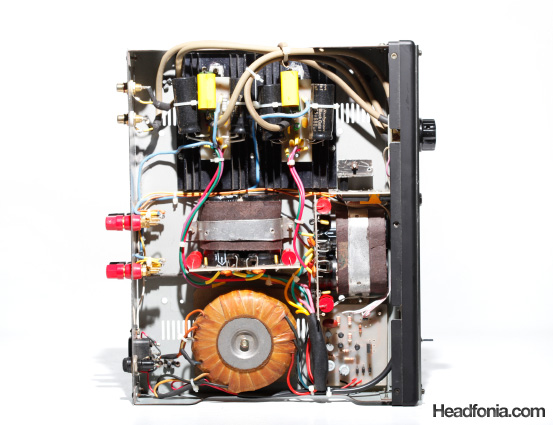
You can forget about the 2″ short signal path on this build. And yet, it still sounds very good!
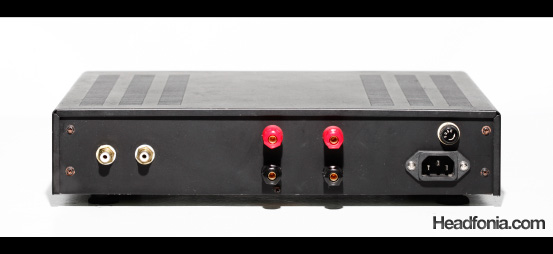
The backside is fairly simplistic. I don’t have an extra cable for the LCD-2, but with the HD650, I can use an XLR -> bare wire adapter to hook up the HD650 to the speaker taps.
This is not meant to be a usual review article. After all, I can’t do a proper review until I can locate a store that offers a good standardized build of the Gainclones. However, I just want to get the word out there. If you have some DIY skills and are willing to give the Gainclone kits a try, you can get them at sites such as chipamp.com, or even eBay (search for Gainclone or LM1875). LM1875 is preferable for headphone duties due to their lower power output and DC-offset level.
Thanks to Adhisan for loaning his gainclone amplifier for this review.
Here are some links to more Gainclone-related stuff:
- Chipamp.com – LM1875 and LM3886 amplifier kits
- Audiosector – Audio designs by Peter Daniel
- 47 Labs (home of the original Gaincard)
Reviews of the Gaincard:




Mike
Another link:
Three Resistors Amp. http://dogbreath.de/Chipamps/ThreeResAmp/ThreeRes…
That looks like a great amp for first time DIYers!
iyayy
After i started picking up a cheap solder gun and tweaking my lovely cube, diy is very interesting, especially reviewed, since there arent many sites or reviewer that evaulates them. I still dunno how to read a circuit board tho, if this is easy to understand, i might wanna give it a try. Imo neutral is very hard to find, manufacturer always seems to build an amp with purpose, or tuned to fit or using specific headphones, hence not very neutral. I prefer amps that provides driving power and boost imaging since it’ll improve the capability of the cans further, rather than tuning it, so works with everything. My reference for neutral amp is go-vibe ppk, quite a nice pocketable thing. So, how does this compares to the m-stage?
Mike
I think everyone should try to pick up a soldering iron. It's a lot of fun. 🙂
Kunal
I will agree on that,specially after I made my own DIY speaker adapter cable for the HE-6
Mike
When I started this hobby, I struggled to build a mini to mini cable. But look at me now, I've successfully build a Beta22 amp. B)
Of course I spent a long time talking on the phone with psychaudio asking questions during the building process. 😛
(and I've also spent a lot of money on soldering tools)
Earfonia
To build a Balance headphone amp with LM1875 sounds interesting 🙂
Mike
I'm more interested in building a higher quality GC with a 9cm short signal path and boutique components. 😀
Mike
Guys, check this out by Peter Daniel:
<img src=http://www.audiosector.com/images/patek2/patek2_10.jpg>
<img src=http://www.audiosector.com/images/patek2/patek2_09.jpg>
Now that's what I call a sweet build! 😀
Earfonia
Wow! That's pretty! 🙂
tingm
That is really pretty isn't it? I want to build one like that, if I have time. I think he uses copper block for the ground?
David
the copper block is the heatsink. Peter use LM3875TF which is the insulated version of the chip. The grounding is all on his genius PCB design.
Regarding the short signal path… I recall that what Peter found is not the signal path going from input connectors or going to output connectors. You can see in his design, that he is not that care with that… (besides, your RCA cable and speaker cable would be much longer that what you can save inside the box.
THe shortest distance which always brought up on gainclone design is the shortest path of feedback resistor going from the ouput pin going to the (-) input of the chip. the way to make it is short as possible is by soldering the resistor right on the chip pins, instead of on PCB.
additional information: that four big caps are Blackgate N series capacitor. His resistors , depend on his amp grades, are: Caddock or Phoenix (now part of Vishay), Panasonic or Riken.
Mike
David showed me this beautiful Gainclone PCB design by Peter Daniel
(right click and "View Image" to see uncropped)
<img class="maxwidth" src="http://www.headfonia.com/wp-content/uploads/2010/12/gc_peter_daniels_01.jpg">
Mike
Anybody interested to build one? 😀
3875-KIT-P-DM LM3875 Dual Mono Premium Kit
– 2 x Amplifier gold plated PCB's
– 2 x Premium Amplifier Components
– 2 x Rectifier PCB's
– 2 x Basic Rectifier Components
$95.00
3875-KIT-C-DM LM3875 Dual Mono Classic Kit
– 2 x Amplifier PCB's
– 2 x Basic Amplifier Components
– 2 x Rectifier PCB's
– 2 x Basic Rectifier Components
$59.00
3875-PCB-P LM3875 PCB Gold Plated
– 2 x Amplifier PCB's
– 2 x Rectifier PCB's
$29.00
3875-PCB-C LM3875 PCB Standard
– 2 x Amplifier PCB's
– 2 x Rectifier PCB's
$24.00
http://www.audiosector.com/lm3875.shtml
Không Có Ai
Hi Mike, i’m planning on building gainclone 3886 for my fostex, we it work? I need to use 10 ohm resistor in output jack right? How much W do i need for the resistor?