




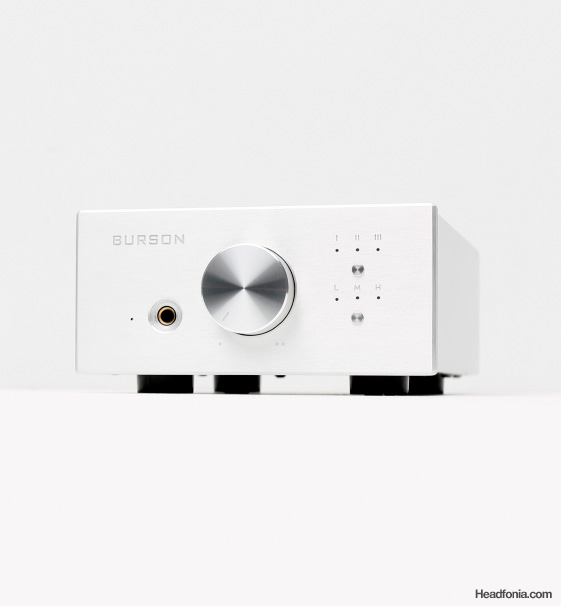
Amplifier Comparisons
One or two days after the amplifier arrived, my local headphile friends wanted to audition the amp so I took it to the Jaben store and all of us auditioned the Soloist and we A-Bed it to the Burson HA-160D which belongs to a friend of mine. They were just as excited about the Soloist as I did, mostly because of the same reason: they’ve never heard the HE-6 with this sort of a bass and midrange body. Not only does the Soloist add bass body, but it also adds a stronger impact than the HA-160D does. I think we can give credit to the 4 WPC output for that impact.
In terms of sound signature, the Soloist had the thickest body out of the trio of amplifiers. The RSA Dark Star and the HA-160D were more linear, with the Dark Star being more spacious while the HA-160D having a more forward sound and a better PRaT. I enjoyed the fact that the Soloist not only adds body to the HE-6, but also that it relaxes the treble more than the HA-160D and the Dark Star. Comparing the Soloist to the HA-160D is like comparing the Sennheiser HD650 to the HD600.
Headphone Pairings
Technically, the HA-160D had a wider soundstage and a clearer articulation, while the Soloist had a better depth in the soundstage. I also felt that the Soloist had a more natural decay, while the HA-160D is more abrupt on the decay cutoff. With headphones that never really lack bass and midrange body like Audez’e’s LCD-2 and Senn’s HD650, I think that the HA-160D is still best, though by a slight margin, simply because I was getting better bass articulation and a more “correct” treble presentation. Paired with the Soloist, I still enjoy the LCD-2 and the HD650 highly, so it’s not like the Soloist are enemies with the two headphones. Especially with the HD650, it’s quite noticeable how much better the depth on the soundstage presented by the Soloist is, compared to the relatively flat HA-160D.
With the Hifiman HE-500 and the HE-6, I think the Soloist is my number one amp for those headphones now. I also had the chance to pair the Soloist with Mr. Speakers’ Mad Dog headphone and the two pair very well. A friend of mine who owns a recording studio and is a music engineer was impressed to hear his Mad Dog headphone being transformed by the Soloist.
I don’t really have the habit of driving IEMs with desktop amps, even more 4 watts amplifiers. For those of you who do, the Soloist is among the quietest desktop amp I’ve auditioned and had absolutely no noise issue with sensitive IEMs.
Some Notes About Burson’s Volume Attenuator
The Burson comes with a discrete volume attenuator which in theory is a mechanical switch with 24 different stops, all linked to a different value resistor. Stepped attenuators are agreed by the audiophile community to provide a better quality signal transfer path compared to standard sweeping-taper potentiometers.
When I compared the Soloist to the HA-160D which is about one year old, there was a problem in the volume control where everytime you move the position of the switch, there would be a loud “pop” noise that’s audible on the headphones. Not very pleasant, and my friend the owner told me that the pop got louder as the amp ages. The first thing I thought of is “bad contacts”. So I took a can of electronic contact cleaner, specially developed for cleaning electrical signal contacts, and I sprayed the attenuator unit with it. Afterwards the pop disappeared completely.
Apparently the same problem had started to build up on the Soloist’s volume control, though in much milder level and with much lower pop sound. Again the contact cleaner would solve the problem, but I thought that it would be good for Burson to improve the sealing on the contacts.
Continue to the next page…




Victor Yu
Mike, how would you compare this with the HA-160?
Trent_D
I think the answers you seek lie in this review. With a keen eye, look it over again. Page 2 has some good stuff. Just remember, the HA-160D equals the HA-160.
Mike
Thanks, Trent.
Victor Yu
Hi Mike, with Alessandro MS-PRO and W3000ANV, which one, the soloist and the HA-160, will be your better recommendation?
Mike
I like the MS-Pro with the Soloist better than the HA-160.
For the W3000ANV I like it with the Soloist, but never compared it to the HA-160.
The nice thing about the MS-Pro + Soloist combo is that it add bass body and relaxes the treble. Pretty much the same with the HE-6.
Chris Allen
Great review, Mike! I must say though, I think the Burson logo looks good even without the original logo we all know. It kind of makes it live to its name in terms of originality. Anywho, great review again, Mike! 🙂
Mike
Thanks, Chris! 🙂
Liviu Raicea
Hi Mike, How does the Soloist pair with the HD800?
Mike
I didn’t try it with the HD800 to be honest. I tend to like the 800 with tubes.
Terry Lee
Hi Mike,
the Soloist and 160DS, Which one is better with Denon D7000?
Mike
Terry,
I didn’t check it with the Denon D7000. Personally I like the Soloist far more than the 160 series. So I’ll probably like it better with the Denon as well.
johthor
Thanks Mike for another excellent review. I have owned the 160DS for some time now and the only HP I own that it does not seem to have enough power for is my HE 500. I have to pretty well max out the volume with this HP and I am concerned that I am not getting the best out of this oustanding HP. In your review you mentioned that the new Soloist works well with the HE500. Would you be able to elaborate as to how the Soloist manages this. Thanks Mike and I really like the review
Mike
With the HE-500, the Burson amp on medium gain, I’m listening at about 12 O’clock, while at 1-2 O’clock it’s getting too loud for my ears.
johthor
Thanks for the reply Mike. I must be missing something here. How do I adjust the gain on the Burson 160DS?
Mike
You can’t. The DS only comes with one gain setting.
johthor
Well that sucks because otherwise the DS160 is a very nice DAC/AMP combo. I will not be selling it as it powers everything else I have. It is actually worth keeping for my HD650s alone. Could I get a recommendation from you for a combo DAC/AMP for the HE 500 and for a future HE 6. Budget $500 to $1000. Thank you in advance
Mike
Nothing that I know of at the moment.
Song Kyung-han
Mike, how much does the Soloist sound open, airy, and fresh compared to its competitors? What can you tell me about its clarity, and bass quality? When you said “the best sounding solid-state amplifier you’ve listened to” you mean you personally prefer this amp to the likes of RSA Dark Star?
More importantly, I’d like to know how the Burson Soloist performs with low impedance closed dynamic headphones, such as those from Audio-Technica. As you know I’ve recently bought myself a Fostex TH900, and now I’m looking for a decent solid-state amp to drive it. The Soloist is one of the amps I’m considering to buy, and I have high expectations for it, but it’s the headphone matching with the proper headphone amp that’s really important.
Mike
Yes I truly love the Soloist more than any other solid states I’ve owned or had auditioned. The Dark Star I still have, but I think the Soloist, while not sounding as spacious as the Dark Star, offered more for me in that I find it to be more musical due to the thicker mids and lows. The sound is not as clean in the Soloist, but again it’s not always about pure technicalities superiority.
I enjoyed the Soloist with the W3000ANV and W5000 and that’s the amp that I use the most to do the Audio technica review.
I’m not so sure about the Fostex TH900 though.
Song Kyung-han
Thanks for your input. I’m selling my current Schiit Lyr (not quite suitable for driving sensitive TH900) and ordering the Soloist. I’ll share my impression with it once it’s in my hands. But so far everyone I’ve asked said nothing but positive things about it, especially with low impedance dynamic headphones.
Mike
Yes I’m listening to the Burson with Sony’s Z1000 at the moment. Superb combination.
Song Kyung-han
One more question… what is the preferable gain setting for low-impedance, high-sensitive headphones? Does the gain setting matter with such specifications, at all?
Mike
You can try either the low or the medium gain. You’ll get less volume control range with medium gain, but I think the sound is more forward and more fun at medium gain, while at low gain it’s more laid-back but with a lower noise floor.
Mike
Zero hiss with the Z1000 on Burson’s low gain, and I’m listening at about 12 O’clock with the Z1000.
Song Kyung-han
One more question… what is the preferable gain setting with low-impedance, high-sensitive headphones? Does gain setting matter with such specifications at all?
Mate Mayer
Hi Mike,
Which DAC would you recommend with the Soloist?
Thanks,
Mate
Mike
Mate,
I really don’t think it has to be one particular DAC, but the ones I’ve been using with it with good results are: HRT HeadStreamer, KingRex UD384, and Matrix M-Stage DAC.
Mate Mayer
Thanks Mike! How about pairing it with Burson’s own DAC?
Mate
Mike
I actually haven’t tried that combo, Mate.
Victor Yu
Hi Mike, after trying the HE-500 on the Soloist, will you think that this is a better match compare to HE-500 with Graham Slee Solo?
Mike
The signature is different, Victor. The Solo is smoother and mellower, the Soloist more PRaT and bass, but less clean than the Solo.
Nick Tam
Seeing how you haven’t done an exact comparison, down memory lane, what are the sound characteristics that stand out between the V200 and Soloist, or even the Solo SRGII? You’ve mentioned their synergy driving the Hifimans, so was thinking about the ideal amp driving the Hifimans. Thx Mike
Mike
Nick,
The V200 I still haven’t listened to.
Simply put, Solo SRG II is smoother and slower paced. Burson is more lively, stronger bass, more energy.
Alexander Ivanov
Did you try this amp with Sennheiser 800 / 650 / 600?
Mike
Yes.
I tried it with the Senns and they were good, but not particularly stellar. Especially the HD800 I think is best with tubes.
Song Kyung-han
I wonder if you are having the same issue with your Soloist. I just noticed it pretty recently, and wonder if this is normal. Now I’m usually listening to it at low or medium gain depending on what I listen to. However, other than the sonic differences between gains you’ve mentioned in a previous article (laid-back/forward, clearer, soundstage, etc.), I also notice a volume difference between the two channels. When I switch from low to medium gain while listening to music, I can definitely feel that the volume increase in the right channel was greater than that of the left channel. In other words, at low gain the music sounds relatively tilted to the left, while at medium gain it sounds more tilted to the right. Could you try this yourself and tell me if you notice the same thing?
Mike
Hi,
No such problem with my Soloist.
Can you try this though: unplug your headphones, and rotate the volume knob clockwise and counter clockwise really fast, about 10-20 times. Just checking if it’s just the dirty contacts on the volume attenuator.
Again make sure there is no headphone connected.
Shahrose
Hey Mike, I’m wondering what you think of the Soloist vs the Arete + Volcano in terms of SQ.
Mike
Hi,
I don’t have both here at the moment, but from memory I think the Arete + Volcano is more spacious.
Horatiu Mihalache
Hi Mike,
I asked the same question in the Lehmann Black Cube Linear preview, I hope you don’t mind I repeat it hear. How does the Soloist compare with the BCL? Especially when paired with HD 650 or LCD-3 (LCD-2?).
Thank you!
Mike
Sorry missed your question!
The Lehmann is very clean, precise, a little sterile, more laid back.
The Burson is more organic, more analog, fuller mid and low end body, more grainy, stronger bass punch, more forward.
With high quality digital classical and Jazz recordings I think the Lehman is very nice to listen to. Pop/Rock mainstream stuff, I’d go for the Burson.
Horatiu Mihalache
Thank you, Mike, I appreciate your efforts. I think I might go for the Soloist, though I found an used BCL at a very good price.
Mike
You’re welcome. Next time I’m not answering your question again, please repost. 😉
It’s easy for me to miss questions.
Mike
I have both at the store, let me check it out next week and get back to you.
Elroy
I like what I’ve read about the Soloist and am considering buying it but wonder what would be a good DAC to pair with it. I ask because I have read that the Conductor is outstanding but the DAC is not quite equal. Am liking what I have read about the Rein X-DAC. This combo will more than likely be used with Senn. HD700’s or Audeze LCD 2’s. Also, it will be used to listen to a variety of generes ripped at lossless. Any other suggestions as to DAC would be greatly appreciated, looking to keep the entire setup in the $3000 range.
Trent_D
Does that budget include the headphones? I thought I should mention that if you don’t need the preamp function, Burson just released the Soloist SL, which is the same amp, just smaller and $400 less.
Elroy
It was to include the headphones. Regarding the preamp function and to quote my 4 year old nephew “I do not know!” Do I need the preamp function, what does it do for me, or what else would do that function for me. It gets more complicated, in searching for info on the Rein and Burson combo I am now leaning towards the Violectric V200 & V800 combo. Any thoughts?
Mike
I really have no experience with the the Rein units and how they compare to the Burson.
There are a lot of DACs to recommend, perhaps you can start by browsing the Source page?
aras87
Hi Mike,
Can you compare soloist and centrance dacmini? Thanks!