




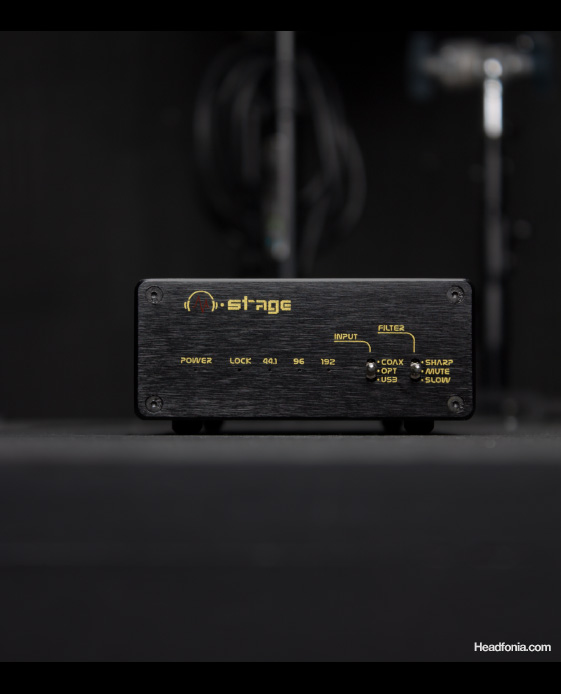
Disclaimer: I received the M-Stage DAC directly from Matrix Technologies.
Here is a new choice for you seeking a desktop DAC. At $300, the Matrix M-Stage DAC competes directly with other popular $300 DACs like the HRT Music Streamer II+ and the Centrance Dacport LX. The sound quality is good, and without going to deep little details about the sound, I’d just say that it gives a sound reminiscent to the HRT Music Streamer II+. Warm, analog, spacious, grainy, with good three dimensionality. The M-Stage’s weightier bass section is personally very addictive for me so I do favor it quite a bit more than the HRT. Little differences, but MS2+ feels more airy and spacious, though overall soundstage depth is better on the M-Stage DAC. So if you’ve been a fan of the MS2+, the M-Stage should be a good fit as well. If you’re looking for a cleaner, grainless sound of the Dacport LX, then this may not be your cup of tea.
So, for the sake of comparison, we’ve established that the M-Stage is roughly comparable, or say mostly equal to the HRT MS2+. The price is $49 cheaper than the HRT MS2+ (going by Amazon.com’s prices), but how strong of an advantage is $49 is for a $300 product?
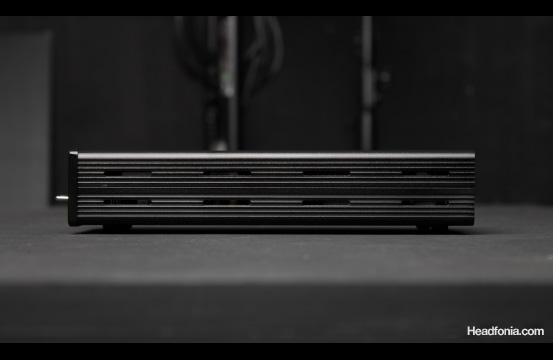
Going by the factor of convenience, I’d definitely go for the MS2+. It’s plug and play straight from the USB hub, no additional need of a power cable. The form factor counts too, the MS2+ is smaller, takes up less space on the desk. The M-Stage on the other hand is bigger, heavier, and require a separate power cable.
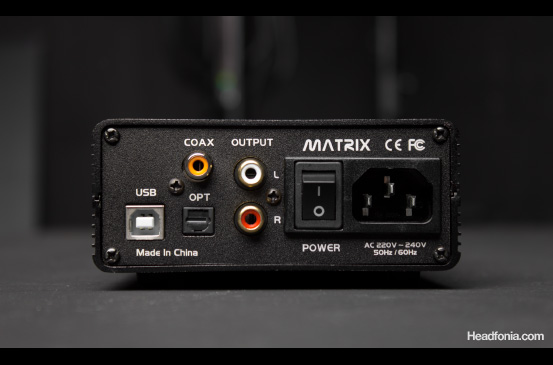
I was doing a Google Search for the MS2+, as I wanted to check what the current street price of the MS2+ is. Accidentally, I found this question from Head-Fi on the search result (the link outlined in red):
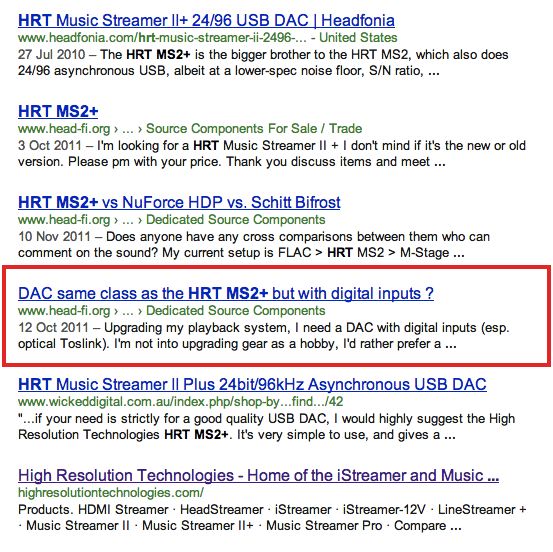
And seriously, that IS the added value for the M-Stage DAC. The MS2+ is a hugely popular DAC with a likable sound signature, but in one hand the simplicity of it is somehow a double edged sword as some people need S/PDIF connections (I’ve asked Kevin Halverson if he has plans to add S/PDIF input for the Music Streamers, and his answer was no — he’d like to maintain the focus on what the product was designed for). Archaic as it may be, people still have a need for S/PDIF (such as using it in tandem with a CD Player) and that’s probably the M-Stage’s biggest selling point.
I can write a long winded review that ends at some 1,500 words, but basically this short few paragraphs is what matters. One thing I need to add is the filter selector switch on the M-Stage DAC which gives you a choice between Sharp and Slow (Mute is not really a real filter). Sharp gives you shorter, more precise transients which works better for fast music (most noticeable on complex bass passages). Slow gives longer decays that works better for slow music. The filters are quite efficient and I switch around between the two quite often.
At the end of the day, how good of a DAC is this? Pretty solid performance. I’ve used the M-Stage with both the RSA Dark Star and the Burson Soloist, going from my Ipod + CLAS as the source (using the CLAS’ S/PDIF out), as well as my Onkyo ND-S1 dock. With a high end amp the class of the Dark Star, I really don’t see the M-Stage holding the entire system back. Music is very enjoyable and analog. Not a clean technicalities monster like the KingRex, or the Centrance Dacmini, but I enjoy the slightly grainy analog sound.




James O'Connor
Would the M-Stage DAC be a worthwhile upgrade from a Creative Titanium HD soundcard, or would the gain be small?
Nick Tam
I’d daresay most dedicated DACs are better than those PCIe “Audiophile” soundcards including the Asus Xonar STX, but probably not the Audiotrak Prodigy HD. I know this is a general assumption but the implementation of DAC chips by Creative was never great. If I recall, the Titanium HD wasn’t that highly acclaimed and people tend to prefer the STX.
But anyways. The difference is huge. HRT MS2+ and the Matrix M-Stage have far better soundstage, imaging, depth and technicalities.
A more valid comparison of the DAC section of Titanium HD would be something like the Fiio E7 and E10. It’s just that big of a difference.
Steven Setiawan
HRT MS2+ and the Matrix M-Stage have far better soundstage, imaging, depth and technicalities.
“have far better soundstage, imaging, depth and technicalities.” HRT MS2+ or matrix m-stage ?
Mike
Well I did say that the HRT and MS2+ stands roughly equal technicalities wise.
Gorboman
Why does some DAC use own power source and other choose USB powered? Any difference between them?
Mike
Different design for different purposes I guess. USB powered is simpler. AC power when regulated properly should be better than USB powered.
Gorboman
I see. One more question. I found the MS2+ to made sound smoother. Does this Matrix also do the same?
Mike
I don’t think it’s a deliberate smoothing effect (MS2+), perhaps more of a higher resolution DAC combined with less distortions/artifacts. The Matrix is similar in that regard.
Gorboman
Ah… So that’s part of higher resolution effect. I thought it was just some sort of ‘coloration’. Now I’m curious about higher end DAC, especially the CLAS -dB.
Nick Tam
Unfortunately for the same price of the CLAS -dB, I would happily go for the Kingrex UD384 w/ UPower.
Trent_D
You know I am with you there Nick. I think the CLAS -dB is for those who demand that their dac also work as a portable one for their idevices.
Gorboman
@Nick:
I’ve never tried the Kingrex. I have tried the CLAS and I like it’s sound, but for iDevice only.
@Trent:
I thought CLAS -dB is for those who liked the CLAS but wished it can connect to computers?
Trent_D
I suppose. I was just agreeing with Nick’s point.
Nick Tam
If you’re running exclusively through an iDevice, I guess that’s your choice. I just feel that most of the price of the CLAS comes from licensing from Apple. Alo really is trying to make money off it’s customers from discontinuing the old CLAS.
If you like Alo Audio’s sound, definitely consider the Pan Am if you’re running a computer setup instead of the CLAS -dB
Gorboman
Oh you’re right. I didn’t think about licensing cost.
Nick Tam
Speaking of which I noticed the IEC socket is labelled 220-240v since it’s from the Chinese market… that’s quite a problem with countries running 120v isn’t it?
Mike
They should have a version for the 110-120V countries.
Mate Mayer
Hi Mike,
How does it compare to the Schiit Bifrost?
Thanks,
Mate
Mike
Sorry Mate, I don’t have the Bifrost around for a comparison.
Ted Tillholm
Mike,
Ahh, addictive bass. What a wicked web she weaves. I’m going through the same thing with the c421 AD8620
Mike
That’s right, Ted. Everybody needs bass in their music. 😉
Ted Tillholm
What I was trying to convey(and obviously didn’t do a good job of it). Is my agreeing with as to how nice a good solid bass punch sounds to the ears. In my case the c421 AD8620(Very defined bass) VS. c421 OPA2227(Murkier bass). And in your case the “Additive bass” of a free sample you received from some random Chinese electronics company 🙂
Mike
Ah so that was your point. Mysterious man. 😉
The problem I have with the AD8620 C421 is despite its tighter and punchier bass, the midrange and soundstage is much worse than the OPA2227 version.
With the HRT and Matrix comparison, you get pretty much the same midrange and soundstage, yet the Matrix having an edge in bass.
bala
Mike, How about the DAC Magic (the older version) vs Mstage DAC – is it worth switching to the Matrix just for the 24/192 capability? since the older DAC magic is available at competitive prices!
Mike
How often would you be using 24/192? The Dacmagic supports only 16/44.1 if I remember correctly?
I would choose based on sound signature though. The Mstage is better with soundstage three dimensionality, better bass body, more grainy. Dacmagic is smoother, cleaner sound, less bass, little brighter, flatter soundstage.
calluna
Mike, how do you compare M-stage dac and Matrix mini-i in SQ?
Mike
M-stage is a better DAC but it doesn’t have balanced out like the Mini-i. Sound signature somewhat is close, a bit dark, good bass, grainy.
Brian Werner
Mike, do you know what DAC chip they are running? The new unit isn’t even up on their website yet so no spec sheet. I was wondering which chip they used given the analog/ bassy sound you’re noting. Obviously implementations matter and the chip isnt the end all be all but I was just curious.
Nick Tam
PCM1792
http://www.ebay.com.hk/itm/Matrix-M-stage-DAC-PCM1792-Audio-DAC-NEW-Version-Decoder-/320998308730?pt=US_Home_Audio_Amplifiers_Preamps&hash=item4abcfd7b7a
Mike
Hi Brian,
PCM1792 according to their chinese site:
http://www.matrix-digi.com/english/cpshow.asp?pid=36
Eric Jean Hickert
Mike, how would Matrix compare to the Halide Design DAC HD ?
Mike
Actually comparable. The DAC HD is so much more convenient though some premium over the Matrix.
Both have a nice warm sound with good bass.
Mike
Actually comparable. The DAC HD is so much more convenient though some premium over the Matrix.
Both have a nice warm sound with good bass.
Mike
Actually comparable. The DAC HD is so much more convenient though some premium over the Matrix.
Both have a nice warm sound with good bass.
Mike
Actually comparable. The DAC HD is so much more convenient though some premium over the Matrix.
Both have a nice warm sound with good bass.
E. G.
I’m curious about this sharp/slow filter. What is it, electronically speaking, and how does it work? Do other DACs have this kind of feature?
Mike
It’s a digital filter applied to the signal. Some DACs have that feature yes.
David Vincent Aldrich
Mike, I am hoping you still have an M-DAC laying around, I just received on today from the Massdrop buy, and it sounds quite good. However with my amp (Meier Corda HA-2) I’m noticing quite a lot of noise when the sound is muted and the volume on the Corda is above normal listening levels. Is this something you experienced at all? Using a Focusrite Saffire Pro 24 as a DAC yields less noise even when the volume is pegged on the Corda. I may end up selling this and opting for a different unit.
Mike
David,
That doesn’t sound right.. I don’t think the M-DAC has that high of a noise level. But the Focusrite should be a good DAC as well.
aras87
Hi Mike,
Can you compare DAC sections of Dacmini and M-dac? Which one would you buy? I would also like to get some feedback on headphone sections.. Great website, thanks in advance!!
Mike
The M-Dac is dark and warmer. Dacmini is brighter and cleaner. Personally I’m more into the M-DAc sound.
Headphone out comparison, the M-Dac doesn’t have a headphone out..
Eyal Sade
how does it preform VS. Yulong D100, and UD384 ?
Mike
I think it’s less capable technically than the UD384.. but overall it’s a different signature. This DAC is warmer sounding.
The Yulong D100 I haven’t tried, sorry.
Magos Péter
Hi Mike,
The Mute filter what doing? Mutes the DAC or turn off the filters?
Mike
Hi Peter,
It mutes the DAC, I believe. Been so long since I used the DAC.
Magos Péter
Thanks! Can you compare Mstage DAC to DacMagic 100?
Mike
Hi Peter,
Unfortunately no DACMagic 100 for me, but between the original Dacmagic and the Matrix, the Dacmagic is cleaner and more flat, the M-stage darker, bassier.
Dan
Hi Mike,
Does DT990 pro work well with M-STAGE DAC?