




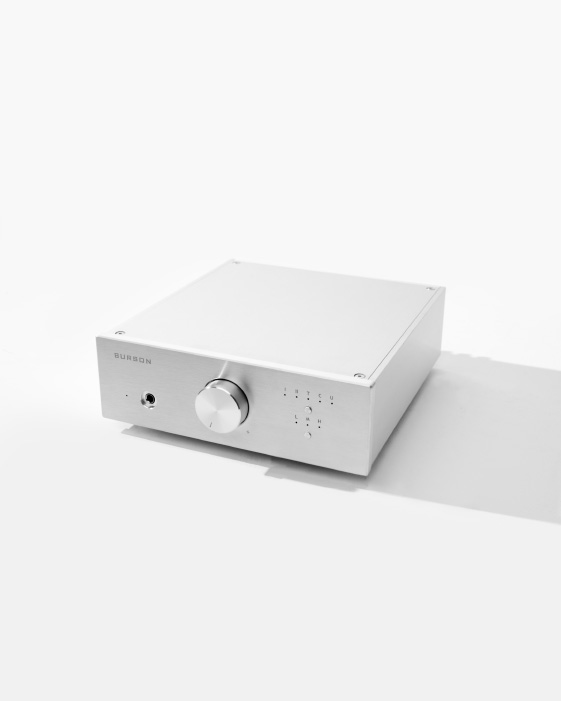

Disclaimer: The Burson Conductor unit used in this review is a loaner unit from Burson Audio.
Roughly two years ago I came across the first Burson headphone amp that is the HA-160. I liked the amp from the first moment I listened to it. It was a distinct solid state sound: warm, full bodied, but most of all it had this pace, PRaT and impact like no other. After a while Burson decided to add a built-in DAC to the HA-160 amp, naming it as the HA-160D. Not long after the HA-160D, Burson released the HA-160DS which omitted the pre-amp function from the HA-160D to make a more affordable desktop Amplifier/DAC unit. Last year, Burson came out with a new headphone amp with a new, simpler circuit design yet offering 4W of power: the Soloist. I loved the sound of the Soloist, even more than the sound of the HA-160 and it quickly became my favorite solid state amp. Finally we now have the Conductor, where you have the same 4W amplifier of the Soloist put in the same box with a Sabre based DAC. I’ve been using the Conductor for a few weeks now, and this amplifier simply has it all: sound, power, digital-to-analog conversion, pre-amp, connectivity, and build quality. The most complete and whole one box package I’ve seen to date.
Amplifier Impressions
The first thing I did upon the arrival of the Conductor was comparing the amplifier section to the Soloist which I loved. One of the thing I love about the Soloist amp is it adds low end grunt to the Hifiman orthodynamic headphones (especially the HE-500 and HE-6 that can definitely use some addition there). The Conductor supposedly has identical amplifier section to the Soloist, but I find the Conductor to have an even beefier low end compared to the Soloist. Sweet! What’s causing the difference, I asked? According to Burson that’s because the Soloist in my possession is a pre-production unit, and had I compared the Conductor to a production unit Soloist, the amplifier section would’ve sounded the same. Sounds good to me as people are getting a better version of the Soloist sound that I find to be excellent already.
When Burson moved to the new Soloist based amp, the biggest improvement in my opinion is not the 4W output but the simpler circuit with smaller components count. I’m with the camp that believes that less parts count would give a more natural, more organic sound. Like on the Soloist, the sound on the Conductor is more natural, more coherent, and more organic than on the HA-160D. It loses a bit of that bass articulation that the HA-160D is very strong at, but I don’t mind since I’m getting a more organic sound overall. The amplifier is also more laid back and the pace is a bit slower than that of the HA-160D, but again, the change is welcome to my ears as I enjoy a laid back sound (you all know the Sennheiser HD650). Despite these changes, PRaT is still very powerful with the Conductor, though slightly behind the HA-160D’s.
The Conductor covers just about any headphone in the market. I’ve used it with easy to drive dynamics like the Senn Amperior, Senn Momentum, Denon D600 and D7100. The amp is dead quiet even with the Momentum which is very sensitive and easy to drive. With the big heavy orthos it obviously work very well, from the HE-400 (which the Conductor conveniently drives at low gain) to the HE-500 and the HE-6 (I use high gain for this). I still prefer pairing the 300Ω Sennheiser HD650 and HD800 with big tube amps, but tube amps are usually more limited in headphone pairing compatibility, especially OTL designs. The strong point with the Conductor I find is that it works very well with almost anything I can throw at it. You can throw Grados/Alessandros to it, old Fostex orthodynamics or new Hifiman/Audez’e ones, ultra sensitive portable headphones (not that you’d need a Burson to drive them), big impedance dynamics like the HD650 or the DT880, all the way to the exquisite Japanese wooden headphones from Audio Technica. Chances are, the Conductor will drive 99 out of the 100 headphones in the market. And based on my experience with the HE-6, I really don’t think that there is anything out there that the Conductor can’t handle, except perhaps the Japanes TakeT headphone which I’ve yet to try.
The only problem I have with the Conductor is when I tried to use the ultra-low sensitivity JH5Pro IEM. Though the stepped attenuator volume control was precise and free from any imbalance, I only get 4 clicks from zero level (where I still get small sound leaks) to my comfortable listening level, even at low gain. However, I don’t think it’s a big issue though since I don’t normally use IEMs with 4W amplifiers.
DAC Section on the next page…




Rūdolfs Putniņš
A good read!
I’ve been having a lot of trouble with that Tenor USB receiver chip lately. The drivers are buggy as hell which means that it may connect in synchronous mode. I hope that Burson did something about it because Audio-GD sure didn’t.
Mike
Thanks! I didn’t have a problem with the drivers Burson supplied.
Christian Ruiz
Hi Mike, Im looking between fostex hpa8 and conductor, i have a LCD2 but i dont know which i have to choose… for amazon i can find the two at the same Price.
Mike
Christian,
The Conductor gives you a better amp where the HP-A8 a better DAC.
If it was me, I would go for the ALO Pan Am. Simply better synergy with the LCD-2 and I do sell both the ALO and the Fostex at my store. Short of comparing to the big thousand dollar amps, I think the Pan Am is a very good pairing with the LCD-2.
Christian Ruiz
My budget between 1000 and 2000, you said the alo pan am is a better dac/amp combo that the others? I need something that take out the potential of the lcd2.
Thanks mike
Dave Ulrich
From the Pan Am review:
The real magic happens when we paired the PanAm with the Audez’e LCD-2.
At
first we only wanted to find out if the PanAm can drive the LCD-2
sufficiently, and it did. We thought that the amp had enough power to
drive the LCD-2 with good impact, and we enjoyed the pairing as well.
But the more we listened to it, the more we got hooked into the
combination, and at one point Moko remarked that ALO must’ve used the
LCD-2 as a reference to develop the PanAm because the pairing is
incredibly good. I gave that a second thought, and not only do I agree,
but I can’t remember the last time I listened to a pairing this
impressive with the LCD-2.
It’s funny because the LCD-2 doesn’t seem to work well out of the high end tube amps (pure tubes, no solid state hybrids) like the Woo Audio WA5 and the others. So far I’ve always been recommending the LCD-2 with the Burson amps, especially the HA-160 line up as the best pairing I know for the LCD-2. Lieven also swears by the Violectric amps which is another solid state. I don’t know how the Vio compares to the Burson when it comes to driving the LCD-2, but compared to the PanAm, the synergy is clearly better with the PanAm. You get a much bigger soundstage with the PanAm, the midrange is fuller,
smoother and less grainy, and the dynamics is also bigger with the
PanAm. PRaT is a little better on the Burson, but that’s about it.
Clearly this isn’t a function of power output alone, and I really don’t
know how ALO made this amp to be such a brilliant amplifier for the
LCD-2, but it does.
For the past two weeks I’ve been telling all my local friends to go audition the LCD-2 with the PanAm.
Another magic with the LCD-2 and PanAm pairing is the genre bandwith. I haven’t been keeping track of all the changes that Audez’e does with the LCD-2,but this last revision with the wooden housing (not bamboo) and the new style cable connector (introduced in the LCD-3), had just the right amount of everything. I tried just about every genre out there, and the pair just played good music. I was especially blown away listening to Massive Attack’s Mezzanine as I don’t remember any LCD-2 pairing giving me that sort of a bass texture I hear from the PanAm. But more than that we tried so many different songs from mine and Moko’s Ipods; from Jazz to Rock to what have you. The pair just played music.
The NOS 6AK5W Siemens tube ($29 in a pair) gives a more forward and sweeter midrange, an even cleaner sound than the stock and an even bigger soundstage than stock. With some headphones like the Aurisonics ASG-1, I didn’t like the extra midrange which is a little too tubey. Also PRaT is a tad less than the stock tube. With the LCD-2 which has no problem producing PRaT, this tube simply rocks, and the more forward midrange is just perfect for the LCD-2.
L.
Then again, I didn’t really like the LCD with the Pan Am, I prefer it on the Burson and the V200, especially the Violectric
Christian Ruiz
Its difficult to find violectric in us, i will go for the pan am maybe later if the conductor upgrade his dac ill buy it too. Thanks for the commemts.
Christian Ruiz
So definitively, the pan am is the Best dac amp combo for the lcd-2.. i Heard that the dac is not good at All, do you think that i have to make an upgrade to the dac?
Dave Ulrich
Read the Pan Am review. It’s all there.
Mike
Thanks for the quote Dave. Don’t even remember I wrote that. 😉
I also talked a bit about the V200 + LCD-2 pairing somewhere. Lieven likes the V200 better than the Pan Am pairing (mainly on bass, and I agree the bass is better) but overall I thought the LCD-2 was more alive and more dynamic on the PanAm. Midrange quality is definitely better on the PanAm.
Mike
Yes I would recommend the PanAm. Definitely one of the best pairing with the LCD2.
John123John
seems like that is a good one box solution these days.
especially with the orthos.
Alexander
Nice review! It is the best all in one box I have heard until now. I am very happy with it! I don’t know why you said it falls short at the DAC section. I had the chance to listen to it side by side with the m2tech vaughan, which is in a totally different price league. I found the amplifier from Conductor to be better, and the dac section to be very very close to Vaughans’ :D, and that is amazing.
It does have some usb drivers issues, but I heard they are working on them. If you don’t use it as a default playing device in Windows or in other programs like skype, gtalk, etc while you listen to music, the problems will almost disappear.
Mike
Hi I didn’t have any problem with the USB on my Mac.
Sent from my mobile device. Sorry for any mistype.
Unknown
Lol u kidding? Vaughan DAC is not even close to Eximus. Sorry I don’t know about the amp section. But i know it is much better than Conductor overall. I think you should buy the Conductor that u heard. Perhaps it’s a special one. 😀
Mike
Perhaps you can share your impressions on the Vaughan and how it compares to the Eximus?
Alexander
I am saying what I heard. The Vaughan had a smoother more detailed sound because of the battery I think. So yes the sound was cleaner.
The separation of instruments a little better. However the differences were minor. Conductor on the other hand had a better lower midrange and bass pressence.
Beware that Psychoacoustics is likely to occur on this huge price leap between the two. I have heard them both with lcd2 & lcd3
Mikael
Must…have..Conductor.
A great read, as always. Loving the pics too!
Mike
Thanks!
Sent from my mobile device. Sorry for any mistype.
Albert Broman
what does “organic” mean?
Mike
Natural, not digital. Something along that line
Sent from my mobile device. Sorry for any mistype.
b.l.
Hey Mike, would you agree that the dac is the “least important” part of a setup?
Ken Stuart
While I’m not Mike, I find that the DAC is the most important part of a setup – because everything else can only be as good as the DAC output.
Mike
Thanks, Ken
Sent from my mobile device. Sorry for any mistype.
Mike
Not really, the DAC is very important.
Sent from my mobile device. Sorry for any mistype.
Alexander
I think both have the same level of importance, but have no fear, the DAC in Conductor is awesome, and I do not agree with Mike where he says it is lacking at all! It is far better than the old dac from Burson and can compete with other dacs at even higher prices!
Guest
I think both have the same level of importance, but have no fear, the DAC in Conductor is awesome, and I do not agree with Mike where he says it is lacking at all! It is far better than the old dac from Burson and can compete with other dacs at even higher prices!
niice
Hi Mike, great review again! I’m looking for the Amp+DAC at this price range so I wonder how the sound different when compare Conductor with Fostex HP-A8. My headphone is Alessandro MS Pro-i
The types of music I listen are kind of Jazz (both vocal and instrumental such as piano, guitar, trio or big band) Vocal (audiophile music), bossa nova with many type of percussion, middle pace pop music, new age. I don’t listen electronic music, hard-rock
Thanks!
Mike
I would recommend the Burson for the MS-Pro, especially as I own the same headphone.
Better low mid and bass body, powerful impact is just right for the MS Pro
Sent from my mobile device. Sorry for any mistype.
Minh Duc Nguyen
finally, Burson had added S/PDIF
ryan
How about a comparison between the conductor, hp-a8 and grace m903? Itching for a high end dac/amp to pair with the beyer t1
Mike
I don’t have the Grace, and but between the Burson and the Fostex, you should be able to get a good idea of both if you already have reviews.
Sent from my mobile device. Sorry for any mistype.
ryan
Probably one of these days, there is going to be a review starting with ‘Mike bought his Grace M903’….hehehe
Mike
Lol…
Sent from my mobile device. Sorry for any mistype.
L.
I have a feeling it could be pretty soon as well 😀
Piotrek
Mike,
first of all thank you for a great review (as always). I was searching for a new DAC/Amp combo and was considering between Burson Conductor and Fostex HP-A8C, but now i think it’s a clear call.
This have helped me a lot, since in my country (Poland) it’s almost impossible to hear Fostex (only very few retailers list them on their website, but don’t have them at shop) and Burson is much easier to get / hear (authorised dealers etc.).
Once again thank you for the review, because now i don’t have to ask myself a question if LCD-2/3 or Hi-fi 500/HE-6 would sound better paired with Fostex than with Burson (which after your review i’m going to get).
Peter
Little off topic.
Based on your recommendations i got AKG K550 and Beyer DT770 Pro AE, which were a top call, but now i’m looking for a small dac/amp combo for an office rig (any chance for a nuforce udh-100 review in near future?).
Mike
You’re welcome, Peter. For a small dac amp, and try the Matrix Portable. http://www.headfonia.com/the-320-portable-dacamp-matrix-mini-portable/
Sent from my mobile device. Sorry for any mistype.
ryan
Am I right to say that…
Burson Conductor – Amp first, dac second
Fostex HP-A8 – DAC first, amp second
Mike
Yes, correct!
Albert Alonso
When will you review the HDVD800 from Sennheiser? It should be nice a comparison with the Conductor and the Fostex HP-A8
Mike
Hi Albert,
Unfortunately for me, Lieven is getting that one.
Sent from my mobile device. Sorry for any mistype.
L.
Maybe after CES! I’ll try getting it to you too Mike 😉
Albert Alonso
Yeah! I’ll look forward to your reviews
Michael
I owned the 160D and felt the DAC was the weakest part of that unit. I also thought it was a poor pairing for the HD-800 (it accentuated the HD-800’s bright upper middle frequencies to the point of annoyance), but paired better with my HD-650.
Does the Conductor right any of these perceived problems? It sounds like you really like it.
Mike
It’s more relaxed on the treble but I think the 800 pairs best with tube
Sent from my mobile device. Sorry for any mistype.
Barron Jordan
Hi Mike. I want to buy a Conductor to pair with LCD-2’s, but I already own the HRT Music Streamer II+ and may go with the Soloist because of price. What would I be missing quality wise in your opinion (as compared to the Conductor) by going this route?
Mike
I think mostly convenience. I haven’t had the chance to compare the DAC section of the Conductor to say the HRT MS2+, but the Conductor DAC definitely has a better, beefier bass.
kai
Hi Mike,
Both conductor and fostex HP-A8 price come very close. Which one will be better pair with hd600/he400/ath-m50?
Liviu Raicea
Hi Mike.
You said that the amp in HP-A8 is on par with its dac and since the Fostex DAC is better that Burson’s then.. I gues Fostex should be the winner here.
What’s the use of a better amp if the dac feeding it is not on par? The amp is waisted (I think)
In which way is the Burson amp better than Fostex amp?
Thank you.
PS
pricejapan has the HP-A8 listed for ~1000$.
Damián Bonadonna
I second this.. also, I see that many other combos in the same range offer balanced output and more controls/connectivity options.
Elie Imelda Rik
Nice review! Sounds like an awesome unit.
But i was wondering.. My music library consists out of almost 70% mp3’s (192kb/sec or higher) and a lot of not to great recorded albums. Now, will I be able to hear a difference with this kind of audio between a Conductor and a 160Ds? It will be paired with a LCD-2 (which is pretty great with nonperfect recordings imho!). Will the Conductor be worth 2x the price of the 160Ds in your opinion?
Mike
Well I can’t say for sure as I very rarely use mp3 these days..
But if you’re already using the HA160D with good results then I don’t think you should worry about upgrading.
Barun C
Hi Mike,
Am considering buying an amp, am confused between the Conductor and EF6
I have the following headphones
1. AKG K340
2. AKG K141 (600 ohms)
3. AKG K301 ( 120 ohms )
4. Denon D950
5..Fostex T20 V2
6. Hifiman He 5
7. Sennheiser HD250 Linear II
What according to you should be a better option?
Thanks in advance.
Barun
Mike
Hi Barun,
Unfortunately I have no experience with the EF6 as the review was done by Julius.
The Burson should be able to drive all those headphones just fine though.
Michel
Hi Mike i had the Burson160ds with the LAWTON AUDIO denon d-5000 (25 ohms) and i loved it ,would i be blown away by the CONDUCTOR you think or it would be only an average upgrade in sound quality waiting for this to pull the trigger on the CONDUCTOR.or is there a better alternative in that price range keeping in mind i love a good bass. Thanks
Mike
Hi Michel,
Would love if I can give you a straight answer as I don’t have that headphone around to try with the Burson. I can only say that the Conductor and Soloist (they’re the same amplifier section) are overall a better amp than the HA160 series.
I find it hard to go back to the HA160 as the Soloist circuitry sounds much more analog and with a beefier low end. The sound is overall more organic.
Mike
I think you should also read the Soloist review as I talk more about the comparison to the HA160 there.
sdsmpie
Hi Mike,Can you please tell me how something like the Conductor compares to a FiiO E17? Burson States “that they refuse to use IC Based building blocks” why is that better? reading sites like NWAVGUY it seems that O2 DAC would be as good as this ? i just ordered my first high-end cans T5p and later in the future would perhaps go for a pear of Hifiman.. I just hope you can advice me on the matter .? Should i start small with something like the FiiO E17 and later on move to the Burson Conductor ..? Or will i be missing out so much that i should just jump in to the Burson Boat?
admiralwiem
Mike, check this out http://bursonaudio.com/Burson_Conductor_SL1793.html . Interested for comparison between the PCM1793 and the ESS? 😉
Mike
Just finished the draft 😉
admiralwiem
You do have a lot of hidden toys back there :O. I’ll be waiting for it then ;).
Mike
And I’m also doing another article called Burson vs Violectric 😉
admiralwiem
Damn, add the HP-A7 and the asus XE one muse edition. And that’s gonna be one cup of hot coffee with some crackers to read the review :).
Dave Ulrich
This is one I can’t wait to read.
ExpectationGap
I’m curious about the power rating of the Conductor/Solist. Most early reviews claim 4 Watts @16 Ohms, but Burson’s site (as of 7/4/2013) states 4 Watts @8 Ohms. I’ve sent them an email asking for clarification, since that’s a pretty significant difference.
ExpectationGap
I received a reply from the good folks at Burson, very nice fellows indeed. They validated that the Power rating is 4W@8 Ohms. Here’s how that plays out:
4 Wpc into 8 Ohms
2 Wpc into 16 Ohms
1 Wpc into 32 Ohms
.5 Wpc into 64 Ohms *current LCD-2 is 60 Ohms
That 1W@32 ohms really stood out, as that’s what the woo audio WA7 delivers – which I’m also considering. Burson complimented Audeze on great headphones, but cautioned against believing that the LCD line, while demanding, are difficult to drive.
This seems the case, as many professional reviewers and enthusiasts agree that the power output drives the LCD2/3 sufficiently, and with great results. It’s also fantastic to receive prompt, and earnest responses from audio manufacturers. Very impressive indeed.
L.
I agree and yet there’s “driving” and “Driving” the LCDs. Volume wise the LCD-2 isn’t that hard to drive, that’s a fact. Unlike the upper Hifiman headphones.
ExpectationGap
I should correct my earlier post, as I have some better measurements for the soloist/conductor gleaned from this: http://www.head-fi.org/t/613800/burson-new-soloist-headphone-amp/1020
[from that thread – post 1027, and Tyll’s burson soloist measurements:]
Ohms – Watts at 1% THD
16 – 3.0317 (Measured: 3.0870)
32 – 2.2779 (Measured: 2.1977)
50 – 1.7926
60 – 1.5943
70 – 1.4267
80 – 1.2815
90 – 1.1534
100 – 1.0388
110 – 0.9351
120 -0.8405
130 -0.7535
140 -0.6729
150 -0.5979 (Measured: 0.6227)
The formula can’t be trusted outside the range 16 Ohms through 150 Ohms. It’s really just an approximation for values that fit this range.
So… an LCD-2.r2 at 60 Ohms would be getting around 1.6 Watts. An LCD-3 at 45 Ohms would be getting around 1.8 Watts.
That would help answer why the Soloist/Conductor has been such a good pairing for the LCD-2/3. I’ve actually been listening to this rig, lent from The Cable Company, for the past two weeks – and neither LCD-2 or 3 have struggled at all with the conductor.
Now, I just have to try out the WooAudio WA7 with these headphones and I’ll be set on a direction for purchase.
STARSTERN
how do you compare the alo six amp to soloist amp ?
Mike
Six is on a different level of course.
STARSTERN
a neko d100 dac combined with a soloist amp would be the world best pick for overall including the lcd,s headphones ?
Mike
Neko + Six.
STARSTERN
how do you compare the conductor to fostex hp a8 ?
Mike
HP-A8 is the better DAC.
STARSTERN
solid state dac cant compete a tube dac ? but does it at amps ?
https://docs.google.com/viewer?url=http://www.theaudiocritic.com/back_issues/The_Audio_Critic_26_r.pdf
L.
Dude, how many questions can one ask?
Mike
I know.
Mike
DACs, I think solid state is the way to go. Tube DACs have too much coloration which you don’t want in a DAC.
STARSTERN
good question ” I guess as many as its of public interest ”
do you have any more questions ?
Mike
While we’re trying to be helpful, it certainly is too much to expect us to answer every question that pops in your head.
vick_85
Has Mike stopped writing for headfonia?? I miss his reviews.
Can we expect a review for the conductor virtuoso??
It would be really great if both the burr-brown and sabre dac modules are reviewd just like they were for the previous conductor.
Headfonia_L.
Miked stopped reviewing in January 2014, you’re a bit late to find out 😉
I asked Burson a long time ago but never got a reply, I will check again