




I have the uDAC 2 loaner from Hadi and I’ve been spending some time with it. Good thing that at the same time I was able to borrow the original uDAC from my buddy Sem so I can do an A-B comparison between the two. Here is a short get-in and get-out write up of the products.
Nuforce has definitely improved the quality of the DAC section on the uDAC 2. I’m not even taking the 24/96 capability into the comparison here, since the original uDAC can’t do 24/96 (more about the 24/96 later). Listening with a Hifimediy TK2050 and HD650 combo, the uDAC 2 has a more spacious soundstage and a smoother sound in comparison to the constricted soundstage of the uDAC. The sound is more open and refined now, and definitely ranks higher in terms of sonic quality.
The uDACs still have a couple of coloration issues. If the original uDAC is heavily colored in the bottom end, then the uDAC 2 adds a coloration in the upper midrange. Not bad, as it helps makes the sound more engaging and livelier. But such colorations comes at the expense of the overall refinement in the sound. Comparing the uDAC 2 to the HRT MS2 DAC, and it’s definitely clear that the HRT is the superior DAC. The HRT is more transparent, has better low level detail, better transients, better decay, and overall a more natural sound. The HRT MS2’s only catch is that it lacks a headphone out, which can be very handy for laptop/office set-ups. But at this price point, I think the performance is very very good, and I really am being too demanding when I said that the uDAC 2 needs to be more such and such. However, while I would confidently rank the HRT MS2 as a budget audiophile DAC, the uDAC 2 is more like a well designed gadget with a good price to performance ratio.
Somethings that I don’t understand is that the uDAC 2 has a much lower line out level than the original. For instance, when the volume is maxxed out in the uDAC 2, I have to dial down the original uDAC to around 1 O’clock to get the same volume level. Likewise, the headphone out is also weaker in uDAC 2, with roughly the same volume level differences. Driving the 300 Ohm HD580, for instance, the original uDAC is quite comfortable at 1 O’clock, where the uDAC 2 is all the way at maximum volume. Also, I’m getting quite a punchy bass with the original uDAC, where the uDAC 2 is less punchy.
On the other hand, the lower gain of the uDAC 2 gives a very usable volume control for use with IEMs, and this is very important for many people. On the original uDAC, using the JH16Pro, I can’t get any decent volume control. At one level there is no sound, then with a slight twist on the knob, you already get a moderately loud volume. On the uDAC 2, I’m getting a far more usable volume control from zero volume to about 9-10 O’clock depending on the recording level. Volume imbalance problems has also been improved on the uDAC 2. The uDAC 2 is also much more quieter at maximum volume, even with the JH16Pro, so I can leave the potentiometer at max and control volume entirely from Itunes without getting too bothered by noise level from the amp. This gives a better sound output than if you were controlling the volume with the uDAC 2’s potentiometer.
Being able to play 24/96 files is a nice addition, though at this level the difference is mostly due to the better recording quality you get with the newer 24/96 files. But I’m sure that many of us have started building a library of 24/96 files, and it’s lame to have to downgrade your 24/96 files to 16/44.1 just so that your DAC can play it. So, again the uDAC 2 scores a point here.
As with the first version, probably one of the strongest factor behind uDAC’s strong sales performance is the first class build quality that we rarely see, even on many higher priced products. If you look at the closest competitors to the uDAC in terms of price, the HRT MS2, the Audinst HUD-MX1, the Styleaudio UD-1, and even up to the $300 price bracket products, none of them simply have the beautiful craftmanship that the uDAC has. Not only does it look prettier and more sophisticated than the HRT MS2’s DIY-like build, but the uDAC also has a better quality finishing than some $1,000 DACs. Being super tiny also help with the overall positive impressions. The uDAC is definitely one of the most iconic looking entry level audio products in the market today.
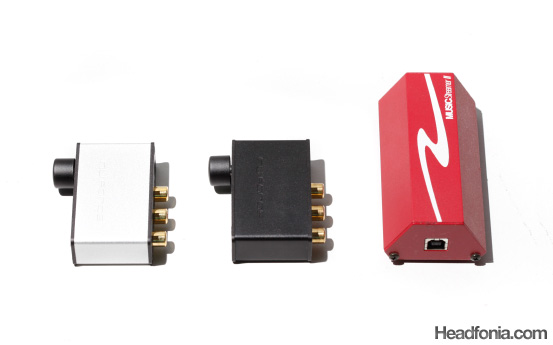
From left to right: uDAC 2, uDAC, HRT MS2
The original uDAC was priced at $99, and we all wish that the uDAC 2 has the same pricetag as the original. It’s funny that psychology affects our judgment a big deal here, as suddenly $130 seems a steep price to pay for the uDAC 2. However, the improvements in the DAC section is very real, and given how much the uDAC brand name has grown, I think that $130 is ultimately still a fair price for such the upgrades in sound.
Overall, the uDAC 2 makes for a nice simplistic system alongside a netbook. But if you’re planning to build a decent headphone system with a separate headphone amplifier, I’d still recommend you to get something better like the HRT Music Streamer as it gives a more mature DAC sound than the uDACs.
System used for review:
System A: uDAC/uDAC 2/HRT MS2 > Hifimediy TK2050 Amp > Sennheiser HD650
System B: Macpro > uDAC/uDAC2 > JHAudio JH16Pro




Eswar Santhosh
Thanks for the review. I didn’t expect the review to be up so quickly 🙂
Looks like I can safely upgrade my uDAC-1 to uDAC-2. I like HRT MS2 compared to uDAC-1 and the Maverick D1, but MS2 requires an amp whereas I can carry uDAC along with the laptop for travel more easily.
On the pricing front, if someone wants to use the Headphone functionality alone, one can always go for the uDAC2-HP @ $99 🙂
Mike
Yep, it's quite an upgrade from the uDAC 1. The lower gain is nice for IEMs, but people who uses this for big headphones may find the new one less attractive.
Freeze2
Nice comparisons and very helpful review!
I am sure there are plenty of folks who would be interested in knowing how the uDac2 compares to the Audinst HUD-MX1 if you can comment.
Thanks
Mike
The Audinst HUD-MX1's DAC is a bit darker in tone, but overall it's still a better DAC than the uDAC 2.
🙂
Freeze2
What about the amp section between the two?
Mike
The MX1's amp has quite a bit more gain than the uDAC2, and roughly similar to the uDAC1. As for the character, I think they heavily take on the character of the DAC sections.
EclipseMike
Hello Mike, great review I would have to agree with you here on the uDAC 1 and 2 comparisons, I love the newly fetched detail and soundstage of the uDAC2, However the lower output has caused me to return the unit since I do not use iems. I'm actually upgrading my original uDAC to an Audio-GD NFB-12 placed my order and counting down the days till it arrives, I feel in general it will give me the detail and soundstage I am lacking of the original uDAC, but with more power.
My current headphones are: Grado SR225i, Audio Technica M50, Darth Beyer VXD3, and a pair of DT990 600 Ohms coming in shortly. 🙂
Mike
Interesting choice of cans. Especially that 600 Ohms DT990. 🙂
Erik Negakinu
I'm still wondering how the Udac-series compares to the Headstage DAC Cable. That little thing is just $70 and I read some very positive comments on it. Would love to read your opinion! Btw, I sold my Udac because I liked the line-out from my Sony X1050 better. The Udac sounds quite cold to my ears. Their sound reminded me of Cowon mp3 players.
I'm in the market for a decent desktop DAC around $500. I've been looking at the Audio-GD NFB11 and the Yulong D100. Still can't make up my mind. 🙂
Mike
The original uDAC was not a cold sounding DAC, but it definitely wasn't the most refined thing out there for $100 either. 😉 The uDAC 2 is quite a bit better, but I did make some brief comparison with the HRT MS2 to give a picture of where things stand.
So far my favorite desktop DAC for $300-$400 is the DacMagic and the HRT MS2+. I have no experience with the Yulong or Audio-Gd, other than the Compass. 🙂
genialus75
i got the uDAC 2 just over a month ago and im very pleased with its performance…
i usually pair it with my shure srh440 and my gateway laptop…
the DAC functionality offers excellent clarity and detail… but the amp section really needs some more muscle than it presently provides… good thing my shure isnt that demanding…
im looking forward to purchasing the audio technica ath m-50 and the nuforce icon hdp sometime next month… hopefully mr. mike you get to review the hdp in the coming days…
more power to you man…
Mike
Thanks! The M-50 should be an upgrade to your SRH440. 🙂
Kreisleriana
Hello Mike! Great review as always.
I was wondering if you had a chance to test NuForce HDP or NuForce Icon HD out. I’m greatly interested in purchasing either one of those two and I would wholeheartedly appreciate your insight regarding the aforementioned products.
Thank you!
Anonymous
Hi Kreisleriana,
Unfortunately I have no experience with NuForce products. They refused
to send us product samples.
Shyam
In my country, only uDAC-1 is available and that too at a price of US$65 and I doubt whether any other dac (with HP amp) could beat it at this price. I am very happy with it. I have listened to uDAC-2 but I don’t think that the upgrade is worth double the price.
Anonymous
If you’re happy with it, then that’s all that matters. 🙂
Kiwidave
Just to let you know, Nuforce have release an SE version of the uDac2. It now has asynchronous USB ability … plus there is an upgrade kit available for existing uDac2 users. This should mean that th uDac2 will come closer to matching the HRT series of dacs.
Mike
Not so sure about the uDAC 2 matching the HRT. The difference in the DAC performance was huge and I am not sure going asych would radically improve things. The DACport for instance is running on adaptive USB and its performance is on par with the similarly priced HRT MS2+.
Kiwidave
well, will find out, for 180 SGD — have ordered kit from local SNG Dealer. Given that it’s 7 months or so since I brought uDac2 it’s a more palatable option to buy kit than a new Dac – new Dac get’s noticed by the “wrong” person :-).
Anyway – did say come closer to matching — not expecting the same performance. 🙂
Kiwidave
I will try and take a a couple of photos of the two boards, since kit is a complete replacement, only old housing used.
Mike
Lol, alright I get it. 😉
Yangorang
What’s your opinion of NwAvGuy’s absolute thrashing of the Nuforce uDAC-2?
http://nwavguy.blogspot.com/2011/02/nuforce-udac-2-drama.html
Mike
I am not a big fan of the uDAC one or two myself, but I think that NwAvGuy listens to his graphs more than his ears.