




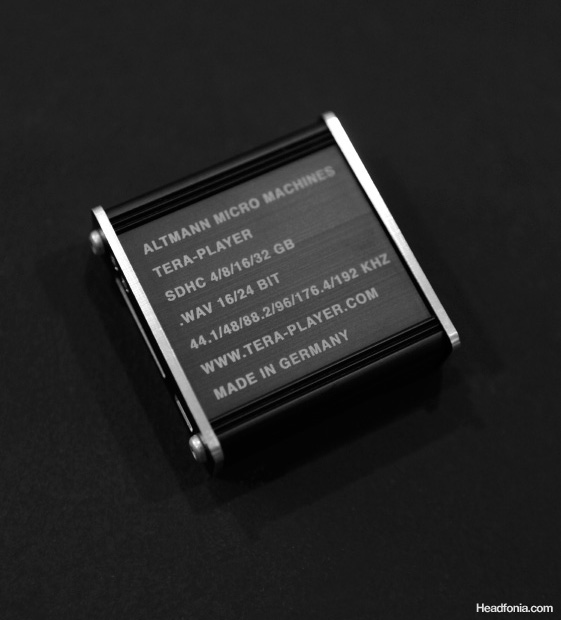
Have you heard about the €840 portable audio player that started going viral around the web late last year? It’s a really expensive player (the introductory price was €550) and everybody was questioning if the player is really worth its price. I’ve read through Charles’ blog entry on the development of the Tera-Player, and I got the impression that this guy is a true genius with deep understanding of both the hardware and software aspect of what it takes to make a good audio player. I also discovered that Charles also has many equally impressive projects that include the €950 Attraction DAC and the €950 BYOB Amplifier.
But just because someone has a deep understanding of the programming or the technology behind digital to analog conversion, doesn’t mean that he can make a good sounding player, so I have reserved any comments until I can actually listen to the player.
At this point, I have had the Tera Player in my possession for two months now (Disclaimer: it was a loaner sample, I don’t have the money to buy a €840 DAP), and I have been very impressed with the performance of the Tera-Player, even in comparison to the other high quality sources like the Hifiman HM-801, the Cypher Labs AlgoRhythm Solo, and the Fostex HP-P1. Now, I’m working on a formal review o the Tera-Player, but there were some questions that I had about the design of the Tera-Player that prompts me to ask some questions to Charles, and he was kind enough to take the time to reply to every one of my questions. Here is the full length of the interview, straight from my email program.
The black text is me, the blue is Charles’.
After using the Tera-Player for two months now it’s officially my favorite
portable player and the one that I use the most. The sound is superb, and I
enjoy the simple screen-less UI, the fast response time, the tough build
quality, making it a very ideal high quality player to use day in and day
out.
I am very happy that you like it 🙂
I’m getting ready to write the review for the Tera-Player, but I have a few
questions and I hope you can answer it for me:
1. I understand the first blog entry you posted on the Tera-Player is dated
as early as 2008. So development time is roughly three years now? What’s the
hardest part of this development period?
It took me almost 4 years to finish the Tera-Player. I was not at all content
with the sound quality of any DAP I had tried, in fact some of them gave me a
good headache.
I was also tired of mp3. I wanted high-resolution audio with superior sound
quality in a portable player, so I decided at a very early stage to use the
wav format, as it is the oldest and most simple file format for audio. There
is neither reduction nor compression taking place in the wave format, it just
the orginal samples of the recording written down.
The hard parts of creating the Tera-Player are obviously the software and the
higher level of sound quality. I also had problems with the first generation
of ARM7 processors (which were used in the early prototypes), but when the
ARM Cortex came out, I realized that I could achieve 24/192 playback speed in
such a tiny device, which seemingly nobody else has managed at this time of
writing.
But sheer playback speed is nothing if you cannot transport the sound
quality. That was the biggest effort and to really get it right took a very
long time. While the first prototypes from 2008 already sounded superior to
anything else on the market, and friends who took a listen were blown away, I
was still not entirely satisfied and decided instead of going to maket
earliest – and then adding mkII, mkIII … mkwhatever version later on – to
take the long way home instead.
I just kept continuing the perfection of the sound quality more and more
until I was really really satisfied and came to something like a
technological end, considering given means and target.
2. Why the decision to use a NOS Philips D/A chip? I understand that you
used the Burr Brown 8552 DAC on the development stage, so I assume the NOS
Philips is better? Would you tell us which Philips chip is used here?
I started building DACs back in 1997, and have built many experimental
prototypes and a couple professional DACs since then. I have learned that
there are basically two different kinds of DACs made: R2R and sigma-delta,
and I like the sound of R2R DACs better, because they sound more real and
less artificial to me.
So the decision to use an R2R DAC for the Tera-Player was made right from the
start. The problem is, that R2R audio DACs suitable for a portable device
(i.e. small, low power consumption) are not made anymore (which is a shame).
So I looked at industrial R2R DACs and found the DAC8552 worth to give it a
try. It sounded very good, so I played with it for a while, but finally it
was not good enough.
(note: you can read more of Charles’ writing on R2R and Sigma Delta DACs HERE)
I use the PCM1704 since 1998 in the Altmann Superlative DAC and the TDA1543
since 2004 in the Altmann Attraction DAC, but both are not suited for a small
portable player with long playtime.
So I found another Philips DAC, with improved SNR and THD over the TDA1543,
smaller package and lower power consumption. This sounded very good from the
start, but I still have spent another year on the final implementation for
perfecting the sound quality to its full potential.
Continue to the next page…




Erik Wijnands
This is just MY opinion 🙂 but I’d rather have 85% (and I’m being generous here) SQ in an ergonomically advanced package with full file support, media and playlists than 100% SQ in a screenless, UI-less, mp3/FLAC/Ape/OGG-less, functionality-less, spartan DIY DAP. It’s a portable device for crying out loud! If I want hifi I’ll go sit in front of my desktop rig. In a portable environment the external sound pollution will be so high you won’t even notice the difference between this and a Clip+. Try some critical listening when you’re in the metro surrounded by schoolkids.
A modern DAP is meant to entertain me on the go, providing me with a soundtrack to my outdoor activities. My focus will be on that activity, not on those last 15% of SQ. And I mean, who uses WAV these days? WAV is for grandpas. :p Kidding ofcourse, but it’s highly unpractical when FLAC will do just fine. I think the target demographic for Charles is very small. This ofcourse is perfectly fine, Charles seems like an intelligent dude who isn’t really looking to sell this to thousands of people. I see this product more as proof of concept than anything else. A DAP without compromise. I just wish he made it slightly more accessible. SLIGHTLY would be enough. 🙂 All the best!
Mike
Thanks for the feedback, Erik.
I think the points are valid, and on the formal review I will also talk about those points you mentioned.
Iyan
Very nicely written and make me curious of how it would sound like. Sometime I wonder how wide its quality gap compared to popular MP3 player, such as iDevice.
Mike
Thanks. I’ll make sure to answer that question on the formal review.
Don Vittorio Sierra
If convenience of being able to play all formats is sacrificed and the DAP is for pure sound quality alone… Whats the point if it can’t drive any good headphones. No matter how good the sound is on something, it is useless if it can only be hooked up to a very small selection of ultra sensitive IEMS and cans. I mean if you connect an amp to this, the sound will be compromised so the only way to listen to them is straight via the headphone jack and with headphones like etymotics or something like that.
Don Vittorio Sierra
I think if this was a serious DAP and had no way of getting good power output, It could at least have a line out that should be comparable in sound quality to REGA or MERIDIAN CD players for example 🙂
Andrew Smith
I was lucky enough to purchase Tera-Player (TP) number two from Charles at the introductory price and consider it a sonic bargain. For it’s size the sound quality is astonishingly good and comparable to my HP-P1, CLAS & Rx MkII and HM601. Whilst the TP is undeniably quirky, it’s a truly world class DAP with non fatiguing sound, solid construction and true 24/192 playback.
Mike
I agree with you. I think it’s world-class.
Brian Cretty
Not sure why anyone would spend this much on a WAV player when you can get a QLS QA-550 for $135.
Mike
That’s like asking “why would anyone need a player if my laptop can play WAV just fine”.
DEFAUT Quentin
hi mike,
any chance that you’ll get your hand on both the “€950 Attraction DAC and the €950 BYOB Amplifier.”
looking forward for it.
respectfully.
Q
Mike
I haven’t thought about it, but yeah maybe I’ll ask Charles. 🙂
DEFAUT Quentin
great! looking forward to it 😉
Andrew Smith
Mike, it would be extremely interesting if you did review the Attraction DAC and BYOB Amplifier, as both use 12V DC power, have no casework whatsoever and the components are mounted on a wooden plinth. There was I thinking that the Tera-Player was quirky! 😉
Mike
2nd request, noted. 😉
They are interesting indeed.
Austin Morrow
Just thought I’d give my input here on what I think of the whole price to performance ratio. Now, I haven’t yet heard this tiny little player, but I can already make a few observations. Let’s say I were to get this player and it did have world class sound that sounded good with even the most demanding and high end headphones like the HD800 or the Audez’e LCD-3, I still don’t think that the features (and the $1115 price tag) of the Terra Player will be up to par even if the sound quality is excellent. Take for example, I can totally see someone (In this case, typical audiophile A) jumping for joy if they A) needed a small, simple player that provides excellent sound quality and B) drives even the most demanding high end headphones. If I were that person, I would have the biggest grin on my face right now just due to the small package and the extraordinary sound quality with the high sampling rate.
However, let’s say typical audiophile B sees this player (AKA me). He’s blown away by the world class sound quality that lives up to the high price point, so there is no problem there. However, what person B is not blown away by is the lack of features and the limited functionality of the player. No screen for navigation (an audio junkie loves to sort through and play through his songs, not just go by a random shuffle), and only WAV support (I know a lot of people who love to use WAV, while the vast majority of the others use mostly FLAC, and sometimes ALAC). I guess I’ll just have to wait and see…
Looking forward to the review! 🙂
Mike
Valid thoughts. It’s not going to be a popular player.
carlo
The passion of Charles to create a great sounding portable DAP is commendable but the price is depressing.
I hope you can also do review/comparison with the iBasso DX1000. Thanks.
Mike
We’re not going to do a DX1000 review because they are asking us to pay $700 to do a review.
Anonymous
I think they’re selling it for $700 for those who wanted to review it. But still, you get it for $129 less and it’s yours already. Retail price soon is $829. I’m also hoping that headfonia could make a review of it.
Mike
Yes I understand and we’ve always been fans of Ibasso products before, but asking $700 for reviewers to do a review is something that I can’t accept.
Anonymous
Oh I forgot that you review products when companies give a free sample for it. Forgot that thing, really. Now I understand.
Mike
Carlos,
I paid money to buy two Ibasso products to do a review on the Ibasso PB-1 and PB-2 amps.
Now I don’t make that much and you can’t expect me to buy every new product releases out there do you? Umm let’s seeLCD-3 $2KHD700 $1KShure SRH1840-1440 $1.5KUtrasone Ed10 $2KWooWA5 $4KSAC Thailand amp $3KRSA DarkStar $3.5K
Anonymous
don’t you always sell some of those stuffs in your local forum??
Boun Ly
You Carlos, are an idiot. I, among a lot of other people, appreciate the work of Mike and Lievin. No one makes them spend their time writing reviews or purchasing equipment. They do it for the love of audio and for the community who make it worthwhile! Go read another review site if you don’t like it.
Mike, Lieven, ignore this guy, he doesn’t know what he is talking about. Keep up the good work fellas!
Mike
Thanks, Boun.
Rudolfs Verdins
I have mine for 5 days now.
As for the interface, I can do most things I’m used to, and everything I really need. The size is just perfect, too.
More important is that it DOES sound good.
As for comparison, I cannot meaningfully compare it to anything ‘in the same class’, as a) this is my first (and most probably the only) player at such a price point and b) there is nothing that promises this performance with a matching size.
To summarize – I am content.
It was not cheap, but it sounds so good that I have no urge to look any further.
Mike
Thanks for sharing, Rudolfs.
I love the Tera. Perfect size, superb sound. I just wish that the edges are a little less sharp but Charles defended the design saying it’s for opening beer bottles. 😉
Vince Huynh
“During all this time, I have had many instances where
an highly regarded audio device or an implementation of one of my own devices
sounded very good and superior at the start, but after an extended listening
time (hours, days or weeks), irritations or distortions became noticeable.”
Yes, how many times have we experienced this as audiophiles? The human brain may get confused with quick A and B testing, but long term, we always know which product we’d rather keep.
Mike
This is one of the reason it’s hard to implement a proper blind test. When given a short 5 minutes window to pick up all the nuances of an audio system, the brain tries extra hard to pick up all the details but often you only get the big picture in long term listening.