





Disclaimer: Loaner sample from a friend/owner of the amp.
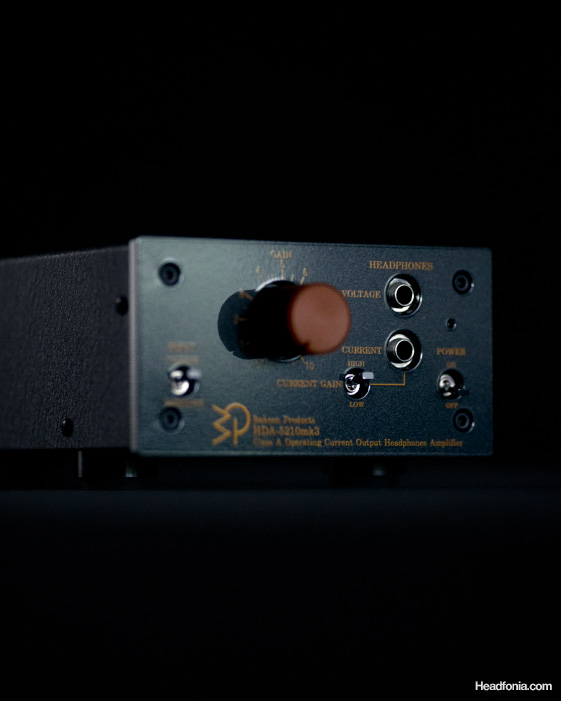
Bakoon of Japan came up with this very interesting take at a headphone amplifier. First of all, why the difficult name? To show that only die-hard Bakoon fans and owners can refer to it as the Bakoon HDA-5210mk3. Other people would be excused to refer to it simply as the Bakoon headphone amplifier.
The pricing of $2,120 clearly shows the playing level that its creator intended it to be at. The two different outputs labeled “Current” and “Voltage” indicates that it may have something unique hidden inside the enclosure. Availability seems to be limited as this Bakoon, different from the south Korean made Bakoon amps, is hand built in Japan. And questions such as “Where can I buy one” is one that I can’t help to answer either. A friend of mine happens to be buddies with some Audio distributor in Australia and that is how he got the amplifier, which I then got the privilege of keeping for some weeks to listen and evaluate.
Impressions
Though no amplifier can be labeled as perfect, the Bakoon is quite a brilliant amp. At this price range, all amps sound vastly spacious so that alone is not going to impress me at this price range. However, hooking up the Bakoon to the Fostex HP-A8’s analog out, the drop in resolution compared to the Fostex’s internal headphone amp is the least I’ve heard so far. As you know, any DAC’s internal amp, though may be weak in power, enjoys the benefit of the shortest signal path from the DAC circuitry. Any external amp requires a longer signal path and there is bound to be drops in resolution. Compared to the Burson Soloist/Conductor/Soloist SL or the RSA Dark Star, all solid state amplifiers, the Bakoon has the least noticeable drop in signal quality, and that shows that there are some serious thing going on inside of that misterious looking Bakoon.
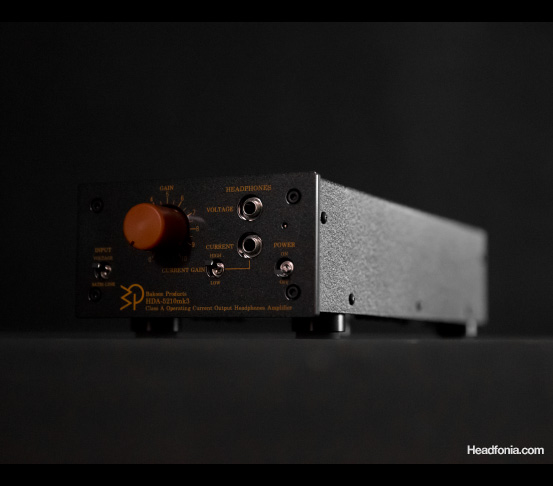
Talking of the looks, the build quality actually gives a strong impression that the builder is someone who is so confident of the sound quality of his amplifier, he doesn’t really care to make a positive impression on the outside. The build is very solid and has no traces of cheapness, but it does look pretty quirky. The sort of quirky look that oozes from a typical genius designer with his/her own quirky habits and aesthetics taste. In a nutshell, it is no eye candy, but I would never mistake it for a cheap amplifier.
Back to sound impressions. The Fostex’s built in amp may still be the most resolving channel if you want to hear everything the HP-A8 DAC outputs, but when it comes to musical enjoyment, the Bakoon trounces it by quite a big margin. Well it’s an integrated amp from a $2,000 DAC/Amp compared to a $2,000 stand alone amp. Different league. Wide spacious soundstage on the Bakoon, stronger bass impact, better dynamics and dynamic range, better fundamentals, bass, midrange, I can go on and on. Even with Fostex’s own TH-900 and TH-600 headphones, I still go for the Bakoon (as a matter of fact, for some strange reason pairing the Fostex headphones to the HP-A8 was just an “it’s alright” moment for me, nothing impressive there). And given the minimal drop in resolution from Bakoon’s amp, I guess I can say “Bye bye, miserable Fostex HP-A8 headphone out”!
The amplifier is unlike most of Japanese amps I’ve listened to (I did think that it was going to be similar to the majority of Japanese amps I’ve listened to: mellow and slow). No, the Bakoon is quite fast, very dynamic, strong bass impact, and overall very lively. There is no mellowness, not even the slightest. The background is very dark, but the presence of grain in the sound masks the black background (usually amps with dark backgrounds are relatively free of grain). It’s quite analog sounding, despite the slight v-shaped tonality.
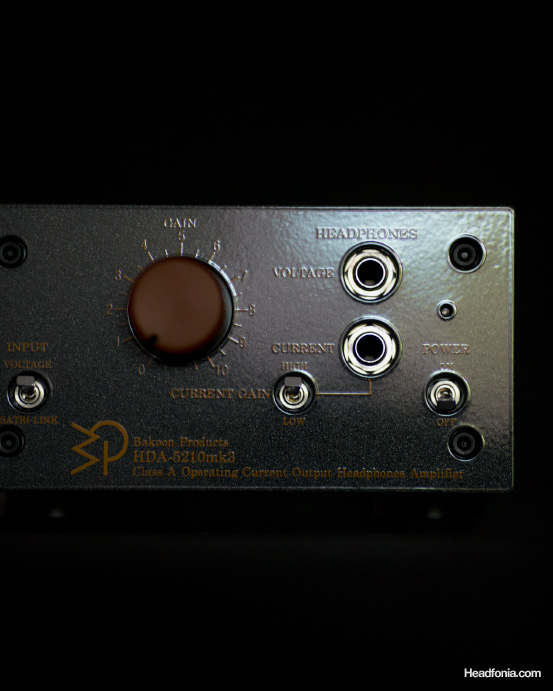
Between the Current and Voltage output options, I was mostly using the Current option as it gives a clearer and bigger sound than the voltage option. I wish there was some sort of a manual that explains what difference in schematics the two different ports are wired from, but I’ve been unsuccessful in trying to find that out. Between the low and high current gain level, this is not an amplifier for sensitive headphones and IEMs. Not because of the noise level, but the fact that the Bakoon leaks sound even at the minimum volume control level. I think it has something to do with the circuit design, rather than some fault in setting the gain level.
Comparisons
A review is worthless without a frame of reference, so here goes.
I did compare the Bakoon to the RSA Dark Star, a high end solid state headphone amp from Ray Samuels which have earned my praise so much, and the Burson Soloist SL which is the latest iteration of the Burson Soloist circuitry (slightly different sound than the original Soloist and Conductor, plus and minuses, more on that on the Soloist SL review). Every amp is different and clearly has different signatures and specialties. The Bakoon was noticeably the v-shaped one in this bunch, though not extremely so. The Dark Star the most linear. The Burson a slight bottom up tonality, and Bakoon’s own SCA-7511mk3 power amplifier (with a built in headphone out) the most heavily bottom up tonality.
All of these amps (I’m using the non SL Soloist for the HE-6) can drive the HE-6 well, but the winner goes to the Bakoon power amp as it drove the HE-6 most effortlessly, and with a beefy low end to help add some meat into the HE-6’s bass section. The Dark Star is the cleanest sounding amp of the bunch: clean not in a sense of sterile (oh no, it has a good body and musicality), but clean as in the most grainless, blackest background amp of the bunch. It’s also the most linear sounding.
The Burson Soloist is the most fun sounding of the bunch: bottom up tonality, but with a faster speed than Bakoon’s power amp. The narrowest soundstage of the four, but the best layering and three dimensionality. The Bakoon headphone amp has a great bass impact, super spacious soundstage and with a good depth (though layering was a bit flat), some grain in the sound, but the best resolution out of all the amps here. It makes quite a lively all rounder amp, and it is the one amp that makes me really go from “Gosh that TH-900 should be priced around $1,500” to “I wish I have $2,000 to spend on a Fostex TH-900”. It was the best amp for the Fostex TH-900, period.
End Words
It’s an extremely nice solid state headphone amp, but it didn’t really make me want to ask for an extra credit limit from the bank so I can go out and buy one. Personal preference, I guess. I’ve heard and seen pictures about the Korean Bakoon which would be priced higher, runs out of battery power, and is a mass-produced product. Maybe I’ll get to play around with one, one day.




Trent_D
Cool review. I thought the Soloist SL was basically the same thing, just smaller and without the preamp option. Looking forward to reading that review.
Mike
2 watts of power instead of 4 watts, and the use of a non stepped volume pot. Those two changes make the amp more relaxed than the original Soloist.
Review coming.
Song Kyung-han
I’m planning to audition the Korean Bakoon headphone amp with my TH900 once it becomes available. I’ll let you know what I think of it.
From my experience so far, however, the best amp for the TH900 was the Zana Deux SE, period. I know it’s counterintuitive, considering that TH900 has a low impedance of 25 ohms and should be paired with a decent solid-state amp in theory, but the exceptionally low 3-ohm output impedance of ZDSE (which is surprisingly OTL in design) makes it possible drive it without any audible distortions. I’ve auditioned the TH900 with tons of different headphone amps, including those in the $3K league and above, but nothing – and I mean nothing – drove the TH900 better than the ZDSE did. In fact, some owners of Balancing Act, are even considering ZDSE just for their TH900.
Although the TH900 is my most favorite dynamic headphone, it has two weaknesses: smaller soundstage compared to the best open-back headphones, and not being neutral, that is, its relatively rolled-off mids giving it a V-shaped tonality. I can’t really complain about the first issue, because it still has the widest soundstage I’ve heard from a closed-back headphone. The reason I said the ZDSE sounded best with the TH900 is because it solves the two issues completely, by throwing a massive soundstage and bringing the mids forward to make it more neutral, while sounding ever so clear and musical at the same time. The TH900 and ZDSE is a match made in heaven IMO.
What I don’t really get is that while you said that the Bakoon amp was the best amp for the TH900 in your experience, you also mentioned that the Bakoon amp had a V-shaped tonality. Intuitively thinking, one should try to avoid a V-shaped sounding amp for the TH900 because the TH900 is already V-shaped. Didn’t the TH900 sound more colored when driven by the Bakoon amp? Or did you find the Bakoon amp so enjoyable overall that you could tolerate more laid-back mids?
I think it was a good idea to drive the amp in Current output mode. Low impedance headphones such as the TH900 are driven mainly by current, whereas voltage plays a greater role when it comes to high impedance headphones like Beyers or Senns. My guess is that’s what the current and voltage output modes represent. You may have better results with Voltage output mode when driving the HD800 or T1.
Mike
I am not surprised that the Zana SE drives the Fostex beautifully. I already have a feeling that based on my experience owning it that the amp would pair well with the Fostex, only I don’t have one around to try it with. The issue here is not the low impedance, rather the Fostex being a very easy headphone to drive that doesn’t require a lot of currents. It does, however, require high quality amplification and the Zana is precisely that.
The Bakoon amp is mildly v-shaped yes, and likewise the Fostex, but in practice audio is not like math, and pairing the two I enjoy it immensely for many different types of music. Without the Bakoon I probably would not consider owning the Fostex.
Still if I have a Zana around, it probably would be an even better pairing.
Mike
I don’t have the HD800 or T1 around anymore, but with the HD650 I still feel the voltage out to sound more constrained than the current out. There is noticeably less grain on the voltage out, which results in a cleaner sound (not clearer/more resolution), but soundstage and dynamics are less free flowing on the voltage out.
So far, it’s always current out for me.
ryan
You sold your hd800?
John123John
first your HD25-1ii and now your HD800?! What headphones DO you still have? :0
funny, I don’t think ill ever be getting rid of my HD650s either… and I just got through auditioning the HE-500s
STARSTERN
Song Kyung-han
am already excited to hear your results at your comparison listening side by side ,with the Zana Deux SE and Korean Bakoon headphone amp ,I would wish if you as well gave a try the alo studio six ,my sound signature ,I love warmness and joy ,but hate to compromise on detail
Ben Brown
A question since it’s a bit hard to tell from pictures: is the volume knob plastic or just some kind of coated metal? I’m not a stickler for aesthetics but certainly a product this expensive without the ergonomics and weight of a metal knob would be very offputting.
Regardless of material, it’s an… interesting …choice of colour.
Mike
The outer surface has some sort of a rubberized texture. It feels very classy and not in any way cheap looking.
Calvin Purnomo
Ah I think I did try this bad boy at local headphone store. I was going to try for a balanced T1, the storekeeper hooked it to this amp. The result: crazy staging & transparent sound. It’s like the wall was expanded. I did hear T1 hooked to Slee Solo, this one is another sh*t.
ryan
You like T1 with Slee Solo?
Calvin Purnomo
Sounds okay to me. Love the warm lush sound of Slee Solo.. Gives compensation to the detailed sound from T1.
Although my friend says that T1 needs more powerful amps such as Burson in order to get the potential out. Dunno. Trust my ear. Hahahaha.
Minh Duc Nguyen
hey Mike. would you say that Fostex HP-A8 DAC section is in the so called “benchmark” range for its price? I will be getting one and use it as my main DAC.
Mike
Yes, definitely a benchmark.
Minh Duc Nguyen
Thanks a lot Mike
Burge
Hi there – does anyone know how the original HDA-5210 Amp stacks up against this one? The company seems quite an enigma… hard to find much info thoughts about these ..
Mike
Sorry I can’t help you with that. Yes it’s really hard to find information on their amps
Gothika Genta
I also discovered and tried this particular amp 2 months ago at Jaben. Coincidentally, I had brought my HE-500 because I wanted to audition some powerful amps to drive my HE-500. I then noticed the Bakoon and can’t help but marvel at its presence. I agree it’s not pretty aesthetically but the sheer build quality and high quality materials makes it very appealing indeed.
I immediately auditioned it with my HE-500 and it was my first time hearing my 500 being properly driven (at that time I didn’t have a proper powerful amp for my 500, now I have a Lyr).
I was extremely surprised on the power this amp could deliver (volume knob at 2.5 was sufficiently loud). It also spreads the 500’s wings fully open and it sounded like it was a completely different headphone. My impressions on this amp is in line with yours, it makes music sound exciting and engaging.
I also appreciate the obscureness of this amplifier which makes me even more interested on it. I searched and searched and found absolutely nothing. Zero, nada, zilch. Even on Bakoon’s Japanese website this amp doesn’t exist which makes me wonder, how the hell did the distributor got a hold of this amp?
Anyway my point is that this amp was the driving force behind my purchase of a Schiit Lyr.
Mike
Thanks for sharing, Genta.
Tony S
Just a couple of things to note Mike. War Audio in Perth are the distributors for Bakoon Japan while Audio Addiction in Brisbane are the distributors for Bakoon Korea. For people out of Japan, Australia and New Zealand you can purchase direct from Bakoon Japan.
The volume control knob is a piece of machined Bakelite.
The current drive on the output is exactly that. The input voltage causes the amplifier to deliver a proportional output current to the driver of your headphones. Current amplification can only work on speakers or drivers of high sensitivity. Headphones fit this criteria. What you are achieving is no longer requiring a conversion to voltage output. It is a pure current delivery to the driver hence why people prefer the current drive. Also if you were to use a Bakoon DAC with the current output to the headphone amp you would completely get away from voltage conversion altogether and get an even greater resolution and lack of distortion.
Mike
Thank you for the thorough post, Tony. I assume you know the guys at Audio Addiction and War Audio?
ryan
Hey Mike, is this good for hd800 and LCD3?
Mike
Yes for the Senn. Haven’t tried it with the lcd3, but it didn’t work with the lcd2 so I assume it’ll be a similar case with the 3.
ryan
What do u mean by didn’t work? Didn’t sound good?
Mike
Yep, no synergy
John123John
I listened to the Bakoon last weekend!
alot smaller than I thought.
Mike
How did you like it?
John123John
lol who voted you down?
To be honest, I couldnt really tell sonically mainly because it was my first time listening to the LCD-3, HD800 and the HE-6. Second time with HE-500 but no THX00 though 🙁
The TOTL Headphones sounded AMAZING! Wow, totally blew my mind. Each one did something so amazing and to my ears so different from another.
I have to say though I was most impressed with either the HD800 or the HE-6. The HE-6 is kind of ruled out due to its difficulties (Sounded great off the EF-6 which was gigantic) but these two definitely, to me, stood out as amazing and of a different class. The vastness of soundstage, the level of tiny tiny detail. Amazing.
Dont get me wrong, the LCD-3 sounded very nice but just that; it sounded like very very nice headphones while the other two sounded like speakers. Crazy.
John123John
Got to listen off of the ALO Studio Six, Burson Soloist, Cavalli Audio Liquid Gold. So nutz.
so this is what its like to be a reviewer…:)
STARSTERN
john123john;
would you share with me your compare experience ?
the cavalli with the alo six
L.
He was joking!
STARSTERN
mike is tied up in the store ;its time to hire additional wine tasters ) amp reviewers
L.
We have Shigzeo now who is replacing Mike 😉
STARSTERN
http://www.head-fi.org/u/41964/shigzeo ?
L.
yes. http://ohm-image.net/
ohm image
That one, too.
L.
I do prefer the Ohm Image guy though 😉
ohm image
Indeed, shiggy lacks synergy.
ohm image
That’s the dude.
Mike
Looks like you had a great time, John. 🙂 where was this?
John123John
Dude, I had a great time actually. My first “Meet”. It was The Home Entertainment Show in Newport, CA.
Tyll was there!! so was Mike Goodman (CEntrance), Ken Ball (ALO), audeze, all the schiits guys, etc
It was pretty amazing. Mostly a HIFI Stereo show. Heard some amazing speakers (astronomical prices) but also heard some meh speakers (still astronomical prices). The differences between even the high end speakers and high end headphones were very different.
headphones truly the best bang for buck although its audience is only for one.
Mike
All the celebrities are there!
John123John
also just realized that what I listened to was the Bakoon HPA-21 not the model that you reviewed.. oops.
L.
The Bakoon Mike is talking about in the last paragraph (the one that can be charged) is on its way to me. I already listened to if half an hour at Canjam and was very impressed with the LCD_2
Ian
What DAC were you using with the 5210mk3 when you were amazed at how good the TH900s could sound? I have an HP-A8 and I’m curious if its a good match.
Ian
I recently purchased one of these and the seller mentioned that there were two versions.
Here’s what the seller told mentioned:
HDA-5210mk3: SATRI-IC-EX version Price range
“Variable Resistance(Standard) 1,100
Metal Film Resistance ATT 1,340
Winging Resistance ATT(Non induction) 1,595
SATRI-EX is equipped 48 transistors by miniaturization of parts, therefore it achieves super precision amplification. Good for Jazz, Rock, Pops..
Distortion factor is 0.05%
HDA-5210mk3: SATRI-IC-UL version Price range
Variable Resistance(Standard) 1,290
Metal Film Resistance ATT 1,535
Winging Resistance ATT(Non induction) 1,790
SATRI-UL is equipped 72 transistors by miniaturization of parts, therefore it achieves ultimate precision amplification. Good for Classic.
Distortion factor is 0.007%
The difference of each type is volume (attenuator) grade which is directly affect its sound quality.”
Which one were you reviewing here?
STARSTERN
5210mk3 bakoon or headtrip or gsx-mk2 when it comes to strictly music enjoyment ,these were praised as tops ,now just left one to share his experience in having compared them line by line “