




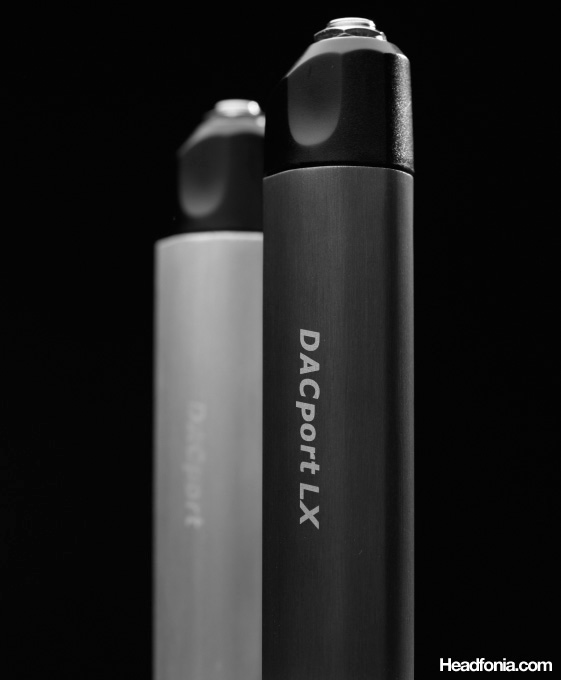
Despite the superb little system-in-a-stick that the original DACport is, some people don’t want simplicity as they happen to like big messy desktop amplifiers with garden hose power cords. So, why not offer the same product sans the amplifier? This is exactly what the Centrance Dacport LX is all about. A DACport minus the integrated amplifier inside. Now that the amplifier is gone (and so is the small potentiometer inside), certainly there would be more hifi to be heard from the DAC section. And indeed it is. The DACport LX is priced at $50 lower than the original version, and as you will see in a bit, I would go on and on how the LX sounds better than the original! I wish more manufacturers would follow suit. Cheaper products that sound better is just what our wallets want.
COMPARISONS
Loosing the amplifier section has improved the sound considerably, putting it ahead of the Fostex HP-A3 (the original DACport is less transparent than the Fostex) and roughly on par with the HRT Music Streamer II+. The Fostex HP-A3 and the DACport LX shares a very similar sound character, both very smooth and clean sounding, deep soundstage and roughly the same detail extraction level. The Fostex HP-A3 is leaner on the bass and is less punchy, and is also inferior in terms of instrument separation and instrument body.
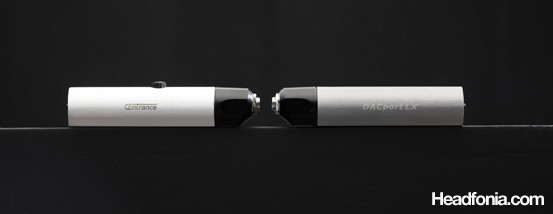
Identical dimension and casing, only without the volume knob.
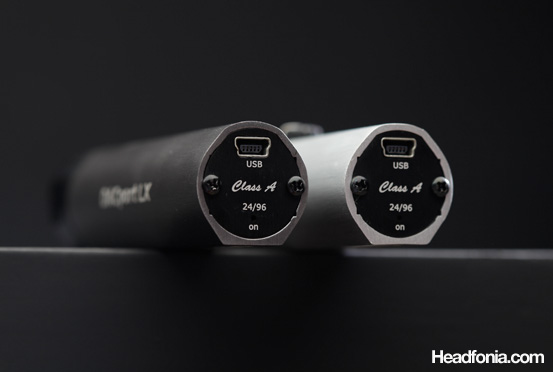
Both runs from USB power, at Class A, and is capable of handling 24/96 files.
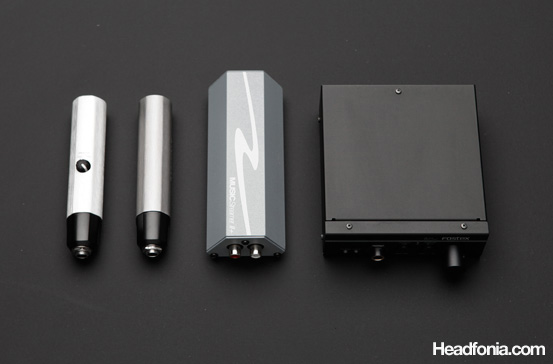
Left to right: DACport, DACport LX, HRT MS2+, Fostex HP-A3.
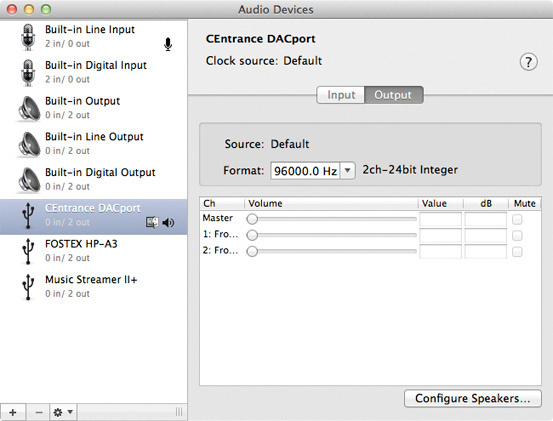
24/96 setting through Apple’s Midi Dialog. Apple Users: Applications > Utilities > Audio MIDI Setup.
Compared to my favorite $300 USB DAC, the HRT Music Streamer II+, the DACport LX has a slightly different sound signature: the LX is cleaner sounding, blacker background, and separation of instruments being clearer, while the HRT has a more enveloping analog sound, two inches wider but less deep on the soundstage, though being 10% more grainy sounding. The HRT Music Streamer II+ is warmer and like ten percent darker, with more bass body, though less detail on the bass. The DACport LX lets an ounce more top treble out, resulting in an airier yet a tad more sibilant sound, and an extra bit of micro details extraction. Indeed a very close fight there, but put it simply, the HRT gives you a warmer and more analog sound, while the DACport a cleaner and clearer sound. Still confused on which is better? Well, the DACport is better looking.
RUNNING AMPLESS
So you no longer get the convenience of being able to plug headphones and IEMs straight into the DACport LX the way you do with the original DACport. But testing the unit reveals that things still sound good, even as I try plugging anything from a Hifiman RE-272 IEM to an Audez’e LCD-2 headphone (Yes! the big Orthodynamic!) to the LX’s output socket. Volume control is done on the digital domain via iTunes. No breaking up of sound, no distortions, no frequency rolls off, only a noticeably weaker bass punch compared to the DACport’s output jack since we’re running the headphone straight from the DAC’s analog stage. This is what Michael Goodman says about it:
“The output stage is buffered, but you may be maxing out the buffer that way. We recommend that LX is followed by amp with a higher input impedance. But it won’t get damaged the way you are using it, so it’s ok.”
I’m not suggesting that you run on that configuration, but you can get away with it as long as you can bear that bass punch is not as punchy as it’s supposed to be (though bass levels are not an issue with the LCD-2).
The point is that taking off the amplifier section has given the DACport a fresh boost in sound quality, and now you don’t have to feel bad for having that unwanted amplifier being stuck on your audio chain and fearing that you’re not getting every last bit of the sound quality you deserve from the DACport. The sound signature is actually very nice, deep and spacious with less of a focus in miss as in the original DACport, and also less dry than the DACmini. You can pair it with say a desktop amp like the Schiit Asgard, or even a portable amp like the JDSLabs Cmoy and you’re good to go.
OTHER DETAILS
On heat issues, the DACport LX still runs very hot like the original. I didn’t measure the temperatures, but I’m pretty sure that the LX, for practical purposes, runs just as hot as the original DACport. That’s significantly hotter than the HRT Music Streamer II+ or the Fostex HP-A3. But hey, it’s a desktop USB DAC and nobody is going to be carrying it around and so I really wouldn’t make too big of an issue of the heat, as long as it sounds good (which it is).
The choice of 1/4″ TRS jack for the output of the LX is objectionable, and it’s understandable why. I need to make my own 1/4″ to RCA interconnect cable to hook up the LX to a typical desktop amp. Hooking up the LX to a portable is less messy though, since portable amp more often uses 1/8″ TRS input jacks, and so all you need is a mini-to-mini (which you probably already have) and a 1/8″ to 1/4″ converter on top of that. Bottom line is that the 1/4″ TRS jack was not the best choice for this otherwise superb DAC, but it’s understandable given the need to preserve the same housing design. Now the good news is that CEntrance is already working into this and newer shipments of the LX should include a high quality 1/4″ to RCA interconnect cable, so you should have no issues when you decide to order one for yourself.
END WORDS
The DACport LX is such a great product all around and is really strong on becoming my favorite $300 DAC. Even considering to add it to the Recommendations page.
GEARS USED FOR REVIEW
Sennheiser HD800, Audez’e LCD-2, Apex Peak, Hifiman RE-272, Superlux HD661, ALO Continental, HRT Music Streamer II+, CEntrance DACport, Fostex HP-A3.




Zenmidy
Wow, you already have Superlux 661, how does it sound? Will you review it?
Anonymous
Yes I will review it. 🙂
Themiddlesky
knowing that Centrance will make their own converter 1/4″ to RCA is indeed a good news 🙂
Anonymous
Indeed. I’m quite curious to see how the cable looks.
OnTheEdgeAustin
This looks perfect for me. Hopefully the resolution is really good. Hmm, I may pick this up sometime in the future if I don’t try the Bitfrost, which I am still holding out for. I’d love two Schiits at my desk with a pair of LCD-2’s. 🙂
Anonymous
It is very nice, Austin. Though the Bitfrost looks very nice as well. 🙂
Anaxilus
Spot on Mike. I’m a big fan of the LX as well. Highly recommended. I had both the DACPorts for a bit and the LX is the way to go unless you need to keep things simple.
Anonymous
Nice Anaxilus. So you sold the original DACport?
P. J.
I will read the review tomorrow Mike as I’m too tired from work but I have to say those photographs are top notch!
Anonymous
Thanks, P.J!
Corben
OK, “putting it ahead of HP-A3 and roughly on par with HRT Music Streamer II+”.
Mike, so for sure it’s better than the HP-A3, my question is, the HRT Music Streamer II+, is better than the HP-A3 as well?
Roughly on par, so is it down to sound preferences, when compared to the HRT MSII+?
thanks
Anonymous
Yes the Music Streamer II+ is better than the HP-A3.
Corben
So ranking it is like this then
1. HRT MSII +/ DAC Port LX
2. Hp-A3
3. DacPort
Am i right? or the dac port LX is below MSII + and above the Hp-a3?
Anonymous
Yes that’s how I would rank things.
No DACport is not below MS2+
P. J.
Mike thanks for this very transparent review!
How would you say it compares to HM-602/601 as both have a line out like the LX? I assume HMs are warmer and have less treble than the LX?
Anonymous
Yes, the HM601/2 are warmer, less treble and less spacious as well.
kevin luo
thank you for the nice review…wondering how bifrost stacks up to these two.. but dacport and MSII+ seem to have better specs.
kevin luo
Btw, Mike, are you sure that future dacport lx will incude the 1/4 to RCA cable?
Anonymous
Yes should be pretty sure.
Heard it myself from CEntrance / Michael Goodman.
Anonymous
Yea we’ll have to see about that. It’s impressive how these small, USB-powered stuff manage to throw such a big sound though.
Jonathan
Here is the info on the CEntrance website:
http://centrance.com/products/reserveseries/
Guest
thanks for link.. wow that costs more than expected
Anonymous
Yea, I am asking CEntrance if that’ll raise the price of the LX if they are shipped with that cable.
Guest
jay listens on headfi told me that centrance would be offering dacport and the new cable as a bundle with a discount
Anonymous
Yes, that is what I heard from Centrance too.
Guest
Haha.. Centrance lowered the price of a regular dacport lx to 299 and are selling the dacport lx with the new cable for the original price of 349. Man i love these guys
Anonymous
That’s a very good news, thanks for sharing.
Anonymous
Thanks, Jonathan.
That looks like a really nice cable.
Simon Guilmain
Hey Mike. How far is the Dacport LX from the DACmini? and can you please provide more detail on the improvement from regular dacport?
Thanks
Guest
I’m interested in this as well. But on other note, Centrance reduced price of dacport lx to 299! and furthermore, they made a bundle of dacport lx with new cable for the original 349 price! Awesome!
Anonymous
Hi Simon,
I no longer have the DACmini around, so I am just writing from the basis of memory. What stands out is that the DACmini still has a blacker background and overall a more linear, cleaner, slightly brighter sound than the DACport LX is.
I think the difference between the DAC performance of both units is fairly slim then, based on my comparisons of the DACmini > DACport, then DACport LX > DACport.
What I’m saying is, both the DACport LX and the DACmini have quite a big gap in performance from the DACport, and so the DACport LX shouldn’t be that far off from the DACmini.
Simon Guilmain
I own both the Dacport and Dacmini and like them both for their purpose. Please don’t tell me I have to get the LX too!!!
Anonymous
LOL you shouldn’t have asked for a comparison in the first place. 😉
eugenius
Yeah Mike they cut the headamp out and the thing lost half of it’s appeal for a small increase in SQ – and it’s small, admit it. 🙂 The DACport is so special because it’s so damn small and it’s ALL YOU NEED for the laptop.
If they were serious about improving it, they could have added a bypass button for the headamp, and it would be the best of both versions. My guess that damn small potentiometer is so glitchy they decided to dump it and make a version without it. 🙂
Anonymous
No, it’s not a small increase.. admit it you’re in denial 😉
Yes the DACport is special because all you need is a laptop.. but all these time people also want a simple USB plug-n-play DAC and all I can recommend them is the HRT MS2+. Now it’s better because people have a choice.
eugenius
I don’t need a lx anyway, so I won’t admit anything. 🙂
Trick question: what’s the difference between a HF2 and a PS500?
Anonymous
Hey, when did this article become a Grado HF2 thread? 😉 And how am I supposed to know the difference between the HF2 and the PS500? 🙂 They look like mass-produced HF2s though.
Guest
hi Mike, I would like to purchase the dacport LX but without the cable, where should I start to get a cable just so I can connect it with my IEM re-0 without the RCA ? just a TRS to TRS with a phono -> 3.5mm converter should work ?
Anonymous
What? Sorry I don’t understand the question.
Dacport > RE-0? Why would you need an RCA? You can just plug in the IEM directly with a 1/8″ to 1/4″ converter.
Guest
Hi Mike, thanks for the fast reply. Good review on the site by the way.
Oh, I didn’t know I could do that . Sorry. So if I want to plug in any iem, low impedence headphone I could just use the 1/8″ to 1/4″ converter ? That is good to know. I guess all the TRS balanced and all that confused me. Thanks for clarifying.
Anonymous
Well actually it is advisable to use an amplifier, but in case you don’t want to, you can do that.
I wrote a paragraph on it on the review, please go over it and if you have any questions you can ask me again.
Guest
hi there, I have a stupid question, i already have a musiland 02 usb, and I mainly watch youtube videos. I have a few 320kbps mp3 as well. Do you think I would benefit from the 24/96 from the dacport/lx series when I don’t use the ASIO full-time only occasionally??
Your response would shed a light to a question I have been asking myself a long time about why I need to upgrade. Thanks again so much for sharing your insight.
Anonymous
The thing with YouTube (and I don’t know if you notice this) is that the quality of audio from one video to the next varies greatly. And in my experience watching all sorts of YouTube clips, most of them are really bad, except for say movie trailers and stuff. Sometimes the quality is so bad I don’t bother using anything except my Logitech USB headset.
So in that sense, it probably won’t matter if you upgrade or not.
As for the 320kbs mp3, it may be good to upgrade, depending the quality of the recording in your music. If the recording quality is good then an upgrade will be worth it.
Please read some of the entries in the FAQ, that ought to help you get a better idea on this.
http://www.headfonia.com/faq/
Guest
Hello, you said that Dacport Lx is significantly better than dacport, can you sort of describe how much of a difference? day and night ?
could you also touch on the soundstage and what not again ? on your previous post you wrote that the soundstage is bit less wide than E10? thanks!
Guest
sorry i want to edit out the E10 comment since I can’t find it anymore.
Guest
oh, I was confusing the soundstage of the dacmini and HRT MS+ you were talking about. So how is the soundstange of the Dacport LX compare to dacmini ? still tunneled and backseat?
sorry for multiple posting.
Anonymous
The soundstage would be better on the DACmini, but I don’t think either of them have a tunneled soundstage.
Guest
thank you for your answer, how is the PRaT with the LX ? did u feel there was any ?
Anonymous
The PRaT is just moderate, normal. Most DACs with the exception of the Burson DAC is not quite that high in PRaT. You normally get that when you start choosing for an amplifier.
Guest
LX is detailed but the MS+ is more fun to listen to in long run(doing work while listening to music on headphone) is that correct ? thanks again 🙂
Anonymous
Hmmm… no actually both are fun in their own sense. The MS2+ is more analog, the DACport LX is clearer sounding.
keroro
hi, how does the dacport measure up to the algorythm solo? thx!
Anonymous
I think the DACport is a clearer and more resolving DAC.
Younjulius
I have an opposite question. I have DACPort LX paired with Burson 160. Would I regret much if I go to DACPort alone? I’m sure I’m downgrading, but I’d like to know by how much. I don’t care as much about clarity or dark background, but as long as I can retain much of bass punchy without adding more bass quantity, I’m going portable setup. Any advice is greatly appreciated!
Anonymous
The DACport with the built in amp is a very nice sounding unit. It has a good midrange and midbass. And in that sense I think it’s enough for good music listening. The Burson will give you better detail retrieval, better articulation throughout the frequencies, basically better technicalities. But one thing that I would really miss from the Burson is bass. Tight, fast, punchy bass that I have yet to find in any other amp. And I’m not even talking of a basshead amp here, because even Jazz music would have some beats here and there, and it’s nice to have the bass kicking and well defined when the music calls for it.
So, your choice. 🙂
Younjulius
I have d7000, and hoping that’s enough to keep my punchy bass… One thing that concern me also is your comment of rolled off bass. I’m no bass head either, but I don’t want to miss what d7000’s strength is. I dumped E7 for the reason.
My second idea is to keep Burson and switch out dacport LX to dacport. Do you thing there will be noticeable lose in tight bass in that setup?
Anonymous
I don’t think that the DACport would give you a rolled off bass, and overall the bass performance is still good. But the Burson is just excellent with bass and even with the D7000 I think you’ll still be able to notice the difference.
Bulmanxxi
Mike, have you tested the new V-Dac II? It is the same price range as the Dacport LX and HRT Streamer II+ but with a separate power supply and built-in upsampling to 24/192. Thanks.
Mike
No, not the V-DAC 2, sorry.
Remilio
Did anybody tried Dacport LX + Schiit Asgard? Does they stacks up good?
Mike
Yes very good, Remilio. 🙂
One of my favorite combo.
Bulmanxxi
I tried Dacport and Asgard and much prefer the HRT Streamer II and II+ over the Dacport. The II is the real value and it’s fantastic with the Asgard
Mike
Nice!
The MS2 is a real gem indeed. That’s why you see it on our Recommendations list.
Chris
hi, Mike. You really wrote a nice review. I’ve got a little question on the 2 dacport. I noticed that the price difference between the 2is only 50 dollars. Does this indicate that the built-in amp worth 50 only? And how does it performance against small amp around the same price, like pa2v2? especially when driving less demanding headphones
Mike
The amplifier is actually very powerful, Chris. I can’t put a value on it but it actually drives a big headphone like the LCD-2 very well.
I can’t really do a direct comparison with the PA2V2 though — never really did any comparison of that sort.
Chris
Yeah, I think you are right. Frankly be speaking, your high praise on LX makes me hesitate to make a choice between the two.
The potential meter used by the original dacport seems to be problematic. Some users are complaining that the knob caused noise. It looks like many dac/head amp combo units share similar problems.
I don’t really want a discrete amp at the moment. But it seems it’s unavoidable to have a discrete amp. I actually like the plug-and-rock idea and enjoy compact systems.
Perhaps the LX’s line-out is still good enough to drive headphones like er-4b, k271, and even K701? I don’t want to get an amp before acquiring the 701.
Thanks again, Mike
Bulmanxxi
Look at the Headstreamer – no volume pot to worry about!
Mike
There you go.
Mike
Hi Chris,
I really wouldn’t recommend using the LX’s out for a permanent headphone-driving solution. Definitely need an amp there.
Niko Adrianus Yuwono
Just bought this dac and wow!thanks for the really nice review mike!
Mike
Awesome. Good?
Niko Adrianus Yuwono
Very good mike I think I’ll compare this with my cousin’s HRT music steamer II+
Jim
The CEntrance DACport LX as well as other CEntrance products seem scary good….
comparing them to MSII+ and Burson products. -.-;;
Chris Allen
I agree. I seem to concern myself with instrument separation these days the most, however. Just for reassurance, Mike; does the CEntrance DACport LX have better instrument separation than the HRT MS2+?
Mike
Just on the instrument separation, yes the LX is better than the MS2+.
Zuqi Liu
Hi Mike, I had a chance to listen to the DACport at Jaben Melbourne a few days ago and I’m very impressed, now I’m in a dilemma: to get a DACport or to get a LX and paired with the pico for the RS1i.
Which solution would you recommend? Will there be a big difference in terms of SQ?
Mike
Well with the LX you’re definitely getting a superior DAC section.
Zuqi Liu
I guess that will be the case, what I’m really concerned is that pico will be the bottleneck of the system.
itineranti
I guess the lack of response says a lot too.
Gibran
Hi, check this out: http://www.herronaudio.com/images/Measurements.pdf. I think the magazine is a pretty interesting read on the subject.
Ran Liu
Hi Mike,
Thanks for the great review as always, was wondering if the Dacport LX and MS II+ are leagues above the older less technically capable Pico Dac? If you only listen to CD grade music should there be much difference?
Thanks!
Mike
Ran,
Yes the Pico is old. CD grade music, you mean 16/44.1 stuff? Yes for sure.
Ran Liu
yup i mean CD FLAC mateiral, that is 16/44.1 yeah? i should probably read up as to why 24/96 would be better than 16/44.1 for CD ripped FLACs…
i’m thinking of pairing it with my stepdance and HD600, seeing what the best combination would be for my mostly acoustic guitar and vocal centered music.
might collect them all second hand and see what they’re like. but thought i’d ask for some help.
Chris Allen
There wouldn’t be a difference. Most CDs are in 16/44.1, changing it really wouldn’t improve a thing.
Mike
What’s important is the recording quality, bit depth and sample rate are second.
Chris Allen
You know, you are right about that, I must have overlooked that fact. Thanks! 🙂
Mike
Yes should be good for 16/44.1 stuff, even if you’re not going to use the 24/96 capability.
Ran Liu
thanks mike
Damián Bonadonna
Hi!
I’ve read that if you use the Dacport with the knob at 1.0 then it sound the same as the LX, is that true?
Also I asked the manufacturer and he said that the LX has plenty of power to drive the HD598, is that right?
As I’m reading there is no better sub-300 DAC than this one.
Thanks!
Mike
The LX, I don’t think the line level out has enough punch to drive a full size headphone. Sure you can get it pretty loud, just no impact.
The Dacport with the volume knob at fully open does not sound the same as the LX. I don’t know why, the LX is just more resolving and smoother.
Damián Bonadonna
Mike,
Is there an enormous difference pairing the LX with a CMoy/C421 vs pairing the E10 with another amp?
I’ve read in amazon that one guy didn’t get that much difference with the E10 comparing to the realtek audio.
Thanks!
Mike
Damian,
The LX + Cmoy/C421 is going to be far ahead the E10 + amp.
I can’t say much about that guy in Amazon. I’ve heard someone say that all DACs sound the same and that $1,000 DACs are a rip off.
Damián Bonadonna
Thanks Mike,
I really like the Dacport simplicity (DAC+Amp) and very small size. Will I really feel a difference with the HD598 if going to the LX+Cmoy/C421 instead of the Dacport?
Take into account that my taste is the same as yours, love the mids/vocals and also instrument separation.
I also love simplicity, so my question is if going with two elements I will need to use two usb ports I guess, one for the amp and the other for the DAC?.
You have recommended me E10 + C421, but I want to avoid having two units hanging around.
Sorry to be so persistent and ask so many questions, but I want to spend my money wisely :). If going to spend $400 in the Dacport I want it to have some future when upgrading headphones and that the quality is of a $400 product.
Not in a hurry.. so I will keep reading!
Mike
It’s a difficult choice. The selling point of the Dacport is in the simplicity of the set up. It’s a good sounding set up, but if I had to compare it to the LX + C421, the difference would be pretty big. I don’t know if you will feel the difference, but the HD598 is a resolving headphone and I will choose the LX+C421 set up any day (or even LX+Cmoy).
The nice thing about the LX is that if you decide to upgrade your set up, you can still use the LX as a high quality DAC. I’ve used it with some of the thousand dollar amps and I don’t think the LX feels out of place on those amps.
If you want simplicity for now, just take the E10 and not worry about upgrades for a while. The E10 is very enjoyable with the HD598. It’s not always about the price and the superior technicality.
Damián Bonadonna
Mike your explanations are great! I should call them lectures 🙂
Thanks!
Mike
Thanks, Damian. Glad you find them informative.
Damián Bonadonna
Just to keep you entertained :). What is a comparable all in one USB powered setup with the same quality as LX+C421? I’m near to make a decision :D.
My only need is to use USB power.
Mike
At the moment, nothing that I know of. 🙂
謝文翊
Hi!I just bought Dacport LX.
It drives my He-500 loud, much louder than I need.
And se215 is often ‘dangerously’ loud with it.
I also hear noise from se215/dacport LX.
Turning down the main volume control at windows system help with loudness problem.
I guess that won’t affect sound quality since dacport processes the D/A converting.
I wish there’s no noise from se215/dacport LX combo, otherwise dacport LX is perfect for my use.
Mike
Thanks for sharing!
Stephen Loke
Does this work with the ipod classic?
Mike
No, Stephen. It’s only USB.
Azizul Rosli
hey mike, is this dac, worth the money if i were to use it with my soon to be amp < yet to have anything particular in mind, to my travagans speakers? so i'd assume by your writtings its a bright sounding dac?
Mike
Azizul,
Not sure about the travagans speaker, don’t even know the price of it. 🙂
No it’s not bright, just cleaner sound. Relatively neutral overall
Trent_D
Audio Advisor is selling the Dacport LX for $199.99. That is a crazy good deal.
James O'Connor
Would you care to comment on the LX as compared to the Dr. DAC2 DX? Which DAC is cleaner, has better PRAt etc? Thanks.
Trent_D
Well, according to the reviews here. Dr, Dac< DacMagic<MS2+=LX. I would be surprised if the LX wasn't cleaner. PRaT is usually an amp thing, not a quality of the Dac.
Mike
Thanks for helping me answer, Trent.
Nick Tam
Unfortunately Mike can only comment from down the memory lane but the Dr.DAC2 DX is definitely the inferior product being of design… the LX is pretty much unbeatable in sounding clean other than the UD384 and higher end products.
A more valid comparison would be the DX vs the Dacport which is both now at the range of $300. As a complete product, the Dacport is still better. The old DX doesn’t fare to well due to the whole mass of OPAMPs employed in its older circuitry design.
Trent_D
The funny thing is, John Atkinson, last month, after hearing internet talk of how the LX is clearer than the regular Dacport, actually tested it and, to his great surprise, actually agreed that the LX is that little bit clearer.
Gorboman
i often wonder if objectivists (those who swears by measurements alone) are robots? 😛
Mike
I don’t even know what they did to make the LX but the sound difference is quite substantial and everyone who’s heard it (enthusiasts) can’t even go back to the original Dacport now (unless you want the built in amp).
Hendy Ravenda
Mike, do you know that the only diff between the two DACports is the exclusion of potentiometer in the LX?
Both have the same amp section.
http://www.head-fi.org/t/473473/review-more-to-come-centrance-dacport-24-96-usb-dac-amp/450#post_9667202
Mike
Probably true. And the potentiometer is a device notorious for degrading signal quality. A necessary evil, they say.
STARSTERN
my impression ;that the DACport LX is kind of your best portable dac ,while the Portaphile 627 is kind of your best portable amp ;now: for the price range of these both together’or lower ,are there any dac/amp combo which would meet their sound quality ?? and may be of more compact in size ?
Mike
CypherLabs Theorem. It does iOS DAC too.
stevej12
Mike, thanks for the great site & for the review. I was wondering if you had any experience with the Alo Island – i remember a reviewer favorably comparing it to the Dacport. Which of these would you recommend for me: I listen mostly to classical, and have the DT 880 Pro – maybe it’s because of the genre, but I don’t find them hot.
Thanks once again.
Dave Ulrich
I would go with the Island myself, I guess, although I have not heard the Dt 880.
stevej12
Thanks Dave! Any reason for your preference? The sense i got from the reviews was that the Island had great musicality, but no one ever spoke about it being very detailed, resolving. So i always wonder if it’s actually a good alternative to the Dacport.
About the DT880, I feel it’s a very neutral headphone, but the impression most people carry is of a sharp / hot treble. I can see that may be am issue on pop / not so well done recordings, but since i listen to classical, which us mostly well-recorded, that’s never been am issue for me. So, don’t want the recommendations based on the amp trying to contain the top-end.
Dave Ulrich
The Dacport is a few years old now, and I don’t feel it to be any more resolving than the Island, and the Island is more spacious with more kick in the bass. I don’t have the two here to A/B, but ALO does have a 30 day return policy, and the only way to know for sure is to listen yourself. Also, and this just my opinion obviously, but at this price level, musicality should be prized over technicality. If you are looking for the last word in micro detail and resolution in an all-in-one, you will need to look elsewhere.
I should also make sure, you are referring to the Dacport, right? Not the Dacport LX, as you have posted this on the LX page. The Dacport is a DAC/amp combo, the LX is a standalone DAC.
stevej12
Thanks so much Dave! That clarifies.
Actually I was looking at the Dacport / LX interchangeably. It seems the LX is more resolving & transparent, and has enough power to drive my headphones (my DT880 are 250 ohms) so was thinking of using those with the iTunes volume control. Good idea, if one were to go for the LX?
Incidentally have you had a chance to preview the Geekout? Any views about that one?
Dave Ulrich
I have not heard it, no. I wouldn’t recommend hooting headphones straight up to the LX. It you go the LX route, you could pair it with something simple and cheap like a JDSlabs cMoy. They pair nicely together. That was my first setup actually. The nice thing is, should you ever want to upgrade, you will already have a very nice DAC. I should ask, are you just using your computer’s headphone out now? Also, favorite composer?
stevej12
Dave, in fact the upgrade path argument was why I was excited about the LX 🙂
I’m right now using the DT880 out of my MacBook Air (sacrilege, right? :)) Though some have commented the Air headphone out + DAC is decent, and apparently, since it runs SSD, associated computer noise is low. No clue really, since I don’t have a reference point. Although, seems the DT880 sound slightly cleaner out of my iPhone 5S. My tube amp is useless as a headphone amp because of the really high floor noise, so don’t use any amplification right now.
Even though I had a decent hifi setup, after this introduction to headphones, more excited about music than I have ever been. In fact, rediscovering a lot of it.
Favorite composer: if I had to name one, would be Beethoven. Though, my loves keep changing, my latest one is Sibelius. Wagner, Tchaikovsky, Britten, Bach, remain constant favorites. So really, all over the place.
This is a complete aside now, but have you compared Mastered for iTunes with lossless formats? Either you’ll be pleasantly surprised or my ears have turned lead. 🙂
Apologies for the long rant.
Dave Ulrich
I don’t use Itunes, but more than anything, it is the recording quality that makes the difference. Like I always say, Garbage in, Garbage out (I invented that saying). I love Sibelius, such a unique sound world. You know you are listening to Sibelius, and no one else. Got to hear an excellent live performance of his violin concerto the other year. It’s a classic for a reason. Beethoven is great, of course. I love Mahler as well. My favorite composer, all things considered, would have to be Shostakovich. I guess I like my music light and fuffy.
Anyway, as to the question of Island vs LX/cMoy, it really depends. If there is the thought that you might, at some point, upgrade, and you don’t mind two seperate components, I would go with the LX/cMoy. When you get an all-in-one unit, part of what you are paying for is convenience and simplicity. The rule of thumb is that seperate components will sound better than a single unit. Having said that, most of my listening as of late has been via the Island, because I can just plug it in and be done with it. It also sounds great with my Mad Dogs. I would go with the LX/cMoy though, in your case. The cMoy is great with high impedance headphones and is very musical.
Marc
Hi Dave,
What would you suggest as an upgrade for the DACport LX? I’m looking for a good dedicated and portable DAC that would evidently be better than the LX and would pair well with my Duet. The most obvious would be to get the CLAS however I’m wondering if there are any other portable DACs that would better even the CLAS
Dave Ulrich
The LX isn’t really portable. Mike or L will be able to give you a better answer on this one.
Marc
I’m using a power bank, a dual power USB cable and an Apple CCK to be able to use the LX as a portable!! It’s currently paired with my Duet and I’m trying to find upgrades portable in size but can be USB powered like the LX so I’m not necessarily tied to DACs with their own batteries like the CLAS.
stevej12
A few years back, I would have jumped at the LX + cMoy suggestion. But I agree with you: simpler solutions tend to be more usable: so a slightly lower quality Island may actually go further for me, simply because it’s more usable in a greater number of situations. I think I’ll go ahead with that. Let me see if I can find a way to audition these. The Island can’t be used as a stand alone DAC, right?
Yes, Sibelius is something else. In fact, I find most of the Sibelius era composers from eastern Europe to be incredible. Love Bartok, incidentally. And Dvorak. Somehow have missed Shostakovich – let me find some good recordings. I think a preference for a lighter musical signature is a factor of the artistic sensibilities of our times. Do try out Janine Jansen’s Four Seasons & Bach Concertos – you may quite enjoy it.
You’re right about garbage in, garbage out. What i meant was, we tend to write off compressed recordings – and usually, there is a good reason to do that – but Mastered for iTunes changes the game, I think. First time ever I’m buying from iTunes, just because of Mastered.
Dave Ulrich
Ok, first: Shostakovich was a soviet era composer who composed some of the most intense and bleak music I have heard. I was making a joke by calling it light. It is anything but.
I have heard Janine Jansen’s Four Seasons. She is a talented violinist.
Garbage in, Garbage out was a thing long before me. I love my sarcasm a bit much…
Anyway, no, the Island can NOT be used as a stand alone DAC. That must be taken into account. ALO does have a good return policy, so that is an easy way to give it a try.
stevej12
Lol, ok. By light I meant shorn of the over-ornamentation of the baroque era. Even Sibelius isn’t ‘light’ by any stretch of imagination 🙂
I run a mobile startup, so aware of GIGO – it started as a computer science concept. I thought you were referring to the quality of the base recordings that were then Mastered for iTunes, or otherwise 🙂
And will certainly try out the ALO – hopefully won’t have to take advantage of their return policy.
Thanks once again for all the inputs!
Dave Ulrich
That is what I was referring to. And I hope you like it. I enjoy the hell out of the Island. I hope you find it pairs well with the DT 880. I am a HD650 man myself.
stevej12
I quite like the HD650 myself, but they seemed just a tiny bit recessed & dark to me. The DT 880 on the other hand sounded refreshingly open. So went for these. Plus, while they once cost about the same, today these are $190, against the 650’s $500. So pretty much a no brainer, especially when you’re trying to run a startup 🙂
stevej12
Dave, I need to thank you for pointing me towards Shostakovich. Absolutely in love with him 🙂
stevej12
Sorry Dave, after the thousand word comment, forgot to ask the real question: JDS cMoy + Dacport LX vs. Alo Island? Qualitatively? Apologies for the million questions and thanks once so much for your patience!
Traveller2225
So you would choose the DACport XL over the Fostex HP-A3 and the ODAC’s DAC? because I am up in the air, and have you ever listened to the Custom Cute, because I have read a couple of reviews comparing it to the ODAC
Dave Ulrich
I have only heard the LX and the ODAC, but I would go with the Dacport LX of those two. I know Mike preferred the LX over the HP-A3, as said in this review. The more interesting question would be the Dacport LX or the Fostex HP-A4. I haven’t heard the Custom Cute.
Traveller2225
Basically it was one of the better and or best DACs to come out of FIrestone Audio originally goes for 300$ but can be found for 200$ and I found an open box for 130$, a DACport xl for 125, and CDAC+ for 140$(ODAC separate power from usb and better isolation) Also I am using the DT 990s pro 250 ohm, so that is why I considered the Fostex with integrated amp for 185$ shipped.
MusclePharm
Hi guys,
I want to thank you for the amazing and very detailed reviews you make… I’ve been following this website for some time now… I’ve came across this DAC and the reviews and comments made me interested. Right now, I have some Senn HD650, Feliks Audio Elise, and recently bough the Modi 2 (Non-Uber version).
Since I already have an AMP, I don’t really see the point in getting a all-in-one solution DAC. I just want a standalone DAC, that’s why I got modi as it was cheap. I wonder how would Dacport LX would compare do Modi 2, and since this review has some time now, i’m also wondering if you guys have any better recomendation for me at this price range.
Thank you once more!
Headfonia_L.
I couldn’t tell you as I don’t have the Modi or the LX over here, sorry
dalethorn
Here’s something I found interesting:
http://www.kingrex.com/products.php?c=8&s=13