




I think it was in 2008 that I discovered about the existence of a new amplifier called the Headstage Arrow. At that time, Robert of Headphonia has made a name through his Penguin amplifiers, which was one of the best Cmoy builds around. At his website, he posted a draft of an amplifier that was still in the design stage, called the Arrow. Back then, I don’t remember ever seeing a design as sleek and as slim as the Arrow, as this was before the release of the new generation TTVJ, ALO Rx, and Pico Slim amps. It took a while for Robert to get the amplifier on the market, and I think there were revision and changes along the way, but finally, the Headstage Arrow amplifier is here. I believe Robert has made a few batches of shipment earlier this year, but it took my friend Neob roughly six months of waiting from the time he ordered it in July to the time he received it in December. The poor guy only had his amplifier for a week before I ruthlessly took it from his hand for the purpose of this review. ( Just kidding, he generously offered to ship the amp to me so I can take a look at it.)
The first impression that I had when I received this amp was “Wow, that thing is small!” Yes, I’ve written reviews of the the Pico Slim and RSA Shadow, both of them quite smaller than the Arrow, but this one is very thin. The Arrow was so thin, that it makes amplifiers like the ALO Rx and the TTVJ Slim looks big. The finishing quality is among the best I’ve seen in portable amps. The paint job is flawless and very smooth, and the “Headstage” lettering looks very good on the black enclosure. On the front side you’ve got an input, two outputs (that can drive two headphones simultaneously), and a volume control. On the other side you’ve got the USB port for charging, and toggle switches for bass boost, crossfeed, gain, and impedance settings. The design is very simplistic and yet very logical. I think everyone is not going to have any problems using the amplifier for the first time.
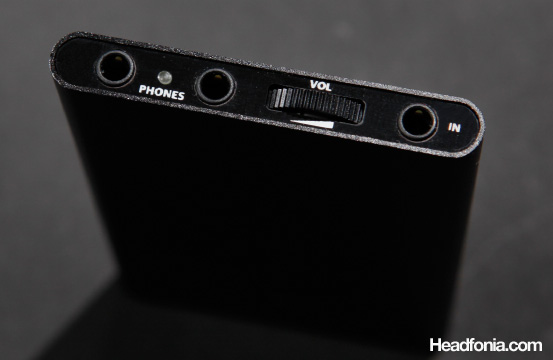
Two headphone outs, volume control, and input. Look at how thin the enclosure is in comparison to the 1/8″ jacks.
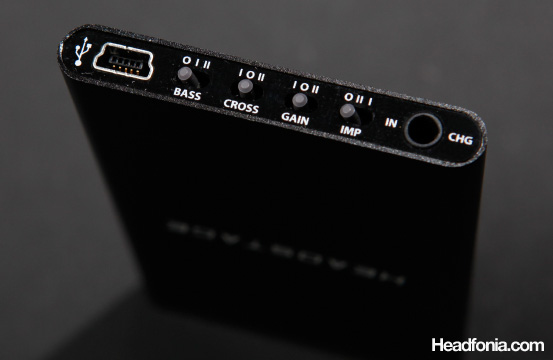
USB charging mechanism, Bass boost, crossfeed, gain, and impedance.
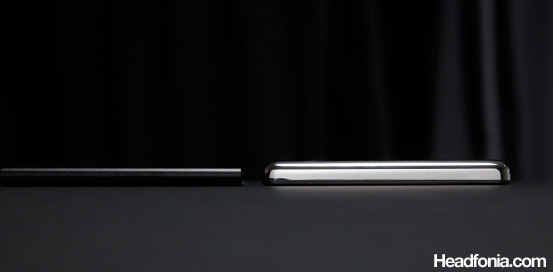
Thickness contest with the 120GB Ipod Classic.
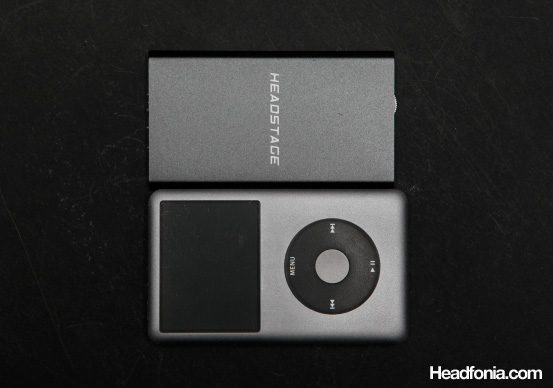
Size comparison. The Headstage is smaller in every way.
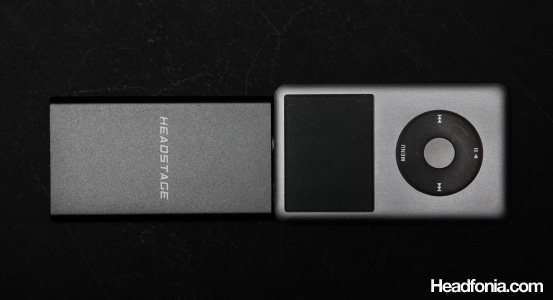
Size comparison. The Headstage is smaller in every way.
Going by the functions, every one of them works nicely as they’re supposed to. The bass boost is probably the one I use the most, as it adds a significant body and impact on the bottom end without any noticeable distortions. Without the bass boost on, the Headstage doesn’t really lack bass. But once I’ve tried the bass boost on, I almost constantly left it on the 1st level boost, even when I’m listening to headphones such as the HD650. The 2nd level boost is also nice, but I would reserve it only for the true bassheads who want the bass a little on the excessive levels. The crossfeed works very similarly as the Meier crossfeed (either on the Meier amps or on my Grace m902). As always, a good crossfeed “bridges” the left and right sound, creating a better integration of the two separate soundstages without adding too much distortions in the signal. Yes, there is some noticeable drop in the signal purity when you turn on the crossfeed, but so it is with the Meier Concerto and the Grace m902 though on lesser degrees on those desktop amps. But the Headstage is a portable, and as always, I would have a bigger level of tolerance with portables. The gain is quite monstrous, and I mostly left it on the lowest gain setting, at which the Headstage is able to drive both the HD650 and HD800 (even simultaneously) to higher than comfortable listening levels. It’s nice to have the higher gain available, just in case you’re dealing with a weak source. But as with all amplifiers, noise levels is lowest at the low gain, which results in a blacker background on the music. The impedance setting is a nice addition, and something that I have never seen implemented on portable amplifiers. However, throughout my listening with various headphones and IEMs, I find the default setting (at “O”) to be best.
The best demonstration of the Headstage’s power is when I plugged in both the HD650 and the HD800 simultaneously and heard no drop in the sound quality or impact level. Now, when you plug in two headphones with different impedance ratings (say a HD650 with a ATH M-50), there will be a change in the sound output. I suspect that this is because the headphone outputs are connected in parallel without a separate buffer for each output. Hence the effective impedance of the headphone changes, and you will feel a difference when you plug in two headphones of a different impedance at the same time. However, with the same impedance ratings (in this case I’m using a HD650 and HD800, both at 300 Ohms), I don’t notice any changes in the sound.
Perhaps the analog ALPS volume control comes out as a surprising element to this otherwise hi-tech amplifier in this age of digital volume controls and stepped attenuators. There is a slight channel imbalance that occurs at low volume listening with sensitive IEMs like the JH or UM Customs. This may be an issue for people who specifically listens to sensitive IEMs at low volume levels. But otherwise, I don’t think the problem is too big of a deal, and especially not if you use headphones. The gain level is also a little too high with sensitive IEMs, and it can be a problem if your source has a high output level. With the HM-602 and the custom IEMs, I have a very limited range of volume control with the Headstage, even at the lowest gain setting. I can still tune the volume quite well from really quite to loud levels, but I have to turn the knob very carefully. Personally, I think it’s not a big issue, but I felt that I need to mention that fact as some people listen to their music at much lower volumes than I do.
Sound-wise, the Headstage is quite a straightforward amp. Some people like straightforward amps, and some other like amps with some flavorings added into into the sound. During the short time that I had with the Arrow amp, I find the combination of the Headstage with the Hifiman HM-602 to be best. The HM-602 has a really good DAC section that betters many entry level desktop DACs, but I have always felt that it lacks the oomph factor. Power level is a bit on a low side with the HM-602, especially when you’re coming from a bigger DAP like the HM-801. Paired with the Headstage Arrow with the Whiplash Audio TWAg interconnect, the sound gains a lot of oomph factor, and the improvements on the bass (even without boost) is very noticeable. The HM-602 has one of the best sense of ambiance and micro details among many of the different sources I’ve tried. But when listening direct from the headphone out, those beautiful subtleties require careful listening session to hear. With the Headstage amp, the ambiance just jumps at you. The combination not only rival desktop set ups, but it actually betters many entry to mid level desktop set ups, and that’s not an exaggeration.
When I’m pairing with a regular Ipod, the Headstage sounds a little dry and flat. I do miss the colorings of the other portable amps like the sweet mids of the TTVJ Slim, or the open and spacious sound of the ALO Rx. But I can’t really blame this on the Headstage, as the dry sound is mostly a factor of the Ipod’s digital to analog section. The sound quality is definitely good, but it’s still second-tier when compared to the popular favorites such as the TTVJ, ALO Rx, iQube, or the Pico. One thing that I’m quite sure is that everyone will love the size, functions, power output, and the friendly $265 price tag of the Arrow. Oh, did I mention that it doesn’t come with a power button? The amp automatically turns itself on when it detects signal at the inputs, and turns itself off after one minute of silence.
I think there is going to be a very long waiting list for this Headstage amp.

Superslick!
The Arrow amp can be purchased at Robert’s website (www.headphonia.com) for $265.00 including free worldwide shipping.
Gears used for review:
Headphones: Sennheiser HD800, HD650, JHAudio JH16Pro, Audio Technica M-50, AIAIAI TMA-1, V-Jays, Ultimate Ears UE700
Amplifiers: Headstage Arrow
Source: Hifiman HM-602, Ipod Classic 120GB




Kunal
Nice review Mike, any idea on what Opams are used.
Mike
Absolutely no idea… Anyone has an idea?
SoulSyde
AD8397
Mike
Thanks!
Brian
Same as AMB’s Mini^3 then.
@leninwtigger
Ah! Great pictures, as usual! Love the review. I have been debating if I should move up from the Fiio E7 to this very same amp. Any thoughts on that?
Mike
I think that should be a pretty sweet upgrade. 😀
DaveWave
Great review, as always!
I am intrigued by your comment about the Arrow sounding “dry” when paired with the iPod. What’s funny is that I had a lengthy session with my iPod/Arrow rig with my old Grado SR60s and I had the same impression: a bit “dry” in the mids. But I attributed this to the Grados rather than the iPod/Arrow because I’ve spent most of my time listening to the Westone 3s and have not had that impression at all. Rather, through the W3s, the sound is rich and full and detailed with no dryness at all. I’ve only had the Arrow for a few weeks now so I’ll have to try some other cans (including my HD580s, HD25-1, and Monster Turbines) to check for dryness.
I agree with you, though, on the cross-feed (seems to reduce SQ), gain (could be dialed down a bit on the 0 setting to better accomodate IEMs), and analog volume control (channel imbalances can occur at low volumes with IEMs, though this is quickly fixed by nudging the volume just a bit higher). Maybe a future version of the Arrow will have digital volume.
That might be worth a trade-in, but until then you’ll have to pry this little powerhouse out of my hands to get me to give it up.
Mike
Hi Dave,
Thanks for writing. I think you brought a good point that I failed to mention specifically. I talked about the HM-602 and the Headstage being a great combination, as it lacks no musicality. So, the source definitely has a role in creating the overall sound. On the output side, the headphones are just as important. Some headphones, like the Westone 3, are very musical, and I think you should not have a problem with "dryness" when using IEMs like that, or even the Turbines.
DaveWave
Hi Mike,
No doubt the headphones make a huge difference. I didn’t mention it, but I had shelved my Ety ER-6i because of their “thin” sound in general and overall weak bass. However, I now use them at the gym along with the Arrow with bass bumped to the “I” setting. Now they sound full and rich.
I think that’s among the most important features of this amp–unlike the Pico Slim, RSA Shadow, and others that cost much more, it allows users to adjust the output to suit not only their tastes & preferences but also the changing demands of different phones. That deserves a great deal of appreciation, IMHO!
Dave
Mike
Yes, I think the Bass boost is highly versatile and is very nice. As I said in the article, I have it on the "I" position for most of the time. 😀
Tash
Hi Mike,
I'm interested you say the HM-602 lacks 'oomph'. Is this comment limited to power hungry full sized headphones or do you think this is also an issue with more sensitive IEMs? I am getting very tempted by the HM-601 (I don't really need the separate DAC functionality of the 602) but a major reason for my interest is that I want a good portable player that will allow me to dispense with carrying a separate amp without sacrificing sound quality. I currently use my old iRiver H340 (running flac files) and an iBasso D2+ headphone amp held together by an elastic band, which is a decent sized 'brick' in my coat pocket!
Also, How do you find the Arrow volume output vs the Pico Slim? This was my previous upgrade solution for my H340/D2+ setup but I ended up being quite disappointed with the Pico Slim – I find I need the volume pretty much on maximum even with my Sennheiser IE-8 IEMs and this means there is a significant background hiss. Also, the sound stage and bass quality seem no better than using the H340 headphone jack directly. The D2+ has more power, better instrument separation and better soundstage in my view (which I was very surprised and rather irritated to find)!
Mike
Hi Tash,
The lacks of oomph on the HM-602 is most noticeable with full sized headphones. As for IEMs, I really can't say. I guess I've been used to always listening to everything with an amp, and even I'd feel portables such as the V-Jays and IEMs like the JH16 to lack a little impact factor when I'm driving direct from Ipods. The only player that I can happly listen to direct is the HM-801. A lot of my friends use full size headphones with the Hifiman DAPs, and one factor that they find the HM-602 to lack is the oomph factor that they get from the HM-801.
The Pico Slim was designed to be low power but precise amp. Although I'm quite surprised that you find it lacking volume with your IE8 (I've never actually tried an IE8 with the Slim though). The Headstage, on the other hand, is much more powerful. It drives the HD800 conveniently at the lowest gain setting, as I've written in the article. It even drives both HD650 and HD800 simultaneously! 😀
anon
which gen could this arrow 12he be?
neob
Robert
neob
Sorry for the first message…
Robert says that it is 2.2G Arrow amp.
Dennis
Which is better, ALO RX MK2 or the Headstage?
Mike
Hi Dennis,I'm working on a portable amp review that will include both amps, among other things. It should help answer your question better.
Dennis
I am looking forward to ur review ^^
Hasan
I am also wondering about which you prefer: Alo RX MK1 or Arrow. Can you tell a sentence before publishing that amp review. I want to get them today or tomorrow…
Thanks for all the reviews by the way…
Mike
Hasan, it would depend on what headphone/IEM I'm using, the music I'm listening to, and where I'm going with the rig.
Alo Rx has a spacious open sound, big soundstage, slightly recessed mids
Headstage Arrow is quite flat and linear
Headamp Pico Slim is also quite flat and linear — haven't compared this one to the Arrow directly
TTVJ Slim has a good midrange body
Ibasso PB1 has a good upper midrange body
RSA Protector has good bottom end body
Say, I'd use the Ibasso for the ATH M-50.
I'd use the Arrow with my v-Jays
I'd use the Pico for my JH Customs
I'd use the TTVJ or RSA Protector for the Sennheiser CX500
I'd use the ALO Rx for ER4P/S
You can say that my approach to amplifiers are mostly to get the most ideal frequency balance for my music.
Hasan
to add: I am using diyMod and UM Mage/SM3…
Mike
With the SM3, I'd probably get the ALO Rx
With the UM Mage, I'd probably get the Pico Slim
😀
but keep in mind that our music is probably different….
Hasan
I am not thinking about getting Pico Slim as I would use it with my HE-5 or DX1000's in case of emergency. (Not as powerful as others.)
So ALO RX is the way for me to go. Thanks Mike!
Mike
The ALO Rx is very powerful. I've actually tested it with the HE-5 and the ALO Rx was able to drive it.
Hasan
Yes, I know you said Alo RX but;
I am thinking and thinking and thinking but Arrow's thinness and that functions are attracting me. Will be "diyMod (same caps with iMod/WhipMod) > Arrow > Mage" too dry?
I am using RSA Hornet at the moment and I am happy with its sound. (Looking for something thin) Listening Rock, Jazz mostly and some classical.
Sorry for bothering you but I couldnt get enough info who I trust and used/tried it both…
Mike
If you're attracted to the dimension of the Arrow, then I suggest you get that one instead. It'll be closer to the Hornet sound than the ALO Rx will. 🙂
Hasan
Ok, thanks again Mike! Loved these photos by the way.
Mike
The Headstage is my 2nd favorite in terms of size after the Pico Slim 😀
<img src="http://static1.www.headfonia.com/wp-content/uploads/2010/12/portable_amps_2010_01.jpg">
<img src="http://static1.www.headfonia.com/wp-content/uploads/2010/12/portable_amps_2010_02.jpg">
deaththeorist
Wouldnt it jus OWN to OWN that whole collection xD just perfect man lol
btw back on topic of the article, how would you say the arrow fairs with the sflo2?
Mike
I think the Arrow would be a good pairing with the sflo2. 🙂
deaththeorist
thanks 🙂 cant wait for your ultimate portable amp shootout! refreshing everyday! haha
Mike
Lol… I'm still busy with other things now. Perhaps check back in a week time. 🙂
Andrew P
Hey Mike. Any suggestion on what I should get for the jh 16 pro? Should I go for the hifiman hm602 or get a portable amp? Is the hifiman good enough on its own? At the moment I have a 5gen ipod nano and a nokia n900 phone that sounds decent. I'm looking at the ttvj slim, pico slim, rsa protector, corda stepdance and headstage arrow he12. Seeing that you have almost all of them, what do you think I should get? I will definitely get the twag upgrade. Thank you!
Mike
I will definitely go with a Hifiman HM-602 than an Ipod + amp upgrade. Thing is, an amp upgrade doesn't eliminate the bad source quality of the Ipod, and the JH16 will reveal the bad source quality of the Ipod easily. Out of all the amps you mentioned, my favorite pairing for the JHs is the Pico Slim. It has the best control of the bass (which the 16s have plenty), and the best level of resolution. The other ones are useful if you want to drive bigger headphones. I haven't tried the Corda stepdance though.
Rafael
Hi Mike,
Whats the best Dac/Amp to use with inears(no hiss, good volume control and neutral)? Up to 250usd
I dont need portability
Mike
There is so many alternatives right now, but if I have to choose one for IEMs, it'll probably be the Pico Slim. If I need a DAC included in the package, I'd get the TTVJ Slim with onboard DAC. Unfortunately they'd don't fit the $250 budget. You can try the Ibasso D12, but I haven't listened to that one, and the D10 was not too impressive.
Rafael
They are better than audinst and Udac2?
Mike
Ah, I thought you're looking for portable devices. Sure, the Audinst and Udac 2 are great sub-$250 DAC/amps. I've personally never compared the TTVJ with the Audinst/Udac though.
Robert
Mike,
I enjoyed your reviews and advice. I have the UE TF10's and Westone UM2's that I use with an iPhone and Nano. I am considering the Pico Slim and Headstage Arrow g3. If there are any other IEM purchases in my future, it is possible the Westone 4. Which of these 2 amps do you recommend for my purposes? I listen mostly to hard rock. The bass boost of the Arrow (and price) are important features to me. But the low volume control of the slim and it's form factor are also important features.
Mike
Hi Robert, I think it comes down to the sort of improvements you need in the sound. If you need the bass boost, then the Arrow is good, although I don't personally think TF10s need bass boost. 🙂 The Pico Slim will give you better resolution in the sound, better bass control, and still a very strong bass despite having no bass-boost. The Pico is also brighter while the Arrow is darker.
Robert
The tf10 bass is great. However I must turn the volume up to enjoy the dynamics of that bass. I’m hoping to be able to enjoy those dynamics at a lower volume and assumed the arrow’s bass boost would help. What do you mean by bass control in the pico?
Mike
What I mean by bass control is that the bass gains better control with the Pico. This is very noticeable with the JH16, but also with other fairly bass-light IEMs like the UE700. The bass becomes less loose and better articulated, while still having a very powerful punch. In fact, I think the Pico slim has a stronger punch than the Headstage, although the Headstage has more bass body.
Another thing that I would consider is the treble areas. The Pico is brighter, while the Headstage is darker. I've always felt the TF10 to be bright in the trebles, and for that I'd probably prefer the darker sounding Arrow.
🙂
Mike
I think that if you don't have any problem with the TF10's treble, you should definitely go with the Pico. It has the most awesome bass section on all the portable amps I've tried with IEMs.
Powerful punch, very clear articulation and control. It's the only portable amp that can give enough control to the JH16's bass section.
Jimmy
Hello Mike I was wondering what would you recommend as a good amp for me. I currently use Sennheiser IE7 and IE8’s for portable use. My DAP’s are Sansa Fuze, Fuze+, iphone 4 and soon to have the Sflo 2. I am really pinpointing my choices between the headstage arrow and maybe the ALO Rx. From the comment regarding the Pico slim not powering the IE8’s kinda scared me away from that amp. Thanks
Jimmy
Anonymous
Pico Slim is not powering the IE8? Who told you that?
On the other hand, the ALO Rx and the Arrow are both great choices. Please go to the portable amp shootout article to read more between the two, and you can decide from there.
http://www.headfonia.com/the-usual-suspects-12-portable-amps-compared/
Sickdrummer182
Hey, is this amp enough power for the HE-6?
George Lai
My new 4G arrived today. This is so impossibly thin I’m tempted to glue it permanently to the back of my iPhone 4S. It will still be thinner overall than my earlier iPods. Just kidding of course.
gagetbOy
how does this work with the iphone 4s?
Fred
Do you use the line out or the headphone jack to send the music from HM-602 to the Arrow. I have a HM-601 and I just purchased the Arrow and I am trying to figure out how to send the sound to it, that will not cost a fortune. I also have Westone 4R IEM
Trent_D
line out. That way you avoid the build in amplifier.
Fred
Thank you. Is there a particular line out cable you would recommend?
Trent_D
Well, Fiio makes a decent one cheap. I like the Charleston Cable Company as well.
Fred
Thank you. Is there any particular line out cable you would recommend?
Fred
If I wanted to use the Arrow with the Westone 4r using my Samsung Galaxy Note 2 as the source, what USB to Arrow Line In would I use? Or do I have to use the headphone to Line in? Thanks for the assistance.