




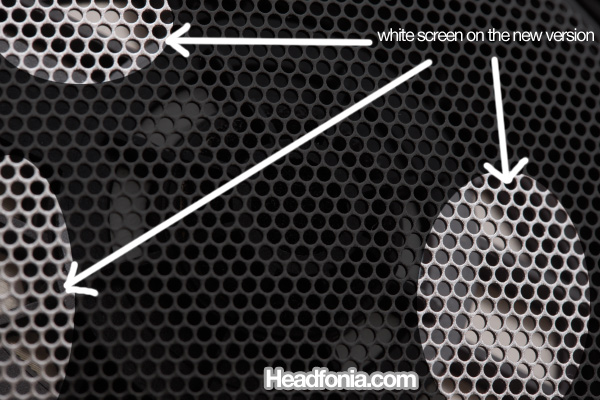
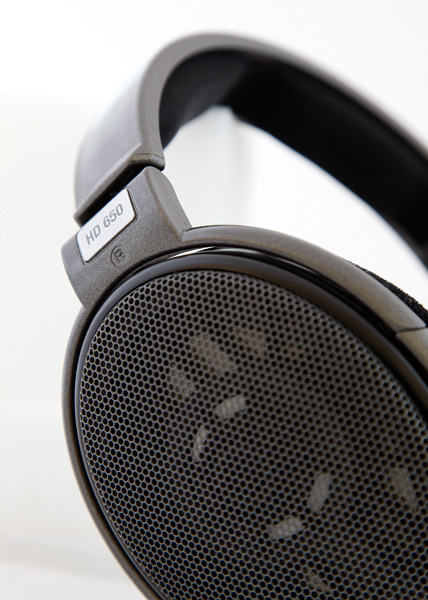
Apparently sometime ago Sennheiser quietly changed the drivers on the HD650, HD600, and HD580 models. While the old ones have black screen, the new ones are white. The material of these screens were changed as well. They may have changed other things inside the drivers as well, but we can’t tell for sure.
What we do know, is that now these new Sennheisers have lost their dark and veiled sound. Instead, they are sounding very neutral, nice and detailed, while still retaining their laid-back presentation. No more muddyness, no more veil. It’s interesting because this driver change may have happened as early as 2007, and this explains the different impressions from people who have heard the HD650, HD600, or the HD580.
In the beginning of my headphone journey many many years ago, I had a listen to the Sennheiser HD650, but I really couldn’t like it, cause I thought the headphone sounded muddy and veiled. However, recently I had a listen to the HD650, and I got hooked on the sound! After owning the HD650 for a few months, I really can’t comprehend what happened. How the HD650 that I had no desire for many years ago suddenly became one of my favorites. When my friends heard my HD650, they wondered the same thing as well: How can they hate this beautiful sounding headphone?
Clearly, the driver was changed by Sennheiser. Although this was also confirmed by a few people in the Head-Fi forum, Sennheiser seems to deny this change. After getting together with other owners and comparing our headphones, it becomes clear, that the new driver has a brighter, less veiled sound. A sound that definitely appeals to a lot of people.
The change seems to be universal, covering all three HD580, HD600, and HD650s. As to when the change officially occur, we don’t know for sure. What’s also interesting is that now the HD650 seems to be much much easier to drive. The new driver works with just about any portable amp that we use, including the Corda 3Move, the RSA SR71a, and the Headamp Pico. Even the headphone out from a Marantz 5001 CD Player drove the HD650 to fairly loud levels at just 10 o’clock in the volume knob. Yes, powerful amplifier like a Balanced Beta22 would be best for the HD650, but what I’m saying is that the new version is actually listenable on any decent portable amps!





pafficype
Hey there everyone i was just introduceing myself here im a first time visitor who hopes to become a daily reader!
Mike
Welcome! Hope you enjoy the articles, and if there is any inputs for us, feel free to use the forums to post them there.
cansman
Hello,
I enjoy reading your website! Recently, I placed a post in Head-Fi regarding the changes in sound associated with the changes in the construction of the HD650 driver. Hope that this is helpful to anyone interested!
The original link is: http://www.head-fi.org/forums/f4/hd650-new-version-455060/index3.html.
I am now quoting my original insight regarding the debate that the new silver metal acoustic mesh version sounds different to the old black acoustic silk version. There are some who say there are no differences between the new and old versions. And of course, some do.
Here is the quote:
“Some people hear the difference between the black acoustic silk and the silver metal versions, and some don’t. The debate rages on. Is there a difference or not? Let me suggest that the answer is both YES and NO!
How can this be? Let me give you a plausible explanation. As John Willett mentioned in the above quote (see the weblink in Head-Fi), Sennheiser had experienced difficulties in fixing reliably and identically the black acoustic silk. I believe part of the difficulty was due to the different climatic conditions that the phones ended up in which perhaps caused the tension in the acoustic silk version to sag and hence, the differing sound quality experienced by end-users. This resulted in the change-over to the current silver metal mesh version.
Evidence for this hypothesis is taken from sennheiser.com website:
http://www.sennheiser.com/sennheiser/home_en.nsf/root/09969_headset?Open&path=private_headphones_audiophile-headphones
“A specially developed damping element, made from fine acoustic metal mesh, ensures a precise damping over the entire diaphragm surface, highly constant in all climates.”
If the damping of the older black acoustic silk version is not consistent, it is possible that this would have affected overall sound quality; hence, the boom in the bass and veiled sound experience.
However, not all black acoustic silk versions have this problem as I’m sure some were ‘perfectly manufactured’ within established tolerances. I am certain that these ‘within spec’ versions would sound identical to the silver metal ones. This might explain why some people say that there is no difference…in this instance, they are right to say this!
For myself, I had purchased the old acoustic silk version and it was boomy and veiled. Perhaps like others, I had ones which had reliability issues in regard to the proper attachment of the silk material. To my ears, the new silver version which I now currently use sounds significantly quicker and tighter. So perhaps we too are also right!
That is my response to the confusion that many have experienced! Unless there is a more plausible explanation, this is the best explanation I can think up so far.”
It would be interesting to hear any comments to my explanation thus far.
Cheers!
Mike
Hi Cansman,
Thanks for the excellent contribution. That explanation does seem plausible, because Sennheiser in the past have stated explicitly that there is no difference between the two versions.
The question is that, I don’t think that these differences is not likely to come from manufacturing differences, because all the dark screen versions I’ve encountered are always darker sounding than the silvers.
cansman
Dear Mike,
Thanks for your kind feedback – appreciate it! In regard to your point stated above, for me personally, I have only heard two HD650s – my previous dark screen version and my current silver screen version. So I cannot comment on other previous dark screen productions. And I am certainly in agreement with you in regard to your observations of the sonic differences between the two versions.
However, the explanation I have given takes into account a significant number of others in Head-Fi who (and very emphatically!) indicate no sonic difference between both versions.
Nevertheless, like yourself, I am enjoying the new silver screen version a lot more with my Benchmark DAC1 USB amp. Thanks again for your well-presented and thoughtful website!
Cheers!
Che15
How come nobody has commented on the same issue with the HD600 since the old ones also use the same black acoustic silk? I have listened to a pair about 8 years old and they didi not sound dark at all, could the issue be caused by something else even if it makes sense to blame the damping materials?
Mike
Hi Che15, that's very true. No one seems to have brought up this issue with the HD600. I wonder why. I don't think they changed the damping materials though.
Trekkie the Techie
Not quite correct. There are three different versions of HD600s. Among these, there are two different earlier versions with black screens, the first with an older driver design and the other with a newer driver design. Additionally, there is the current version with the silver screen, which reportedly uses the same newer driver as the second version with the black screen. According to Sennheiser, the only change in sound you should hear between the second and third revisions with different screens is in a very humid environment where the moisture in the air would be inhibiting or dulling the sonic performance of a black-screen HD600.
http://www.innerfidelity.com/images/styles/600_wide/public/Sennheiser_HD580600650_Photo_Inside.jpg
chipshot
I'm confused. Looks like you're talking about changes in the grill. Isn't that a separate part from the driver ?
Mike
The screen is part of the driver assembly. No, it's not the driver, you're right, but it's what indicates what version of the driver you have.
Bebop McJiggy
Not really that important, but I checked amazon and I bought my pair of 650s in Dec of 2006 and they came with the new drivers.
I'm pretty sure the driver itself is not attached to the screen, it could potentially be carefully switched between the new and old screen to test that hypothesis no? At least to your own ear, assuming of course that you had access to both a new and old driver.
Mike
Hi Bebop, yes that's true. People who owns the old version should be able to order a pair of drivers from Sennheiser (they're not expennsive too, HD650 drivers are ~$50 per side, last time I checked) and get the new version.
Anonymous
hi Mike,
when you said HD650 scale so good with more expensive desktop amps, which HD650 actually you refer to? the black one or the silver (new) one?
since here you said that HD650 “easier” to drive even on portable amps.
previous review of HD650 refers to “dark forces” don’t apply with silver one?
thank you
Anonymous
It should apply to both versions after all the basic driver is the same.
Anonymous
oh i see, the scalability still great with greater amps.
but on tight budget, seems the new one easier to drive from portable amps, which is nice improvement?
Anonymous
It should apply to both versions after all the basic driver is the same.
Austin Morrow
Just for the record, I’ve fallen in love with these. 😉
Anonymous
Nice, Austin. 🙂
Should give the HD600 a try, they’re quite different from the HD650.
Shane Revis
Hi Mike,
I think that I will probably end up buying the HD 600 as my first reference headphone, but I would like to know a little about the veil, and what type of amp would “disappear” with these.
Does the veil indeed go away when the HD 600 are run by a powerful amp?
If I want neutrality, would a tube or solid state amp work better for me?
What amps do you recommend, if I want a colorless, neutral sound?
Lastly, when using the HD 600 can you hear “the clear and undistorted sound of the cymbal shimmering and fading into the background”?
(Quote taken from your article on Stax Lambda)
I am still a little concerned about the highs on these. I love clarity, and sparkle.
Mike
Shane,
The veil is not really caused by amping. In fact the HD600 is relatively easy to drive, given the level of today’s headphone amplifier. The veil is something that people have sort of mistakenly attribute to the Senns due to their dark (aka lack of treble) sound signature.
Neutrality, at the sub $500 level, perhaps it’s better to go with a solid state. A true colorless neutral sound is hard to get at this level, you’d probably need to look at much higher priced amps, $1000 and up. Something like the Lehmann Linear, the SPL Auditor/Phonitor and such. I don’t recommend it unless you really know what you want though. Neutral colorless amps are really hard to appreciate. I would suggest you go with something popular and relatively good sounding, something like the Schiit Asgard.
The HD600 sound is very different from the Lambda. If you want a Stax Lambda sound then you need to get the Stax Lambda.
Shane Revis
I take it that the HD 600 doesn’t really give you “the clear and undistorted sound of the cymbal shimmering and fading into the background”?
Thank you!
Mike
Shane,
I really wouldn’t base my headphone choice just from the way cymbals sound on it, but I do think that you would probably like Stax better than the Senns.
John123John
hey mike,
can you buy hd650 drivers? The sennheiser parts site only offers hd600 drivers and from the pictures, seems like the old black ones.
Mike
I think you should be able to buy the HD650 drivers too. I’ve bought them before. And I think the pictures are just old pictures, doesn’t necessarily mean you’ll get the black ones.
John123John
Can you show me where? i cant seem to find them at the sennheiser parts site. Im in the USA.
all they have are cables, pads and adapter from what i can see
Mike
John,
I think you may have to call them and ask for the part number specifically. The online store are missing a lot of parts from the list. I tried looking for some HD800 pads and they didn’t have it on the online store, but once I called them they were able to give me a parts number. They were very helpful too, and they told me that they are indeed still missing a lot of parts on the online store.
Rachit
Hey Mike, you mentioned the Marantz CD5001, I was thinking about getting the new CD5004, if their headphone out is similar, how would the marantz be with Denon AH-D2000, HD650 and HE-500
Atriya
Hello Mike, what would you say is the ‘minimum’ DAC/amp combo to unlock the new (silver) HD650 to 90%+ of its sonic potential? I am aware that as you go higher up, large pricing differences yield relatively smaller improvements, so I’m looking for the optimum price / quality point.
Nick Tam
There’s no end to this… as you already know the HD650 scales up immensely. What I would say is, buy what your wallet can afford. A Dacport LX + Crack combination is relatively affordable (<$550) and you get good synergy and a heck lot out of them. There is no way of quantifying sonic potential, but even if there is any way of doing that, I'd say that setup would get you the most out of the Sennheisers.
Atriya
Thanks. I wouldn’t like to DIY the Crack, and getting a ready-to-use one gets expensive. Would the Schiit Valhalla be the next best alternative (for HD650 use)?
Trent_D
Well, the Pan Am is also suppose to be great for the HD650, and you don’t have to build that. It runs $600, although, to get the most out of it, you would need to add the passport battery which adds an extra $200.
Nick Tam
But it is a good option, since $600 gets you started, passport can come later. Pan Am could also be tube rolled to certain effect. Also if you’re not exclusive to the HD650/700/800, the Pan Am opens up many more options for other headphones.
It’s like the Crack is married to Sennheiesers, but the HD650 may have an affair or two with the Pan Am and Graham Slees.
Trent_D
But also on that note, the dacport LX is 249, making it 100 dollars less than the equivalent HRT, which also makes it an awesome deal.
It is both a great and a terrible time to be a budding audiophile. On one hand, there are all these great products coming out offering great value for the dollar, and a performance that was previously reserved for those with serious money. On the other hand, for really indecisive people like me, the amount of options is KILLING ME! I change my mind every day as to the way I should go.
Mike
Yes they lowered the price a few days ago. It’s a killer deal now.
If you are going with the HD650, should just go with the Dacport + Crack package. Don’t worry about upgrade tubes and speedball. It’s great already in the stock package. That should cost you roughly ~$550 total.
Trent_D
Atriya said he wasn’t interested in DIY, which is why I suggested the Pan Am
Nick Tam
For Atriya it’s decided. He’ll get the HD650 and upgrade his source and amp later. Who knows, maybe the prices will drop even further, maybe HRT has to drop theirs soon following Centrance’s move.
As for you, you can quit being indecisive. It’s LX+Crack, it’s a done deal. lol
Now everyone can enjoy an awesome HD650 combination for a mere $550!!!
Mike
I was replying to you LOL
Trent_D
Ahh, I got it now. Just took me a minute. Although, do to it’s tiny size, which is important for me, I think I am going with the Pan Am. I need to be able to easily put it in a place where my destructo-godzilla of a 2 year old can’t get at it. And believe me, she loves going after my headphones!
Nick Tam
Remember the LF339? You need an amp grille, literally. Or cage your amp somehow
Trent_D
I was just looking at the LF 336 actually. It’s about the same price as the crack kit. I wonder how it sounds?
Nick Tam
Haven’t tried it myself. Think of it as a ripoff of the WA3 but with heavily discounted labor costs xP
That was a joke.
Impressions are on head-fi
http://www.head-fi.org/t/531960/darkvoice-la-figaro-336c-or-the-332c-332s
I really need to go for a listen myself, but I really wonder why the LF/DV amps other than the LF339 are relatively unheard of. I don’t have the slightest clue of it’s sound reading off reviews, to me the 336 looks very Chinesey? It does run the same set of tubes as the LF339 so it probably should sound similar if LF tuned it to their house sound.
Mike
The gap is pretty big though, from the Crack to the Valhalla for the HD650.
Atriya
Thank you! In your review of a much cheaper DAC/amp, the Yulong U100, you say that it ‘matches beautifully with the HD650’. How much of a difference is it, moving up from ~$250 solutions like the Yulong, to $600 solutions like DACport+Crack or the Pan Am? What’s the best under-$300 DAC/amp solution for the HD650? Would I be greatly undermining the potential of the HD650 if I used it with such an amp? (I’m trying to decide between the HD598 and HD650, and can’t spend more than 300-350ish on DAC+amp). Thank you for all the help, I really appreciate it!
Nick Tam
Like I said there’s the Dacport at $299.99… I don’t think you’ve received the message very well. There is no end to scaling up until the topmost amplifier. You just can’t expect an entry level $300 setup to have the sound of a full-blown ~$2000 setup. Ultimately, your setup is “undermined” by your wallet. When we were discussing an “optimum” price/performance setup for the HD650, the first consideration is affordability. For one, the HD650 is not a flagship headphone so the budding audiophile is very unlikely to be spending $1k+ on a setup for the HD650 (ironically, I did…). What we are looking for is “best for price” rather than “unlocking 100% potential” of the HD650.
What Mike is referring to in his reviews is the synergy of the system and the HD650. If a setup has good synergy, it sounds good. If it doesn’t, no matter how much money you throw into your system, it simply would not work for your music or your headphones. The only thing that scales with the price is the level of technicalities and details. There is absolutely no way of quantifying “potential”, but the factors that we consider in determining the quality of the sound is soundstage depth and width (3-dimensiality), imaging and micro-detail, “blackness” of the background, etc… further subjective factors are like the analog warmth of the sound (grain) are taken into account to determine the likeability of the sound.
Trent_D
The dacport is a darn good deal for $299.
Atriya
You did mention the Dacport LX. But that’s just a DAC, and to pair it with the Crack (as you suggested) would make the total price ~$600. I was looking for a DAC+amp recommendation that TOTALS to around $300-$350, and has best synergy with the HD650 FOR THAT PRICE.
However, thanks for all the other information. It’s very informative for someone (like me), who is new to high-end audio products.
Trent_D
here is what you should do! Snag the dacport lx for $249, then get the
JDSlabs cMoy for $60 and add a 24v adapter, and you will be good to go.
This will get you a better dac (as the lx is better then the regular
dacport) and the cMoy with the 24v adapter is suppose to be shockingly
good with the senn hd600/650. For your price range, that should be your
best bet. You are looking at $330 there maybe after shipping.
and on a side note, the dacport and the dacport lx are two different things.
Atriya
That’s the kind of advice I was looking for – a simple recommendation within my pricing bracket. Thanks a lot!
Atriya
Thank you very much for that detailed reply. The LX+Crack does emerge as the optimum point from your quantification, but since I don’t want to spend $500, I think I’ll go with the LX+Cmoy for $330, as Trent_D has suggested. Once again, thanks a lot!
Trent_D
The nice thing is that, if in a few months… two years… or whatever, you deside to upgrade your setup, you will already have a very good dac, and you need only worry about the amp.
Trent_D
No, here is what you should do! Snag the dacport lx for $249, then get the JDSlabs cMoy for $60 and add a 24v adapter, and you will be good to go. This will get you a better dac (as the lx is better then the regular dacport) and the cMoy with the 24v adapter is suppose to be shockingly good with the senn hd600/650. For your price range, that should be your best bet.
Trent_D
and now I feel like an idiot. As soon as a wrote that, i realized that’s exactly what I should do. Get the dac, the 650 and then work up to the bigger amp.
Nick Tam
Mike has already mentioned with the Dacport LX, he would never feel that the DAC is the bottleneck of his setup.
Trent_D
Just pulled the trigger on the LX. Now, to start stalking out the best price on the HD650.
Atriya
I think razordog has the lowest price at the moment – $385. Do you know about anything lower? I’m price-stalking too!
Nick Tam
I thought you couldn’t afford the HD650?
http://www.juno.co.uk/products/sennheiser-hd650-headphones/399486-01/?currency=USD&utm_source=google_us&utm_medium=organic&utm_campaign=Google%2BShopping
I think I haven’t seen anything lower than this price online
If you’re desperate enough for something 2nd hand, here it is:
http://www.ebay.com/itm/SENNHEISER-HD-650-High-End-Kopfhorer-Kabel-analog-/390485822008?pt=Kopfh%C3%B6rer&hash=item5aeac4ca38
Atriya
I can’t afford it, but I’m still buying it. 😛 No, actually I can ‘just about’ afford it – or at least that’s what I’m telling myself. Don’t mind me – I’m a student on a stipend! Yes, if I can find a good used pair, I might go for it. Thanks for the links!