




It took a while for us to get review samples of the latest Sennheiser wireless headphones but the RS180 and the new RS220 (which was only officially launched at the last CES) finally made it to the Headfonia.com office. These are the first wireless headphones I have ever used so I’ll only be comparing them to each other for now.
The Sennheiser RS180 & RS220 both use digital technology to transmit the data from the docking station to the headphone, yet the technology used is not the same. The newer RS220 uses the DSSS technology with an asynchronous transfer. This means the headphone is in charge of the data transfer and not the transmitter and we all know this is a very good thing to have. The inputs on the RS180 are very basic with just a line in and a switch to select 0db for a DAP or -8db for use with a DAC. The RS220 offers analogue, optical and coaxial ins and outs and has a volume control on the base station. It is of course advised to use a digital input.
The Sennheiser sound signature naturally is present in both headphones but at the same time there is a reasonable gap in sound quality between both. Overall listening to the RS180 is like hearing a more entry level Sennheiser and listening to the RS220 is more like hearing a cousin of the famous HD600. The sound the RS220 produces is very enjoyable and relaxing and I loved it. It really has the smoothness of the HD600(/HD650) and you wouldn’t be able to tell this was a wireless headphone if you didn’t know. It really is like a cousin of the HD600, you can clearly hear the resemblance and yet it just isn’t quite at the same level as the HD600 (for now).
The RS180 is sounding a bit thinner and forward as the RS220 and is less dynamic and balanced. You get a more “inside your head” music with a smaller soundstage. While detail retrieval on the mids and highs is reasonably good, the bass is pretty loose and loses detail. The RS220 places you right inside the music, balance and soundstage is very good and the sound has a lot more body as the RS180. It’s a completely different and improved sound compared to its predecessor. As said before the bass on the RS180 has more impact as on the RS220 but with the 220 it is much tighter and detailed. It’s not at the level of the HD600 and certainly not the HD650 but the bass is very good. The treble is just gorgeous to my ears and the mids are very nice too, more leaning to the HD600/HD650 mids, (but not at the same level) with excellent detail retrieval. A very impressive wireless headphone.
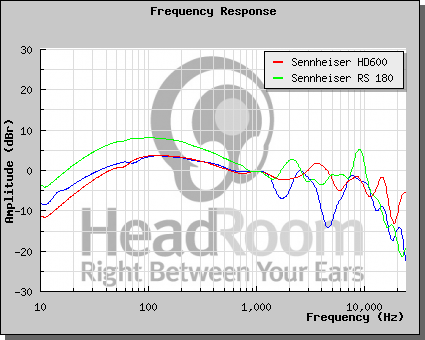
(Blue: RS220)
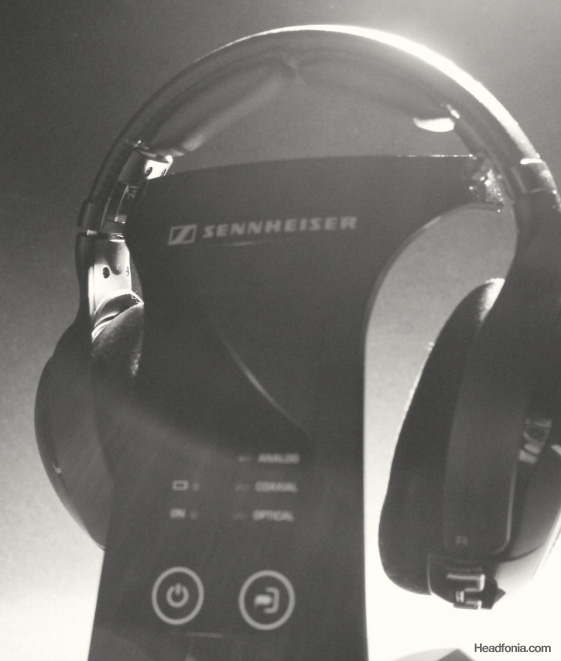
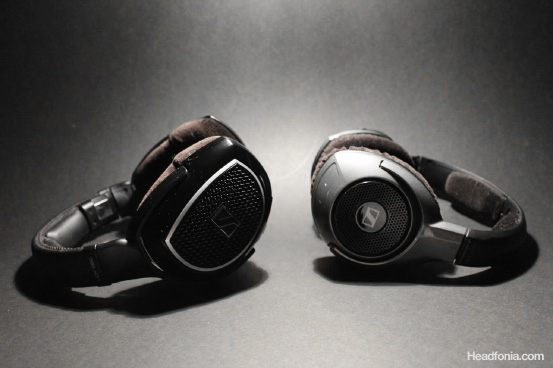
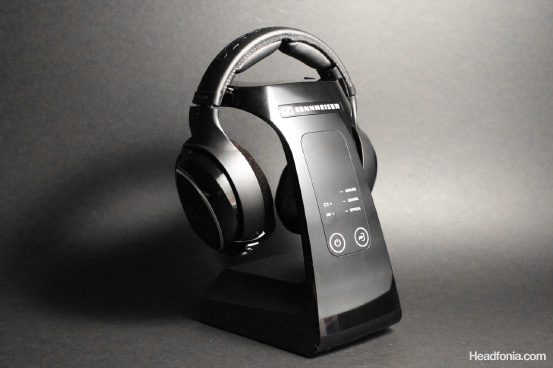
The design of both headphones and docking stations is great, I preferred the RS220 but not everyone did. The RS180 as you can see in the pictures is to be used with the narrow side facing you and has 1 connector in the middle of the headband to charge the batteries. The headphone itself was nicely built and very light but could have used slightly bigger ear cups as they were touching my ears partially. The RS220 station is more impressive and has touch controls on the front. Here there are 2 contact points to charge the batteries. Both sets have excellent built quality as we’re used to with Sennheiser but overall comfort was better with the RS220 as the headphone pads were a bit bigger. The 220 even has a beautiful leather headband and it is a bit heavier too but still very light to me. (RS180 = 204gr without batteries & RS220 = 329gr inclusive batteries). They both have controls to change the volume and the balance and on the RS220 you can even select the source. The only thing I missed with these was a pause, next, and stop button, but that’s another story. They are very easy to use and very comfortable and I could get used to not having a cable hanging around, I never had this much fun doing chores.
You can’t mix the headphones between docking stations as the technology used is different but you can get an extra headphone for the RS220. I can’t really comment on the battery life as they always charged during the night and so I never ran out of battery during the day. It does take reasonably long to charge the batteries though.
As I mentioned, using the wireless headphones was a great experience. When I stayed on the same floor reception was always perfect and I can’t remember getting any drop outs at all, not even micro ones. When I went to another floor however, the headphones both immediately started losing signal. To my surprise the RS180 did better and stayed listenable, the RS220 couldn’t handle the drop outs quite as well and I had to stop listening to it. I assumed the newer product would perform better but that’s not what the experience showed me. You’ve got to hate concrete and steel… I wouldn’t focus on this point too much because in normal conditions with an open space, furniture etc they both performed great without errors but there of course are limits to the wireless technology. Look at it this way, with a cabled headphone you wouldn’t even be able to make it to the kitchen from the living room.
Wireless technology isn’t cheap, in Europe the RS180 costs around 259€ and the RS220 is available for 399€ but considering the RS220 is getting close to the HD600 level (369€) those prices seem legit to me. The Sennheiser RS180 & RS220 are both good headphones and for watching movies I could live with the RS180 without doubt. For my musical experience however, especially after having heard the latest creation, I would fall back to the RS220 each time. I really think the RS220 is worth the upgrade if you’ll use it to listen to music, it really is a few levels better. Also important to mention in relation to the price is that in example a HD600 setup + amp + dac will set you back much more as the all in one RS220. If you’re not planning on investing in a full setup, the RS220 might just be what you need with an incredible value for money.
I only had the sets for 2 weeks and already I was sad to send them back to Sennheiser and so I’ve added the RS220 to my “Wanted” list. If you’re looking for a great wireless headphone and you like the Sennheiser sound, the RS220 should definitely be on your short list. The Sennheiser products can be bought online in the official Sennheiser shop or from an official distributor. Thank you Sennheiser BeNeLux for providing with the samples, I enjoyed using them both a lot.
Gear used: Audio GD NFB3, Fiio E10, Kenwood CDP, Violectric V100, LaFigaro 339






Rūdolfs Putniņš
If you keep in mind that the HD650/600 hover around a similar price point then getting a fully amplified wireless headphone at that price seems like a good deal.
Btw, to how well amplified HD600/650 were you comparing them?
L.
I used the 339 and the V100
Edward Noble
These look very interesting. I guess the digital input on the RS220 uses it’s own DAC and can’t use another one. Did you try to compare the headphones DAC to an external one and see the difference?… Since the signal is sent digitally to the headphones it has to use it’s own DAC anyway I guess, hmm…
L.
You’re right, as the signal is always digitally sent. The HD600 with a good dac amp still tops the RS220 for sure. Without the dac/amp, I’d probably go for the RS220
Joel Rennie
The Sennheiser RS-220s may be expensive, but you won’t find yourself tempted by these sorts of things:
http://aloaudio.com/lariat-copper-18-sennhieser-hd650.html
Just experiment with sitting closer to the transmitter…
L.
Well to each his own Joel 🙂
The RS220 is a “steal” for those not wanting to invest in a dac and amp
DeliciousFlatFrequencyResponse
Wow, graphs!
L.
Especially for you!
P. J.
I remember when I has RS110 and the sound was typical Sennheiser but it had quite some noise because of radio interference. They didn’t fit well and also because of their weight I felt they will feel off if I tilt too much forward.
As much as I hate cables I cannot see myself buying a wireless HD600 for so much more money.
With wireless you do loose the cable but a new hassle arises- recharging batteries.
I do applaud Sennheiser though for finally creating a wireless hifi headphone worth listening to.
Eugen
What happened? 🙂
L.
With?
Eugen
My previous message … 🙂
Anyway, I can’t see how a headphone with that frequency response can be in any way like the HD600 except the Sennheiser name.
The mark of the HD600 is the neutral sound … that headphone has Ultrasone like frequency response.
Ah, the wonder of marketing. Next time we’ll get the wireless HD700, for the modicum price of just 899e. Get it while it’s blogged!
L.
Never said it was just like the 600. It’s family of it and the RS is getting close to getting the same quality as the 600. This has nothing to do with marketing/blogging and I don’t really like the remark 😉
Julian Junishev
I’ve heard RS220 – the wireless HD6500 I think 🙂
It sounds better than some considered highend headphones.
Mike
Nice.
Arvind Singh
Have been using RS220 for over a month , really great cans considering wireless . Sound , Range , Comfort , Aesthetics all top-notch. Very well designed by Sennheiser 🙂
Martin Sabik
i might get RS220 for my dad for Christmas. he’s always had a soft spot for wireless headphones. most of them were damaged because he would listen to them even when taking a bath 🙂
the only thing that bothers me a little is a digital transfer, since my dad is an old school vinyl guy. i guess there has to be a ADC in the base for analog input. Lieven,did you notice a big difference in SQ between digital and analog inputs? thanks for answer.
L.
Hi Martin,
that’s an excellent gift! I did test the analog input only briefly, but then it was coming from my dac so the difference wasn’t that remarcable if I remember correctly. Anyway, the signal will always be sent digitally to the headphones. I’m sure he’ll love it. wouldn’t use it in bath though 🙂
Albert Harris
L, may i ask you for how much for the price of RS220 in belgium these days?and where the place to buy it with the good price in belgium?my sister will go back to indonesia this november.. thx in advance..
L.
I haven’t actually seen it in any shop yet. Online I only found one shop in Holland. I’m sure the regular sennheiser dealers can order it but I don’t think they have it in stock. Official price is 399€, haven’t seen it for less.
Sorry to be not more of a help
Albert Harris
thats okay, any information always help..
i already browse and find that in UK the price divided into two, with VAT and without VAT. if my sister have belgium passport and indonesian passport, which price she must pay? (she was the one who gave you the Headfonia name card last year, if you still remember)
too bad if there are no one in belgium have the stock, so i cant ask her to buy it one for me.. =).
L.
oh yes her. she was cute! (no offence 😉 ) If she’s in the same city, there is one shop who can order it. contact me via the contact form if you want to discuss this further or via Mike, he can give you my details
Guest
@ Mike
Hi Mike, I want to buy either one of these cans & cannot decide which on to go for.
Going by all the reviews I’ve read the RS 220 really seems to better the RS 180 in terms of sound quality but loses on battery life & range & stuff like this doesn’t make the buying decision easy.
I’m getting a deal on the RS 180 for US$ 260 & an
Mike
Well if you ask me I would definitely go for the RS220 if money is not an issue.
Khloe85
Mike
Hi Mike
I want to buy either one of these cans & cannot decide which on to go for.
Going by all the reviews I’ve read the RS 220 really seems to better the RS 180 in terms of sound quality but loses on battery life & range & connectivity options.
I was looking around & the best deal on the RS 180 was US$ 260 & and I’m getting a 3 month old RS 220 in mint condition with original bill & sennheiser warranty for US$360, so should I save a 100$ or go for the 220??
Thanks
L.
Hi Kloe85. If you will be using the wireless set for movies and TV, use the $100 to buy yourself another present. If you’re really going to use it to listen to music I would suggest investing the extra $100 in the RS220. It is very close to HD600 levels. Be aware that depending on your living condition there will be dropouts when going wirelless
Khloe85
thanks for the reply mike
I have a PS3 & my laptop hooked up to a monitor and what I intend to do is, the headphone transmitter base will be paired with the PC & the RCA jacks will be used to connect the L+R audio RCA cables from the PS3.
I’ll be using the headphones to listen to music(every thing from crappy 128 kbps mp3’s to lossless WMA’s & FLAC files), watching movies, playing games, youtube videos etc…etc.
The 1 concern I have is that will there be any interference with the WiFi routers signal and the signal of the wireless keyboard & mouse & Gamepad(all 3 use logitech nano receiver) coz they also run on a 2.4Ghz signal??
L.
I didn’t get any interference from my router. and it’s L., not Mike 😉
Khloe85
@headfonia_lieven:disqus
Thanks
Khloe85
@headfonia_lieven:disqus
L I still cannot decide which one to go for.
Currently I’m using the HD650 with HA160D for listening to music at home & IE8 IEM for portable listening.
Both of the above have a highly detailed sound with slamming bass which is present when I need it and stays discreet when I don’t but above all what I really love about them is the WEIGHTY SOUND they have accompanied with a punchy exciting delivery.
I don’t want a thin weedy sounding can.
I have sensitive ears & only listen to headphones at low or moderately high volume so they should work well at the sort of volume I like to listen to but that does not mean that they fall apart at high volumes.
I’ll be using the headphones to listen to music (every thing from crappy 128 kbps mp3’s to lossless WMA’s & FLAC files), watching movies, playing games, youtube videos etc…etc.
They should work well especially with rock & pop & provide a cinematic experience when wahtching movies.
Between the RS 220 & RS 180 which will provide me the type of sound I want
L.
Get the 220!
Khloe85
@headfonia_lieven:disqus
Thanks.
Guest
@headfonia_lieven:disqus
One last question
Can it be paired wirelessly with a laptop??
L.
if you connect the dock to your laptop
Mike
I would go for the best sound: the 220. 😉
Khloe85
@headfonia:disqus
Thanks
Khloe85
Mike
Mike I still cannot decide which one to go for.
Currently I’m using the HD650 with HA160D for listening to music at home & IE8 IEM for portable listening.
Both of the above have a highly detailed sound with slamming bass which is present when I need it and stays discreet when I don’t but above all what I really love about them is the WEIGHTY SOUND they have accompanied with a punchy exciting delivery.
I don’t want a thin weedy sounding can.
I have sensitive ears & only listen to headphones at low or moderately high volume so they should work well at the sort of volume I like to listen to but that does not mean that they fall apart at high volumes.
I’ll be using the headphones to listen to music (every thing from crappy 128 kbps mp3’s to lossless WMA’s & FLAC files), watching movies, playing games, youtube videos etc…etc.
They should work well especially with rock & pop & provide a cinematic experience when wahtching movies.
Between the RS 220 & RS 180 which will provide me the type of sound I want
Khloe85
@ Mike
Mike I still cannot decide which one to go for.
Currently I’m using the HD650 with HA160D for listening to music at home & IE8 IEM for portable listening.
Both of the above have a highly detailed sound with slamming bass which is present when I need it and stays discreet when I don’t but above all what I really love about them is the WEIGHTY SOUND they have accompanied with a punchy exciting delivery.
I don’t want a thin weedy sounding can.
I have sensitive ears & only listen to headphones at low or moderately high volume so they should work well at the sort of volume I like to listen to but that does not mean that they fall apart at high volumes.
I’ll be using the headphones to listen to music (every thing from crappy 128 kbps mp3’s to lossless WMA’s & FLAC files), watching movies, playing games, youtube videos etc…etc.
They should work well especially with rock & pop & provide a cinematic experience when watching movies.
Between the RS 220 & RS 180 which will provide me the type of sound I want.
Rohan Singh
@L.
L did the headphones go through a burn in phase or were they tested straight out of the box??
Will pairing the headphone base with a high quality source like a good CD player result in better sound quality as compared to pairing the base with a laptop’s on board sound card or does the headphone or base have some sort of DAC and Amp inbuilt so the source is not as important ??
L.
These were already burned in, as this was a review pair owned by Sennheiser.
The signal is digitally transmitted to the unit from the base station at all times. You can either input an analog R/L signal or you can use a digital signal and let the base station translate it for you. So it depends what you use, if you feed a crappy analog signal into the base, the output will of course be crap as well. As with all systems: crap in = crap out. There is an internal amplification indeed, but I wouldn’t really call it that, you just don’t need an external amp for a wireless headphone
Rohan Singh
Thanks L.
Amirhossein Mohammadi
Hi
Is Beats By Dr Dre’s Sound Quality as good as RS-220 ?
L.
RS-220 sounds like the HD600. Please never compare Dr Dre’s with real headphones 😉
Amirhossein Mohammadi
Hi
Sorry for too many questions 😀 Do i need to buy an amplifier to get the best out of my RS-220 ? I’m going to use my PS3 as player and optical cable for connection .
Mike
You don’t need to, it has a built in amp.
Amirhossein Mohammadi
So the output from my PS3 equals to output from my Galaxy S III ?! or my cheap onboard PC soundcard ?!
Mike
No, they are two different sources with different DACs
Amirhossein Mohammadi
Thank you Mike , you’re a great guy !
Mike
You’re welcome!
Aakshey Talwar
I had a RS 170 and now have a RS 180. And both are greatly helped by a good amp and DAC despite popular belief. Try adding an amp and DAC to the chain. It helps a great deal.
mehdi hassanzadeh
Is the RS 180 rechargeable ? I looked up the specs on Futureshop website and it says the power source is 2xAAA batteries?!!!
Could you please clarify.
Thx
L.
Yes, rechargeable of course
mehdi hassanzadeh
Maybe they are rechargeable batteries I suppose……
MassiveTurboLag
What about the RS170? I think that model is more relevant than the open models, considering the circumstances these will be used in.
L.
Haven’t listened to it yet, sorry
Aakshey Talwar
RS 170 is a big step down from RS 180 both in terms of quality as well as sound signature. Besides, RS 180 doesn’t leak enough sound to be audible.
Denis (slicKrox)
Hy, thank you for great comparison. Before I was 100% sure I’m getting RS180, but after your review I’m started to struggle. I trust Sennheiser, because I own old HD555 for around eight years. Was my best purchase from headphones. They never disappointed me, not only great sound, but great comfort as well.
I like RS220 design, build and control more, but RS220 little bit bigger and weight ~70grams more than RS180 or HD555. I do not use Wi-Fi system a lot for playing music, cause I have thin walls and sensitive neighbours, thats why almost all the time I’m with headphones, want to have excellent sound, freedom and comfort. From your experience probably I’ll jump for RS220, more expensive and premium model and I’ll be happy next eight years 🙂
L.
Thank you. For music listening I would recommend the 220 for sure. Movies are ok with the 180 but the 220 is better over all. The 220 is still around $400
Denis (slicKrox)
Agree. They’re still very pricey, but on another had, you get what you paying for. I’ll better pay more for new good product and enjoy it longer. Planing to get them in January, so maybe price will drop little bit. Sennheiser with their Wireless headphones seems like away from their competitors, or maybe you can recommend for something new in the market, with similar quality, comfort and price wise?
L.
I would stick with Senn
Denis (slicKrox)
I made some research and found not bat alternative to RS220 ->
Sony MDR-DS7500. The price is similar, but Sony gives much more options: 7.1 PCM, DTS-HD MA, TrueHD, +3 HDMI connections. 10-12 working hours…
Not sure if DS7500 will have advantage for me, because I’ll connect it by line in and not HDMI to computer.
Maybe you had chance to make some comparison / research?
L.
I haven’t sorry