




This all started when I got a HD600 loaner from Jay. I told him I haven’t listened to the HD600 for a while, and asked him if I can borrow his HD600. Being the generous guy that Jay is, the HD600 arrived at my desk without much delay. The HD600 is similar to the HD650, but in a way it’s also different enough as it offers some things that you can’t seem to get with the HD650. I really enjoyed the HD600 that I decided to buy a new-old-stock HD580, which was discontinued a while ago. Now that I have all three members of the Trio in my hand, I decided to write a brief comparison between them.
The Trio apparently started life back in the Spring of 1993, with the release of the HD580 (there was also a wireless digital infra red HDi850 released in August 1993). Thanks to Tyll’s wonderful article at HeadRoom, I can get a sense of what it was like back then to have a HD580. To quote Tyll:
“The dynamic cans available in those days just wouldn’t hold a candle to the speed of the Mylar diaphragms and dedicated electronics of the e-stats. Then Sennheiser introduced the HD 580 and everybody that cared about headphones (there were like twelve of us back then) were stunned.”
“The HD 580 had punch and warmth, most headphones of the day were thinner sounding. There was speed and coherence up top, not the confusion and congestion that characterized the under-engineered “accessories” as they were thought of at the time. Sennheiser had really put some thought into these new cans and it was easy to hear.”
It seemed clear that the HD580 was quite a successful product, and on Sennheiser’s 50th Anniversary in 1995, the HD580 Jubilee Edition was released. The Jubilee is a limited edition version of the HD580 with a glossy carbon fiber look finish, a special box and special certificates. After the limited edition release is finished, Sennheiser continued the Jubilee into a regular production in 1996 as the HD600 (though without the certificate and the carbon fiber finishing). The HD600 supposedly have better acoustics and tighter driver matching than the HD580, although I can’t seem to differentiate the sound between the two (when you’ve changed the grills on the HD580, more on that later below).
In 2003, 10 years after the HD580, Sennheiser released the HD650. It seemed that they went around consulting almost everyone who cares about headphones, from high end audio people, engineers, journalists, and even internet forum members. From the HD650 Press Release:
“In their quest to develop even better dynamic headphones, Sennheiser consulted high-end specialists, sound engineers and trade journalists. They even consulted internet forums to complete the picture. This intensive research revealed an interesting fact: that listening habits have changed. Today, people prefer to “feel” the music rather than to analyze it. The result was the HD 650 – headphones that captivate the listener with the ultimate in lifelike reproduction, while still maintaining absolute precision.”
Indeed the research very accurately captured the kind of sound that people want to hear in a headphone. So accurate in fact, that even today many people still prefer the HD650 over the HD800’s sound. The HD650 become a headphone synonymous with its coloration, albeit a very pleasing coloration. While other headphones come and go, the HD580/600/650 continues to be respected among the enthusiasts circles, even by people who don’t enjoy them. At one point, the HD580, which is essentially a marked down HD600 is available for as low as $120. Never before has reference quality been so affordable. In the midst of the current race of $1,000 flagship headphones, I started to look back to the years when you can get the “best” headphone for merely $300.
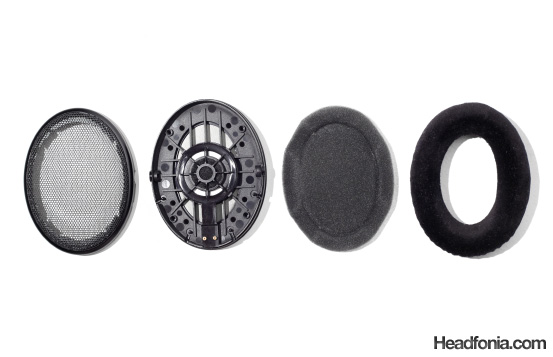
HD650 disassembled.
Digging up further, I found an article by Wes Phillips that outlined even more of the changes on the HD650:
Sennheiser has actually used a tougher metal mesh for the earcups that shouldn’t dent as easily as the old stuff. (I welcomed this news — my 600s, which have traveled to many a recording session, are quite banged up.) The whole structure of the HD 650 seems far more solid and less resonant than that of its predecessors, possibly as a result of a stronger spring in the headband. Sennheiser states that it has beefed up the 650’s “baffling damper” — a membrane that controls the chamber resonances of and within the earcups themselves — for “tighter acoustic control.” If that means the headphones feel dead-quiet and free from any structural vibration, then: mission accomplished.
But the biggest changes in the HD 650 are the aluminum voice-coils, the new diaphragm material, and a Kevlar-shielded OFC cable that sports a dedicated 1/4″ phono plug (a phono-to-miniplug “cable reducer” is also provided). In addition to being made of a different material, the 650’s diaphragms are constructed differently — it’s a membrane of variable thickness that has been tuned by ear. Not only by ear — Sennheiser has comprehensive test and measurement facilities — but engineer Axel Grell found that when the ‘phones measured flat, they sounded harsh. So he very carefully tuned the response to have notches at 5kHz and 16kHz. These notches, speculates headphone maker-designer Tyll Hertsens, of HeadRoom, mimic the ridge notches of the concha — the largest and deepest concavity of the external ear, or pinna — which help you determine the azimuth and elevation of sounds.
So, from Wes Philips’ article, we learn of some additional differences between the HD650 to the predecessors. The HD650 has a more solid structure — this I can confirm. Not sure about the metal mesh, as I don’t want to damage my headphone to test it out, but that’s also possible. The beefier baffling damper is possible, seeing that the color for the HD650 assembly may indicate slightly different plastic material. All these changes would most probably contribute to a better acoustics, something that is definitely heard on the HD650. Then there is also the aluminum voice-coil, new diaphragm material, and a new cable. Interesting indeed. I won’t talk too much about the cables, but the aluminum voice coil and the new diaphragm with variable thickness may contribute very strongly to the superior HD650 soundstage (as we will discuss more thoroughly later).
With the right set up, the HD600 and the HD650 proved to be just as enjoyable to my ears as any of the thousand dollars offerings. Take the HD800 for instance, it has gobs of technicality superiorities over the HD650, and yet it didn’t win as many converts as the HD650 did. At a certain level, any additional technical superiority becomes irrelevant. And even if the HD650 may be inferior to new $1,000 flagships, it has enough technicalities to please just almost everyone outside the Electrostats-addicts. Perhaps the Sennheiser engineers were right when they opted for musicality rather than accuracy in developing the HD650.




Danny
Just curious, when you say adequate amplification for the HD650s to have a good soundstage and be noticeably different from the HD580/600, which of the following from the amps you used were sufficient?
AMB Beta22 (balanced and single ended), Eddie Current Zana Deux, Grace m902, Matrix M-Stage, Hifiman EF-5, Ibasso PB-1
I was wondering at what price point does it become “sufficiently good” amplification and any more beyond a certain point requires a lot more money put into the amp to get a noticeable improvement?
Mike
Excellent question, Danny.
I actually had the same thing in mind when I was writing the article. At what price-point can you start to call an amplifier "sufficient" for the HD650?
There is no easy way to draw the line of what's sufficient and what's not. I mean, an Ibasso PB-1 can drive them to a deafening volume level, and with a good amount of refinement as well. But is that sufficient? Someone with no prior amplifier experience (i.e HD600 direct on laptop) will call the PB-1 sufficient. But someone more experienced with amps will see the shortcomings of the PB-1.
It's even harder for me personally, as most of my listening are done on fairly high end amplifiers, and so my ears have adjusted to that level. It's hard for me to listen to a budget amp with the HD600/650 as I can always see where the amplifier fails to produce the level of refinement that the phones are capable of.
That's probably the best answer I can give for now.
Danny
Thanks for the reply Mike. Just curious since the M-Stage got good reviews from you as well as people on Head-Fi: what (if any) deficiencies using the HD650s on the M-stage as compared to a higher end solid state?
Mike
Oh, the difference is quite big, Danny. I still think that the M-Stage is a great amp, but with the HD650, I can feel that the amp is not that refined, even with OPA627 Class A. It has gobs of power, for sure, and it matches beautifully with the HE-5LE (better than the Beta22). But not with the HD650. Even the Concerto is already more refined than the M-Stage.
Danny
I forgot to add: with the OPA627+class A mod specifically since you did the mod after your review.
iyayy
more readin yes!
will do it later tho.
thx. 🙂
Mike
More comments after reading, okay? 🙂
iyayy
no probs on that.. skimming thru briefly. nice breakout of the components, very informative.
there is one thing that kinda runs thru my mind tho,
HD600 is said to perform better with 650 grills and cables. it's already modding part, but since u have the 600 and 650, it probably nice to include some impression. it would also validate the point about acoustic improvement from housing materials. 🙂
Mike
I've tried the swapping the HD600/HD650 cables and ended up going back to stock configuration. This is why:
The HD650 cable adds low bass quantity, while the HD600 cable is more linear. Using the HD650 cable on the HD600 will add more bass quantity, using the HD600 cable on the HD650 will take off some bass quantity. Theoratically, it should work as some would probably want a tad more low bass on the HD600, and some would want a tad less low bass on the HD650. However, I do find that the bass frequency response is not as linear with the swapped cables. I think there is strong reasons to believe that Sennheiser tuned the drivers, acoustics, together with the cable, and the headphones sound the most coherent on the stock cables.
About the grills, I'm honestly pretty amazed to see how the two seemingly identical grills is able to alter the sound slightly. I wouldn't call the change an improvement, more like a slight tune to the other direction.
On the HD600, the HD650 grills boost the midrange presence a little, which I sort of like. But at the expense of a little less control. There is a slight upper-mid bass reverb that comes out from using this grill.
On the HD650, the HD600 grills reduces the midrange presence a little, while adding a slightly better clarity on the midrange and upper bass. Frequency response sounded a tad recessed and less coherent than with the original grills though.
Keep in mind that I use the word "slightly", "little", "a tad", and so on..
donunus
Wow, we agree on a lot of things Ive noticed. I thought The hd600 stock cables were better than the hd650 cables on the hd580 and the 600 too. I thought the 650 cable took away from some of the cans coherence and the mids sounded cheaper with the 650 cable. The highs were actually also affected as if the lower highs were more edgy from memory and it made the sound less airy because of that.
Mike
Amazing!
I honestly didn't notice the changes to the lower highs and airiness, but it may just be my ears.
donunus
basically the sound became a little more V-shaped except the bass was a little more pronounced than the treble part making them lose some air on the very top. The mids become a little more recessed because of this little extra brightness in the treble(7-10khz) below the top end air zone. I didn't give my hd650 cables time to burn in though since I instantly hated them compared to the stock ones, so that could be the reason for the extra brightness I heard vs your hd650 cables 🙂
Mike
Lol.. that's some amazing observation there! Talk about microscopic ears. 😀
donunus
LOL it wasn't that small of a difference so either I got some fake cables from ebay or burn in really matters with them
Mike
Lol. I don't think you got fake cables, and I did notice the changes in the low freqs, but just didn't catch the changes in hi and mid freqs.
Danny
Forgot to mention: wonderfully written! Its difficult to get good opinions from forums as so many people are biased as to what their favorites are, variety of equipments, etc. Since you had a set group of amps/sources you were familiar with, it was much easier to give your review more weight. Thanks again for the comparison!
Mike
Thanks, Danny. Yes, forums can be a little confusing as you'll always find mixed impressions.
iyayy
sry.. didnt notice at almost the last paragraph.. u did mention about the grills. my bad. >_<
Brian
I'm still trying to figure out what was in Sennheiser's mind when they made that iffy-looking marble finish on the HD600…
Mike
Well, it was designed in the 90s. Clothes people wear in the 90s look pretty outdated now. 🙂
Oversemper
I got Dr.Dac2 DX. I'm considering buying either HD650 or HD600 now with some plans to get about $600-amp in the nearest future (Q2'11).
Which one (HD650 or 600) would you recommend, Mike, for an all genre listener?
And thanks for interesting article!
Mike
For now, the Burson at ~$600 would be my strongest recommendation for HD600/HD650. If you don't mind DIY, the TK2050 Tripath amp ($100) would also be wonderful, though not quite to the level of the Burson. I'm writing a review of it soon.
Frank
I’ve been a mastering engineer for some years(i still do some mastering).
When i had to choose my reference can i asked both to Bob Katz and Steve Hoffman(the most audiophiles audio mastering engineers you can find) which was the headphone they were using for monitoring/mastering purposes.
They both answered : Sennheiser Hd 600.
Since 2007 i’ve only used this can with a lot of satisfaction.
My main rig is totally balanced and it uses constant current drive
techonolgy.I run my hd 600 balanced with a custom cable made of CryoParts SCSCag Hook Up Wire.I can clearly say that the tonal response is very neutral.I always been intrigued by the hd 650 but its own more colored frequency response and somewhat “slow” response to transients
puts mu curiosity almost to an end.
I think that the hd 600 can also sound different by the amplifier you use.
I had one good sound with my lake people G100 amplifier but now i have
a really excellent sound with my hpba2-s by qes labs.
So thumbs up for the hd 600!
Mike
Thanks for the comments Frank. Certainly, using the HD650 would make your mix bass-light.
The CryoParts SCSCag wire is very popular in our local circle, but it's very stiff to be used as a headphone cable (although one guy uses a SCSCag wire for his portable HD25-1!).
I'm interested in the Lake People and HPBA2 amp. Perhaps one day I can listen to them.
George Goodman
Ibasso now sells Sennheiser balanced cables for $39 off their website. The cables are made for the Toucan, as they are terminated in the Hirose connector. Because the Toucan was made to be run balanced, maybe you could do an article about the Toucan and the HD series? It would appeal to many people, as it is semi-budget.
Mike
Thanks, George. I'll see what I can do. 🙂
George Goodman
Thanks.
iyayy
thx for the detailed response on the grill/cable mod. :thumbs:
Professor00179
During my reading through head-fi I have noticed that back in 2003-2005 when the HD650 were fairly new people considered them to be very similar to the HD600. I have even seen few posts saying it's not worth to go for the HD650 since they sound almost identical just like HD580 and HD600. I find it funny that it took about 2 or 3 years for such a big community to realise how different these headphones can be. I actually can imagine someone 'testing' HD650 and HD650 on mediacore AMP and describing it as very similar. I can also imagine how the rest of head-fiers started to repeat this opinion having not tested both. Disadvantages of having big communities I guess. Another funny thing is how the HD600 was loved during ~2000 period and now people say it's 'bad', veiled, dark and dull. Possibly the part of that Beyer DT880/600 'hype' that we have since nearly a year.
Also one thing – you have recently praised the HD650 quite a lot and you even said you think they are better performers (well not exactly but that could be a general conclusion) than K701 and DT880. Be prepared for a war with Senn-haters!
Mike
Hi Professor,
Thanks for sharing your thoughts. You know, I started this hobby with the ER-4S, and back then I couldn’t understand what the HD650 were all about. Of course, we were all drooling for the Grado RS1 back then, which sells for almost double the price of the HD650 (on the street). But after some time, nobody in our forum would even consider buying the RS1, while the HD580/600/650 continues to be highly sought. Interesting changes indeed.
Kelvin
Interesting article, Mike!
Pretty much agreed on the points covered. Although I must mention that the HD600 is by no means bass-shy as the article seems to suggest. Fresh out of the box the bass can be a tad overwhelming.
I agree that the pace the 600's carry would pretty much make it happy with most tunes, just avoid loudness war material with it. It behaves exactly as advertised (in the UK, they are classed as music monitors). So if you feed it well-mastered/well-recorded tunes, it will tell you they're fine and vice versa.
Unlike typical monitors, do note that the music can be very engaging too (down to the pace again?). Kinda reminds me of the sound you'll get in a well-set up producer's studio or theatre.
Certainly not regretting the purchase. 😀
Mike
LOL. You sounded very enthusiastic with the HD600 there. I'm glad you got it. It's hard to go wrong with the HD600. Even my friend who's been going up and down with HD800s, Edition 8s, Vintage Orthodynamics, and dozens of other purchases ended up with the HD600.
donunus
Correction on the release date of the hd580. It was released earlier than 1995 since I bought mine in 94 right after stereophiles review along with some headroom amps 🙂
Professor00179
I was not sure about that but I also thought the HD580 was released in 94.
Mike
Thanks guys, I’ll make the correction.
donunus: you know, I still have never heard the sound of a headroom amp till today! Gotta call the people @ headroom and have them send me a BUDA. 😀
Richard
Curious about your thoughts of the 600 with a portable setup: Fiio X1, gen1 and the e12 mont blanc amp. Using flac exclusively.
Professor00179
@Kelvin – I'm very happy you're enjoying you new headphones! I like my HD580 too.:D
About the bass – I find it to be exactly as it should. Not too much and not lacking. At least in general because on some recordings the bass can be overwhelming whereas on the others it does not appear at all (just my impression though). Still I think it is good these headphones have some wieght to the music. The bad thing about the HD580 is that it made me wonder how HD650 might sound like and since I really have no option to demo them. But then again – HD650 will have too much wieght in certain cases. I have not heard them but being an owner of the HD580 and listening to very wide range of music I know that specific recordings will not sound good with headphones that have more wieght and bass. I will then buy complimentary cans that will have less weight. And this is the story of how I am going to lose another $$$ during a year, lol. I am not sad though (not now when I think it's worth it).
Kelvin
Yup, I certainly do. Although I must mention I had to readjust myself a little to suit the headphones, which actually meant it still isn’t the most ideal.
That brings me on to the bass. I don’t think this simply adds weight to the music per se. Early on (even sometimes now), I’m under the impression I’ve strapped 2 subwoofers to my head and let them POUND the bass notes into my brain. Or it could be that I’m just too used to a more mid-centric presentation.
For myself, a DAC + Amp combo (or a one-box) will certainly follow when I have budget again. High chance being the CEntrance DACport for now.
Hmm…complimentary cans. I seriously don’t know if that’s a good idea. If I were you, though, I would probably opt for the 598. It has a very open presentation compared to the 600 and definitely a lot more relaxed with the lower registers. That is not to say it doesn’t punch low, though. Music is still rather weighty on the 598, just not on the same scale as the 600.
Mike
I know my writing style made it sound like the HD600 is bass thin, but it's not. It's just in relation to the HD650. I need to rewrite that part to avoid any mis-interpretation.
Frank
Mike,
what about the hd 650 defoamed,recabled with CryoParts SCSCag wire
and run balanced? Could it be better than the hd 600?
I wonder if sennheiser will build a worthy successor to the hd 600.
I would not call the hd 800 a hd 600 on steroids 🙂
Mike
Hi Frank,
HD650 stock is better than the HD600 already. 🙂 No need for SCSCAg, balanced, or defoamed.
I heard Sennheiser will soon discontinue the HD600/650. 🙂
The HD800 is far than a HD600 on steroids, Frank. 🙂
Frank
hd 650 better than hd 600?
maybe not from the audio mastering point of view.
Hd600 has a flatter and more neutral freq response
compared to the hd 650.i was talking about defoam,silver recable just to remove the bump in the low-mid frequencies
and to open the sound in the high frequency range.
Then if you ask audio engineers 7 out of 10 prefer the hd 600 🙂
By the way if sennheiser is going to discontinue both of them
i'll buy another hd600 just be sure to have a replacement 😉
Do you know something more about the future models that could replace
both hd 650 and hd 600?
thanks!
Mike
Frank, I was talking about the technicalities stand point. For monitoring, definitely go with the HD600.
No info for the replacement models for now. 🙂
Frank
thanks for the tip Mike.
Thanks again for your accurate and very interesting review.
cheers
Mike
After a clarification email from Sennheiser, I have edited the introduction paragraph with the launch dates. This is direct from Axel Grell at Sennheiser:
Hi Mike,
I read your write-up "The Sennheiser Trio" as well as the readers' comments on the launch of the HD 580.
Then I decided to get in touch with Axel Grell and he told me that the HD 580 was launched in Spring 1993 while the wireless digital infra red version (HDi850) was launched in August 1993.
The limited edition HD 580 Jubilee (for Sennheiser's 50th anniversary) was launched in 1995. HD 600 was launched in 1996 and HD 650 in 2003.
As for your DM on the HD 600/650 discontinuation, it's still just a rumour 🙂
Frank
call me crazy or what but i'm not an audiophile.I tend to evaluate thing from a pro point of view.
Tonight i've just tried a mod on my spare pair of hd 600(bought 2 years ago and well burnt-in).
I've just removed the foam on the outside of bothy drivers(the small ones).
There's clearly a change!!!
The upper registry opens a bit.The sound of bass seems to me less congested and has a more natural sound.A little more speed on transients.
Before removing the foams on the outside of the drivers i've listened 2 times to a song i'm extreme familiar with.And i've done the comparison listening to the same song
after the mod:there's clearly a change.I'ts not snake oil.Try for yourself.
I'm not an audiophile.I've been using the hd 600 since 2008 and i deeply know its own sound signature.i really like the improvement.
😉
donunus
Youre talking about the small foam behind the drivers right?
As far as the foam in front, I don't like the ringyness that happens when taking out the foam. It also makes the bass thinner. Maybe the ringyness without the front foam has something to do with reverberations in there not being tamed enough.
Mike
Thanks, Frank. That's something I've never tried before. I don't think you're being delusional, as little things Sennheiser planted in the assembly seems to work together to fine tune the overall sound.
I've tried removing the foam in front, and like donunus, I didn't like the result as well (although it did make the sound a little brighter, which some people may like).
Now, which little foam outside of the drivers did you exactly remove again??
Frank
the foam here :
http://apuresound.com/images/cables/howto/senn/mo…
i think you can clearly see it in the picture and how to remove it 😉
the problem is that once you've done it it will be pretty difficult to put the little foam
back on the original position.But the sound improves for sure! so it's worth doing it 😉
Mike
Ah, I’ve read that document a long time ago but I’ve forgotten about it!
So, it’s sort of a gambling… take it off and I may not like the end result. Because my experience is when you mod something, you gain one area and you lose the other. Surely the engineers at Sennheiser have their considerations for putting that foam there.
Eswar Santhosh
Thanks a lot for the reviews, Mike. After reading both your comparisons, I think I was right in thinking about a HD600.
I was postponing the purchase primarily because searching through head-fi confused me more than clarify about the strengths and weaknesses of the contenders – AKG K701/2, DT880/600 and HD600 (I was not considering HD650 due to the colored signature).
I already have a HRT MS2 for DAC and Maverick TubeMagic D1 as a Headphone Amp. I’m thinking of later upgrading to Burson HA160 as a headphone amp and may be HRT MS2+ for DAC. Do you think the setup I have and plan to have are good enough for HD600? Any other options I should think of (cheaper the better, of course ;))?
Mike
Hi Eswar, I think the HRT MS2+ and Burson would be more than adequate for the HD600. You can even stick with the MS2 DAC, and I'd still think that'll be a great set up.
B)
Marlene
Allright, I have to write something…
First: wonderful site. I enjoy reading your articles tremendously.
Second: this article is immensely true… I don´t know the moment anymore when I bought my 600 but I still knew that I replaced my 580 with them. And until the 580 I used the more expensive, closed Sony´s (CD-1000). My first Sennheiser was a revelation, I literally fell for them on the first listen. I believe my 600 are now seven years old and until three years ago I listened to them via my headphone output of my multichannel amplifier. So far, they improved with every step I made regarding amplification. Right now, they are powered by the amp inside the ASUS Xonar Essence ST. Mike, do you think that this is sufficient? I still have a Corda Arietta but it colours the sound a bit.
I also use the 600 with the 650 cable and I love it. It takes away the slight sibilance that hinders differentiation present with the stock cable. It would be horrible if Sennheiser would discontinue them…
Mike
Hi Marlene, thanks for the kind words, even as we're going through some major changes in the website — fixing glitches and changing design and all…
Thanks for sharing your impressions. When the HD600 was released, I didn't even know what a good headphone is, so I didn't know what it was like back then.
Now, I guess you're asking about the amplification. I've never heard how the Xonar sounds (gosh I really need to find one), but as far as I know, they are based on the fairly powerful TPA6120 amplifier chip. I think that should be enough to drive the HD600. Plus, if you feel that the music is good with that set up, then the music is good.
When I started, I've always wondered that if a more expensive amplifier would improve my music experience. But after going through so many amplifiers, that is not necessarily true. A good amplifier+headphone pairing is a good pairing regardless of the price. And sometimes more expensive unit may not better that, though technically things may improve.
Having said that, what amplifier do you have in mind to upgrade to? How much budget are you thinking of spending?
Marlene
Hey Mike, thanks for your answer!
I know the feeling, not knowing how a good headphone actually sounds. In hindsight I´ve experienced this for years… you wouldn´t believe the crap with which I started.
Anyway, I really feel that the music sounds the best (compared to what I was having before) with my current setup. When I´m listening to music that I haven´t heard for years I´m constantly baffled at how much the sound differs from what I was used to listen to many years ago. So I don´t exactly plan to upgrade my amplifier, this has not yet crossed my mind. On the other hand, the 600 grew with every source/amplifiying improvement I´ve made so far. I just wanted to ask a general question if an improvement is possible because I think it COULD be possible.
But if you say that sometimes things can be overkill (supposing that I understood you correctly) I´m very confident that I have something good for the price I´ve paid. Of course, one always wants to improve the setup, that´s what makes this hobby so darn interesting.
Furthermore, some of the things you talk about in your articles are fairly hard to get here in Germany, I would have problems obtaining them. Take headphone cables for example, it´s almost impossible to get them here. Many of those can only be ordered via credit card and I won´t get a credit card only for my headphone. I don´t love it that much I suppose 😀
Anyway, thanks for your reply!
Mike
You're based in Germany? I don't live there, but I think there are a lot of things that you can get, being based in Germany.
Reading from your comments, I think the Xonar probably does a fairly good job of driving the HD600s, which is easier to drive than the HD650 anyway. There are several upgrade paths that you can take, but it's hard to give a precise recommendation as high end amplifiers tend to have their own characters. It's like Mercedes or BMW, both very good, but people will still have their own preference.
For instance, the two amps that you can probably get easily is the Lehmann Linear and the CEC HD53N. The Lehmann is more precise, accurate, and uncolored, where the CEC has a warmer tone and a sweeter midrange. Some people would like the Lehmann, and some other would like the CEC. So, it would be good if you can tell us a little bit about your music.
I can also recommend you to get an upgrade in your source by getting a newer DAC, but since you already have the Xonar, I think an amplifier upgrade is better. 🙂
Frank
even if i've said that elsewhere this is what i've learned doing many tests:
1)Both hd 600 and hd650 headphones need proper burn in
2)Hd650 needs a powerful amplifier to drive them.
Hd600 it's easier to drive.Hd600 is far more neutral compared to hd650.
3)Both headphones improve a lot their perfomance if you use a balanced configuration with a real balanced amplifier.Since i've bought this one i've never looked back :
http://www.gearslutz.com/board/mastering-forum/47…
4)Both headphones improve frequency response if you use a silver cable.
High frequencies are more upfront,bass becomes tighter and you have
more speed on transients.
5)Both headphones open their frequency response by removing the little foam on the outside of the drivers.
just my two cents
Mike
Thanks Frank. Solid comments from a monitoring point of view. 🙂
Mike
Yea, I was just listening to the HD650 via the TK2050 amplifier today, and I think it is one of the best pairing I've heard with the HD650. It's semi-DIY though. 🙂
http://www.headfonia.com/hifimediy-tk2050-amplifi…
Will
Hello!
I just bought the Nuforce Icon HDP which is an upper entry lever head amp/dac. I can't decide should I go for the hd600 or the hd650. My local dealer sells them for the exact same price. Please help.
Regards
Mike
When in doubt, the HD600 is always the better choice. 🙂
Unless you can audition them both, then you may be able to decide better for yourself. 🙂
Shahrose
Hey Mike. After spending a lot of time comparing the HD600 and 650, both stock and recabled with the Buffalo 32/Headamp GS-1 and other secondary setups, I've come to the very same conclusions as you. I've got to say you really nailed it with this review…
Mike
Thanks! These old Sennheisers still make very nice music on my set up with the Zana. 😀
Will
I posted the comment before Shahrose. I now have Nuforce HDP and HD650. It's a decent combo, but I find it a little lacking at lower volumes which I prefer at my listening. The problem seems to be a lack of soundstage or resolution or both. As a beginner I'm not sure about all the hifi words.:D Somehow I don't hear a lot of sounds and instruments as well as with higher volumes.
Would an good amplifier such as the auditor etc. Solve this problem and increase the soundstage and resolution at lower and at very low volumes.
Thanks for your earlier reply!
Mike
Will, I'm writing this as I'm listening to a HD650 out of an Ipod/Pico Slim combo. As you know, the Pico Slim doesn't have too much power. At lower volume, the apparent soundstage size decreases, but I think that's expected from any headphone. But at this set up playing at quite a low volume, I don't feel that the resolution has been lowered. Of course it's hard to hear all the details as if I'm listening at a louder volume, but I think the driver still resolves quite a good level of detail.
I also checked this with the Burson HA-160D and found pretty much the same result.
Mike
I was curious, and so I turned on the 4-ch Beta22 with the HD800 in balanced, and I tried to check the low volume performance of that set-up. This is probably as good as a solid-state set up can get.
What I find was mostly similar than with the HD650/Burson or HD650/Pico Slim.
At low volume, the soundstage is smaller, and though I can't hear ambiance cues as well, I don't feel that the resolution of the driver has lessened in playing the instruments that I can still hear quite clearly. I think what happened is that the ambiance cues are washed out in this volume level simply because they have reached a dB level far too low for my ears to capture. As soundstage information is also happening at the high treble frequencies, the soundstage also got smaller because those information has now dropped to a very low dB level and my ears can't hear them anymore.
Hope this answer will suffice. 😀
will
Thanks again Mike!
That's actually good news since the increase of low volume performance was pretty much the only reason I was interested about a more expensive amplifier. So if I want to improve the performance the only option is cranking up the volume and having shorter listening sessions then?
Mike
Yap!
Charlie
I'm not sure if you're familiar with Audio-GD and their line of amplifiers, but if you are I would really value your opinion. I have the Sparrow Amplifier, and I'm trying to decide between the HD598, HD600, and HD650. Based on your reviews, I think I might like the HD650 the most, but I'm not sure that my amplifier is up to snuff for the job, particularly in terms of the soundstage. Because of this, the 598 seems like a safe choice, but when I had the HD555's, I always found them to be lighter on bass than I would have liked.
Mike
Hi Charlie, the 598 is going to be even lighter on the bass. The HD650 and HD600 both have better bass than the 5** series, and I'd recommend the HD600 as it's generally easier to amplify.
Charlie
Thanks a lot for your input.
Mike
You're welcome.
Ed Austin
>better bass than the 5** series
better than the HD580?!
Mike
Sorry not the 580. I mean the 558, 598 and such.
Erik Wijnands
As of today I own the proud owner of a secondhand but mint HD580! I bough them for $110. The first thing I do after obtaining a new pair of headphones is reading your site to see if you have anything to say about them. 🙂 This way I learned about the grill-mod (I’ll buy some spare HD600 grills) and am now looking for a good amplifier to go with them. The only amp currently in my possession is the Arrow 12HE but I’m looking for a nice desktop solution. Is there a hidden gem, a mighty back-for-your-buck giantslayer, I definitely should look into? 😉 Let me know!
Also, would you say a dedicated $250 DAC (audio-gd, firestone, matrix, nuforce etc) would offer a worthwhile investment over my current Tascam US-122L DAC or Creative X-Fi soundcard?
Thanks a zillion in advance!
Anonymous
Congrats for the purchase 🙂
What kind of a budget are you looking to spend for the amplifier and the
DAC?
My favorite $300 DAC is the HRT MS2+, but that’s more like $349.
Erik Wijnands
I’m always a bang-for-your-buck kinda guy. I buy most of my equipment secondhand or look into products that offer great performance at a reasonable price, hence my appreciation for the Superlux HD668b. Do an amp & dac HAVE to cost $500 to sound good? I’d try vintage receivers before shelling out for a Burson for example.
Anyway, my ideal solution would be a DAC that sounds noticeably better than my soundcard hooked to an amp that can power my headphones (ATH, Grado, Senn, Superlux, Sony) but can also power a pair of bookshelf speakers. This setup would ideally cost less than $500. 🙂
Anonymous
The Dr. DAC2 DX comes with a good DAC, headphone out, and capability for
output to an active speaker:
http://www.headfonia.com/dr-dac2-dx/
Erik Wijnands
That thing looks mighty interesting! Thanks! It has most of the functionalities my Tascam US-122L has. Wondering how they will compare sq-wise.
Anonymous
Interesting! I have never auditioned the tascam, but they are targetted more toward the pro-crowd, I believe.
In general, pro-gears are more linear in frequency response, while audiophile gears tend to be more colored and placing more importance on midrange qualities.
Darky
Hi everyone !!
I am progressive rock and metal listener (with very speed pace) and i would like to know your opinion about a budget combo HD600 w/FIRESTONE Audio Cute Beyond (i have a hd 555 it’s ok but the lack of bass is a handicap and i take aside the hd 650 because of its inertia 🙁 ).
Thank for your answers 😉
Regards
Darky
Anonymous
Darky,
HD600 should give a better pace than the HD650, and also better bass
than the HD555. But my suggestion is to go with a HD25-1 and skip the
Firestone amp.
Darky
Thanks a lot for your reply.
The HD25-1 is very interesting, but i prefer open headphone for the soundstage and listening comfort (i spent more than 4 hours on music non stop 🙂 ). Perhaps the HD598 is a great budget update for bass (very important because i’m a bass palyer)/speed combo and i can skip the amp too ?
Rgds
Anonymous
Yes, open headphones have their advantages, but for your music, it’s
going to be very hard to get the kind of fast-paced, tight bass, from
open headphones. The HD598 is voiced more for jazz and vocals, I really
don’t think you are going to enjoy it.
ArenaZ bought a HD598 and ended up getting dissapointed with it, and he
finally got a HD25-1 and was happy with the HD25-1. You can read his
comments here:
http://www.headfonia.com/old-and-new-hd555-hd558-hd598/#comment-148611792
Darky
hello !!
Thanks !!! 🙂
Alright the HD 25-1 is a metal killer :). I regret isn’t a circumaural headphone for the comfort (eyeglasses). I have read the article about the shure SRH-840 but it’s seems to be a good all rounder but more comfortable perhaps. Do you think it can be a metal champ 🙂 ?. thx again for your reply
Anonymous
I honestly think the Shure 840, while wonderful in its own regards, lacks the attack for Metal.
Darky
Ok i will go for the HD 25-1 🙂
Thank you very much for yours experts advises !!
heafonia.com rocks !! 😉
Keep it on !!!
Anonymous
Thanks!
9homme
Hi Mike,
After reading a lot of your review, I have decided to buy HD650 to be my love but I don’t have a good amp for it. Could you give me some suggestion of Solid State Desktop Amplifier around 400$
Thanks,
Anonymous
There is a lot of amp on that price range, but one that I thought had good synergy with the HD650 is the Ortofon HD-Q7
http://www.headfonia.com/ortofon-hd-q7/
TMC
Hi, I am looking at the ATH-W1000X, HD650, and HD600. How would you rank these 3 headphones for classical music (symphonies)?
Anonymous
For symphonies, the W1000X is good, but it doesn’t quite have the low end slam of he Hd650. German headphones, you know? I am quite sure the Beethoven 9th was used extensively in tuning the headphone. Lol.
Anyway, I haven’t listened to the W1000X for a long time, so I am probably not the best guy to ask. But what I remember is that the closed housing still have some reverbs, which is very annoying for Symphonies, and the bottom end impact can’t match the HD650’s.
Between the HD600 and the HD650, I’ll take the HD650 (again) due to the better soundstage and low end impact.
Marburger
Mike do you really can hear difference between recabled headphones or interconnect rca cables? I read contradictory statements in forums. Some say (physicians) there must not be any changes in sound between stock cheap cable (say cheap copper) and branded pure pcocc capbles (canare, Van den hul…) They say little firms make only money and fool the customers. Others argue to death that better cable improves sound little bit. I bought new cable to Senn580, it is on the way now. But I am bit confused. What is your expirience with, share it please.
Anonymous
They do make a difference. Slight though, and the biggest change you get is still with a proper amplifier and source. If your system is 90% ideal and you want a tiny little bit of tuning, then get different cables.
Windsor
Mike recently asked me on Twitter about how the HD 600 was for heavy rock/metal music, and my reply was a bit long, so I’ll share some of my thoughts about that here along with some of my general findings with the HD 600.
Mike’s HD 600 / 650 / 598 review is a great comparison of those models, and I’ll mainly focus on the HD 600 here.
Firstly, the HD600 has changed the way I hear music, wonderfully so.
I find the HD 600 quite neutral and with them, I hear the details on a recording with plenty of pace and clarity and nothing seems to be overemphasized; the HD600 clearly portrays the whole picture of the recordings I hear. It’s a great all-round headphone that can work really well with most types of music, including rock music.
— Rocking out with the HD 600 —
With the HD600, if I listen to music such as heavy rock and metal, I can certainly rock out, and the ‘rock out factor’ is largely determined by the quality and sonic balance of the recording I’m listening to. Using the HD 600 and flat EQ, I’m probably more likely to rock out and move to recordings that have more low-end weight which moves the HD 600 diaphragms more.
‘Freedom’ by Rage Against The Machine is an example of a heavy rock recording that has quite a bit of low-end weight to it. I just listened to it with the HD 600 in the process of writing this and found myself rocking and moving my body, quite enjoyably. ☺
The HD 600 provides a subtler experience of rock music than with headphones such as the Sennheiser HD 25-1 or Grado PS-1, which are more ‘forward,’ sounding, and the HD 600 and could be described as a bit thin or light for some tastes, but if the recording is of good quality then the HD 600 will reflect that and reveal the vibe of the music with clarity.
With the HD 600, the sonic detail and quality of well-recorded music is a treat. Music with relatively complex parts e.g. Lateralus’ by Tool is great to hear. With the HD 600, the drums on ‘Lateralus’ have plenty of PRaT, though at the end of the song, I’ve sometimes wanted to feel more sub bass, but I enjoy hearing the bass relative to the other parts of the recording. It seems that when I use the HD 600, I constantly listen to the overall picture of the music as my default perspective.
With fast-paced music, such as songs by the heavy metal band Slayer, the HD 600 isn’t as ‘forward’ and ‘aggressive’ as headphones like the Grado PS-I can make music sound, but the HD600 is a relatively softer listen and easier on the ears which still provides plenty of pace and clarity.
If you intend to listen to faster-paced rock music with the HD 600, I’d also recommend using a DAC/Amp to enhance clarity and impact. When I used the HD 600 via my laptop’s headphone out, the details in fast rock music were rather difficult to hear, but the DAC/Amp I used was quite inexpensive and made the computer noise disappear and the music sound clearer with more visceral impact, which I found satisfying.
— Some overall impressions of the HD 600 —
The HD 600 is a great all-round, neutral sounding headphone that facilitates hearing the whole picture of a recording. Listening with the HD 600 is what I imagine it would be like to listen to music via high-quality neutral-sounding monitor speakers with a thin sheet of fabric between the speakers and my ears (to illustrate how the HD 600 seems to soften the treble slightly).
I really enjoy the HD 600, and rank it among the ‘best’ headphones on the planet at this (‘best’ being totally subjective, of course). I’d like to say that someone I know who owns a Sennheiser Orpheus said that ‘you can’t go wrong with the HD 600,’ and I think that says a lot.
But at the end of the day, it’s the music that matters. Since I got the HD 600, I stopped listening to headphones as much and started listening to music more. The HD 600 really get out of the way and put the music on display. I like that. ☺
Anonymous
Hey man, all those comments asking more sub bass make me think you should go and try out the HD650. Mine is out on a loaner at the moment, when it’s back I’ll give it a try with RATM and Slayer.
Also did you end up getting a DAC/Amp box? The Yulong U100 sounds exactly like what you need. It should make the HD600 more forward and adds better bass articulation and punch.
Windsor
Hey there,
I have the HD 650, which is great, but a little boomy in the bass at times, esp. with faster-paced music.
I wanted to go for the Yulong, but I’m a Mac user and remember what you said about the Yulong’s Mac compatibility issues, so I opted for the the Nuforce Icon HDP. It makes the HD 650 a little brighter and tightens up the bass a bit, which makes it like a new headphone to me. 🙂
The HDP adds punch to the HD 600, but the treble is bright to the point where my ears are ringing slightly even after short listening sessions.
I was considering the Lavry DA10 as something more neutral, but you said it was cold and bright and recommended the HRT MSII+, so I checked it out and it apparently pairs very well with the HDP, which is best as a head amp.
In the meantime, I’ve applied some EQ to the HDP making it work well in iTunes, but then audio from the rest of the OS is bright. It’d be nice to just have a simple high-quality neutral DAC/Amp solution…
In the meantime, I have a cool product by Lexicon. It’s the Alpha USB interface (24/96) – great value product. 🙂
Anonymous
Ah, I see. Yes the HD650’s bass is a difficult to control well.
So you’ve gotten the HRT 2+ ?
Windsor
Not yet, but I may give the HRT 2+ a listen today at a nearby store to see if using it as a DAC for the HDP seems worth the upgrade. I not sure I want to spend hundreds of dollars if the upgrade is marginal though…
I guess I want the best quality simple system that I can transport with my laptop. The HDP is definitely ‘good enough,’ and I love my HD 600 / 650 / 25 etc. I can do without the excessive brightness of the HDP.
I shall meditate upon it. 😉
Anonymous
Windsor,
With your music, I think the HRT’s bass is not articulate enough for
Hard rock and the metal stuff that you listen to. It is warm and analog
sounding, but not articulate enough in the bass. I guess that makes the
Lavry a good candidate, but I do think the treble issue may not go away
with the Lavry.
Windsor
Hey Mike – thanks for the response.
These days I don’t listen to much hard rock/metal, but I revisited some recordings to share my impressions with you and headfonia community in response to your question. It definitely provided quite a bit of insight into how much of a difference the recording makes to the listening experience.I want my system play music well without getting in the way, whatever I listen to (be that jazz, metal, classical, R&B etc) hence my appeal for neutrality and the Lavry. It could also be used for pro studio applications if I take that route.I may have an opportunity to try the Lavry v. soon. When I hear music with it, I’ll most probably know if it’s for me.
🙂
Anonymous
Awesome. The Lavry is very impressive sounding, but after a longer
listening period I find the sound to be too monitoring for me. 🙂
Mike11
Hey Windsor, my HD600 arrived today, and unfortunately my Yulong U100 is still being delivered, however I was able to use it out of my reciever and listen to some of the cable music which obviously is not the best of quality but it gave me an example of the HD600, holy cow after hearing a lot of cans the one word that comes to mind is Clarity, everything is clear and im sure that has to do with its close ot flat response the pace is pretty quick as well, I tested it on some alternative and metal, and like you said the bass may be a little shy for those recordings I’m hoping the U100 may fill the gap, if not I will get the HD25 / Pro700Mk2 for my stuff that requires a bit more in the bass department but either way the HD600 are here to stay, I’ll comment more when the Yulong comes in, but so far they have left a very positive reaction with their extreme clarity and balanced sound sig. I really see now why its had such a following even after all these years its been on the market. Thanks again to you and Mike for recomending I give it a try, regardless if it will work with my Trance and heavier metal music they will be staying for other genres.
jeffreyfranz
Windsor:
I am responding to your very thorough post in the HD 580/600/650 comments six months ago. So I’m gambling a bit that you’ll even see this. My Q: I have the AKG K701 and too often find them cold and steely. I had the HD 650 and found it murky and muffled. I have been thinking that the HD 600 might be the answer: right in the middle. But now I am also thinking maybe my Fiio E9 amp at that time wasn’t up to driving the 650 properly, and maybe the Bellari HA 540 tube/ss hybrid I now use would open up the 650 somewhat, “put some air in it.” I mainly listen to classical and jazz, plus some female vocal. I come from a purist high-end audio background and want to stay away from eq in my main system (where I run the CD straight into the HP amp). Can you help? Any other suggestions? I’m not sure which way to go at present. Thanks.
Windsor McGilvray
Hi there –
Not sure if you’ll see this, but I’d definitely recommend the HD 600 based on your preferences. I haven’t heard the K701, and have found the HD 650 to sound muddy at times, whereas the HD 600 got out of the way of the recordings more. Thumbs up for the HD 600!
Kenken
Hi Mike,
Need your advice regarding HD600 and HD650 as my “be all end all” home headphones (I hope :p). My budget’s not really high, so I’ll prolly be purchasing e yulong u100 to match these phones, seeing how you recommended them as a good pairing dac/amp at a budget (I don’t have either dac or amp currently). But I’m wondering if I should go with e HD600 for genre bandwidth, or theHD650 for future scalability and jazz?
I listen to a wide genre except heavy metal and hip/hop.
Quite torn between the two cos of the price diff, and yet I don’t mind more bass for my alt rock n electronica songs. Having said that, the savings made on the HD600 could go to the u100, lightening my financial load… Any thoughts?
Anonymous
I’d just go for the HD600 if you are in doubt.
The HD650’s scalability is something you’d probably be concerned years from now when you have a good high end amp. Plus the HD600 works better for rock and electronica.
Kenken
Hm, will the HD600 sound gd for stuff like John Mayer, Diana Krall, Eric Clapton? I understand the car engine analogy, hence I’ll still keep my es7 for rock on the go.
Anonymous
I think the HD600 will be awesome for those three. I happen to listen to all three of them, though not so much Diana Krall.
Kenken
Gd to know! Btw Mike there’s a chance I might switch to a mac sometime in the future. Just to play safe, do u have any other cheap amp alternatives other than the u100? I read someone on head-fi sayin a HD600 and Audinst MX1 didn’t match well.
Also when you say lighter bass n neutral, you don’t mean hifiman re0 light right? :p
Anonymous
Sound signature wise, the Audinst’s slight dark and warm tone should be a good match with the HD600. I dont see why it wouldnt be a good pairing.
And yes, not re0 light. 🙂
Obzen
hmmn.. if im runnin low on budget, do you think getting an hd 580 is a good decision? im currently looking for used hd 600s but cant find any so far.. someone offered me his 580 wit a cardas silver cable, do u think its a good choice? of i course i dont mind payin for a new hd 600 but i jus want some expert opinion on this cardas cabled hd 580.. i listen to anything, but mainly rock n some bassy music
thanks 🙂
Anonymous
Hi Obzen,
The HD580 is for all practical purposes, the same as the HD600. Hence
it’s one of the most awesome headphone in terms of price to performance.
Here is some other articles I’ve written on it:
http://www.headfonia.com/sennheiser-hd580-affordable-reference/
http://www.headfonia.com/new-old-stock-hd580/
Angel Melendez
Hey Mike.!
The next purchase I had in mind was a Senn HD650!
Seems these guys are really scalable and I would do alright with my current Nuforce Icon HDP and most of the amps I’m looking to buy in the immediate future…
But after reading this, maybe I would prefer the HD600 (I listen to Rock, Punk, Emo, some electronica, some Blues, etc.) or even… gasp… the new HIFIMAN HE-300! Seeing that I have an AD700, Shure SRH 440, 940, etc. with which headphone should I go as my “LAST” top end can without destroying my wallet?!?HD650, 600, HE-300 or another one (i.e. I’d like something like the 940s but with a bit bottom-end and great for the genres posted above…)Thanks a bunch!
Anonymous
Hi Angel,
How do you find the AD700 and the Shures to be?
The HD600 seems like a better choice for the stuff that you listen to. And as for the HD650’s scalability, it doesn’t start to be obvious until you get to the $1K-$2K amps.
Angel Melendez
I love my Shure’s!! 😉
The 940s I find a bit bright but great mids, I just love how vocals (especially women) sound with these. Bass extension is Ok, but it really lacks in that area. Hopefully my JDSLabs Cmoy will arrive soon and I’ll see if it at least gets a bit better there.
To give some background, right now the 940s are my everyday portable/office headphones. Pretty Good isolation, velour pads are comfortable and my music sound quite good out of my mp3 player. As you and a lot of people have mentioned, the source is really important. I have some mp3s that plain sounds BAD! Good recordings, resolution make these headphones shine.
Have only used them twice for monitoring, liked what I heard (did a comparison mixing a track with these and with the 440s… I mostly messed up the bass! :-p)
The 440s are the cans that I have spent most time with. I’ve been using them with the 840 pads for more than a year and the pads actually makes a good difference adding a bit more body to an already good all-rounder (in my opinion, this is the most musical, good high end, great mids, and decent bass. Soundstage a bit constricted but oh well… Isolation is perfect.)
The AD700s, I’m still getting used to the sound as I’ve been using closed-back headphones for the past 3 years. Still, soundstage seems HUGE and right now I’m using them on my PC directly to play games and the occasional music/movie playing. In the music front, they sound quite Ok to me, but they also lack bottom-end, and maybe the openness of them make them sound… I don’t know, less tight might be the word I’m looking for. Still prefer the Shures over this one BUT for the use I give them, they perform admirably! I have to say though, these are the MOST COMFORTABLE HEADPHONES I have ever used!!!
Getting back to the original question though, that’s what I keep hearing, the HD600 might be more suited for what I listen to.
Right now, the 440s are the ones connected to the Icon HDP. I know that those cans are fairly easy to drive so maybe it’s a bit of an overkill to be using the 440s with that DAC/Amp combo. I tried using the 940s with the HDP, but to me a good pairing does not make (seemed to make the 940s even brighter, didn’t notice any bass extension, etc.) So basically I’m looking to upgrade my “home” headphones (440s) with something that will sound good with the kind of bright HDP amp section and that will scale a bit if/when I decide to go with another amp.
I know that purchasing for the present and the future is a bit tricky (that’s like buying a CPU or video card… almost ;-p ), but you know, at least something that will kick the 440s butt and extends my home setup a bit more.
Thanks!
Anonymous
Angel,
I think you will be happy with the HD600. It will give you the sort of resolution of the Shure 940 but being a little less dry. It’ll also give you better bass than the AD700, though the soundstage size is not going to be as big as the AD700.
Angel Melendez
Choices Choices… The HD600 looks like a buy but… I’m also looking at the HifiMan HE-500… a bit of a price hike, but I’d like the very best I can get my hands on so I don’t have to buy another one in a while! 😉 (Less than 1000 of course!)
Anonymous
Quite a price gap there isn’t it? How much is the HD600 now? Low $300s I assume? The HE-500 is $899?
Angel Melendez
yep. You are correct.
Don’t know if the differences are such to warrant the jump, but I also want to have some cans that will “grow” with me in case I decide in the future to buy amps and all that jazz…
Thanks.
Anonymous
I think the HD600 is good enough to warrant DAC and amp upgrades up to $1k-$1.5k.
Angel Melendez
Ok. 1 to 1.5k that’s a lot of room to play (and get familiarized) with the HD600s! I’ll try those. Hopefully I’ll like the sound signature a lot for home use! 😉
Thanks!
And keep up the great work!
Angel.
Anonymous
You’re welcome, Angel.
Anonymous
Hi Mike, I’m considering getting the HD600. I’m also a bit fussy on timbre (realistic tone). I have the AD900 right now and I think they’re a bit off. How does the HD600 compare? Thanks.
Anonymous
I think the HD600 has one of the best timbre among all headphones. Definitely better than the AD900.
Anonymous
Thanks 🙂 Do you think they’ll have good synergy with my Asgard?
Anonymous
Oh yes.
Anonymous
Sorry for asking so many questions, I just value your opinion more 🙂 What about the DT880? How does its timbre compare to the HD600 and its synergy with the Asgard? Also, how do the AD900, HD600 and DT880 compare in overall technicalities? I listen to a lot of folk, country and female vocals but also the occasional classic rock. I realize the AD900’s imaging is a little vague due to its big soundstage. I really love my EX1000. Perhaps, something similar but with the benefits of a full size cans? Thanks!!
Anonymous
Okay $1 per question please deposit to my paypal, thanks. 😉
DT880 and HD600 timbre: DT880 is good but HD600 is better. Again HD600/650 has perhaps one of the best timbre ever, even better than a lot more expensive cans.
Technicalities:
DT880: most resolving, most detailed, most articulate, most accurate imaging AD900: least detailed, very spacious but not so three dimensional HD600: detail perhaps same to DT880 but not as upfront, articulation is okay, soundstage smallest of the three.
But if you’re just evaluating headphones in terms of technicalities, or soundstage performance, you’re not getting the big picture. It’s like buying a car based on “which has the best shock absorbers”.
Please read my Sennheiser article, read the Old school trio article, and read the AD-line up article. Then try to get the big picture of the character of each headphones, and then decide from there. NOT from soundstage comparisons, timbre comparison et cetera. http://www.headfonia.com/audio-technica-ad-series-ad300-ad700-ad900-ad1000prm-ad2000/ http://www.headfonia.com/the-sennheiser-trio-hd580-hd600-hd650/ http://www.headfonia.com/old-school-trio-akg-k701-beyer-dt880-sennheiser-hd650/
Cheers.
Anonymous
Thanks for the quick reply. I like to categorize the headphones according to their individual technicalities. This way, I know what to expect when buying them. I chose the AD900 based on many reviews praising its soundstage and balanced sound. But what those reviews / recommendations don’t tell me is its vague imaging and inaccurate timbre, both which happen to annoy me a lot and kills the fun from listening to them.
Anonymous
The timbre may not be too accurate but it’s not so bad.
If you prefer the AD1000PRM has a better timbre.
Anonymous
Copy and pasted from another comment that I wrote:
“Okay for the last time:
HD558 mod vs HD598. Still very different, and yes the HD598 is still the better sounding headphone. Sennheiser engineers know what they are doing and a simple foam removal mod isn’t going to do it. As for the HD600 vs HD598, The HD598 excels in certain areas like vocal and soundstage depth, soundstage image. But overall the HD600 is still the higher end headphone. The HD598 is the newer release and I suppose Sennheiser have learned a lot more things from the HD600 days and that’s why it’s able to accomplish some things better like soundstage and vocal but overall it’s still proper that the HD600 earns the higher model number. I would brand the HD598 as a very fine Hifi headphone. It sounds good and among the best sounding headphones I’ve listened to. The HD600 on the other hand is a solid reference-class headphone and in that sense it’s a higher up headphone than the HD598 is. The HD600 still sounds very musical, but on top of the musicality you get added points such as a far more accurate timbre and a more proper bass impact both of which the HD598 doesn’t have.
Now interestingly if you happen to have a $2,000 headphone amp, the HD598 scales up better than the HD600.. and again I suspect that’s some of the things Sennheiser engineers have learned over the time which they didn’t quite have when they designed the HD600. But for most people, I doubt they’ll be pairing the HD598 with a $2K amp. “
Jake
Does the Hifiman EF-5 do justice to the HD650’s, or am I missing a lot by “only” using the EF5?
Anonymous
Hi Jake,
The EF-5 should have plenty of power with lots of lots to spare even for the HD650.
The HD650 however scales up very well up to the $5000 desktop amplifiers, so I wouldn’t really focus on trying to get all the performance out of it since it’s going to be very costly.
Aztoiozalan
mike, i have a figaro darkvoice bought from audiophile indo, n cud have a chance of getting dirt cheap price for hd580, i listen to vocals, ie celine faye wong ning baizrua sheila majid etc, n sometimes do listen to rock n old skool rocks, iz it a worthy bite, im coming from ad700 which is really light in bass dept especially 🙁 n kinda miss slams of the bass in certain evem slow song with big slam, sounds puff with ad700 amp is figaro darkvoice with slyvinia tube
Anonymous
Yes go with the HD580 it’ll give you the bass slam the AD700 lacks.
Just last night my friend with the AD1000PRM came over and compared his AD1000PRM to the HD580, he totally enjoyed the HD580.
Aztoiozalan
glad to hear that man 🙂 thnx , but it does be lower than the dt880/600 bass slams or the layering of the staging right?
Anonymous
Sorry I just lost you on that last one. What do you mean?
Aztoiozalan
i mean the bass lam comparing the dt880/600ohm iz it because of the semi open nature of dt880/600 it has depth in bass n slams down + has wide stage.
how wud hd580 fare against that, cuz hd650 too far frm my reach .
srsly because bang price for used set i cn get is 880/600 akg701, n d hd580.
Anonymous
The bass slam should be better on the HD580, but overall sound will not be as open and as spacious as on the DT880.
Have you tried reading this article? http://www.headfonia.com/old-school-trio-akg-k701-beyer-dt880-sennheiser-hd650/
I think a lot of the questions that you have will be answered there.
Aztoiozalan
mike, i have a figaro darkvoice bought from audiophile indo, n cud have a chance of getting dirt cheap price for hd580, i listen to vocals, ie celine faye wong ning baizrua sheila majid etc, n sometimes do listen to rock n old skool rocks, iz it a worthy bite, im coming from ad700 which is really light in bass dept especially 🙁 n kinda miss slams of the bass in certain evem slow song with big slam, sounds puff with ad700 amp is figaro darkvoice with slyvinia tube
Icculus514
Mike,
First off…great site. I currently own the Grado SR-225i…and may eventually move up the Grado line. Knowing that Grado’s shine in the high/treble and mid-range category would snagging the HD 650 give me me more rounded out coverage as far as sound goes? I read your reviews…but did not see this question posted . My DAC/Amp coverage is good now…and may upgrade to the Nuforce Icon HDP soon…or maybe a keep my current DAC and get a Schiit amp. Thoughts?
Themiddlesky
hey mike, about this: “Between the HD650 and the HD600, the last and most significant difference is how the HD650 has a better capacity for a more superior and more three dimensional soundstage.”
Do you think I can get that result via Burson? I think I’ll try the Senn route someday, and I wonder which one (600 or 650) that will suit me more (unfortunetly I neveer A/Bing both of them directly), prefer something that allrounder (from techno, RnB, jazz, instrument, acoustic, pop, rock)
Anonymous
The Burson has a good soundstage, but if you really want to hear the HD650 presenting a killer soundstage then you’ll have to go up to the $2K tube amps which I suppose you don’t want to do.
The HD600 is more forward but the soundstage is pretty flat, even with the big amps. This is where the HD650 wins. I think both headphones would be a pretty good all rounder except for perhaps techno (they tend to have super-bright recordings) and the really2 fast rock stuff. Otherwise, RnB, Jazz, Acoustic, Pop, are all good.
C-LOS
Hey mike love the site thanks for helping me choose the HD 25-1
love em, anyway was wondering if budget amps like the jds labs cmoy,
d-zero or e-10 might help the hd600/hd650 do better or should i stick
with the hd598 if the these amps wont help and i need to spend more
money on better amps. Thanks in advance
Anonymous
If you really want to amp the HD600/650, the JDSLabs Cmoy would probably the best choice. It also happens to sound very good with the HD598.
C-LOS
thanks soo much mike, what would i expect sonically from re-cabling hd600/hd650 if any?
Karl
I’m trying to choose between the HD600 and HD650. I listen to music like Frank Sinatra, Beethoven and Yo-Yo Ma’s Goat Rodeo type of music? Which do you think I should choose? Would the HD650 be too slow for fast violin?
Anonymous
Hi Karl,
I think you should go for the HD650 for those, it’ll definitely be better with those genres. The HD650 wouldn’t have a problem with violin passages even the fast ones.
Lieven V
I can confirm Sinatra sounds best on the HD650
Anonymous
Likewise the HD650 simply rocks with Beethoven and Yo-Yo Ma.
Roger
Hi Mike, this is perhaps a different type of question regarding headphones. I only use headphones for watching Blu ray, DVD and internet streaming music (Pandora, Slacker). I drive the headphone with a Yamaha Adventage HT receiver. I am really looking for a headphone that will give me the best possible listening experience and currently looking at the Beyerdynamic DT990, Sennheiser HD600, 650.
Currently I am using an AKG 240Studio, which does a good job, but I think I can get better…….?? Any help you give is very much appreciated. Thanks, Roger
Mike
Hi Roger,
Each of the different brands have their own sound. You can try the HD650 and see if you like the Senn sound. In my opinion the Beyer DT990 is not too good for music, as it is very resolving of the recording quality.
Roger
Thanks Mike, your information is appreciated and food for thought…………..Roger
Chris
So how would a pair of HD 580 Precisions with the HD600 grills and HD650 cables do in comparison to the HD 600 and the HD 650 themselves? I’ve seen the Precisions go for as low as $50 these days on places like eBay, so wonder if it would be worth it.
Mike
Hi Chris,
The HD580 + upgrades would be pretty much equal with the HD600. I personally would keep the cable stock. The HD650’s cable pairs better with the HD650’s driver.
The HD650 remains different than the 580/600 combo, as I’ve explained on the review.
audiojunior
with a entry level dac like audinst, will the hd650 still performs better in terms of soundstage than hd600?
and wondering if audinst is good enough to power those two
Mike
Yes, since the drivers are better in the first place. However entry level gear make it harder to notice the difference, whereas with higher end gear the differences become more pronounced.
audiojunior
thanks
with something like yulong or audinst, will the constricted soundstage or veil on hd650 ( hd650’s problem when it’s feeded with bad source/amp ) will gone?
Mike
That’s not so easy to answer.
I think the problem with the so-called “veil” and “constricted soundstage” on the HD650 lies more on the fact that people are not used to the dark sound signature. People often quote headphones like Grados and/or Stax as being more detailed and having a better soundstage than the Senn while the fact is it is not. Grados and Staxes have a more open sound, but their actual soundstage presentation is very bad and likewise their level of detail. But the way Grados and Staxes are voiced makes it easier for people to perceive detail compared to the dark HD650, hence the impressions that we’ve been hearing about the HD650.
Back to the Yulong or Audinst question. It would primarily depend on the listener. If he/she is not used to the dark signature, then I don’t think the Yulong or the Audinst can do much. What a lot of people are really expecting out of the HD650 is for the sound to be brighter, and to get that they’ll be better off getting some silver cable, or adding 3dB across the treble frequencies on Itunes.
Anonymous
Hi Mike,
I was wondering what is the cheapest Amp option that would get that 3 Dimension effect with the 650’s. Thanks. I just was listening to the HD600 and really enjoyed hearing some that extra dimension of detail. Although with rumors of HD700 on the rise I might wait but still I’m interested in what you think or have experienced.
thanks
F
Mike
Provided you have a good source and a good recording, you should be able to get a very nice soundstage out of the JDSLabs CmoyBB.
Smith
I’d love to see you do a review on the Bottlehead Crack with HD650. Any chance of that?
Mike
Hi Smith,
We are still waiting for the Bottlehead amp to be shipped to us. 🙂
Smith
Awesome. I’m looking forward to it.
Smith
Do you have any idea when the Crack will be arriving, and have you bought the DIY kit or pre-built.
Lieven V
We are waiting for it to be shipped but Bottlehead can’t follow with production. Then we’ll have to build it, so it’s going to be several weeks till we have a review, sorry. I wish I’d have it sooner too.
Anonymous
Is there any headphone with the bass of 650, the forward/fast sound of HD600 with same soundstage ?
Maybe a HD650 with tubes ?
I want a HP for Pink Floyd, Eric Clapton, etc. Slow music like that, and sometimes Classical music.
is the HD650 too dark for these musics ?
Thanks
Lieven V
Tubes will make it even darker. I wouldn’t say the HD650 is too dark for that
Anonymous
some people say the HD650 “punch” bass is better (i like it), while others say the HD600 neutral sound is more enjoyable… btw, i don’t want Grado, for me they are too bright, i want a relaxed sound… what do you think is suitable for me ?
What amp can make the HD650 more bright ?
Beyers can be an option ?
Thanks (sorry for the english)
Lieven V
To me the HD650 bass has more weight, I sold the HD600 because of that and because it was a bit more aggressive. I prefer the laid back HD650. If you want a brighter HD650 maybe the Senns arent for you, but you could get a neutral or brighter ss amp and a silver cable. Have you ever heard the Beyers? That’s a completely different sound
Chris Allen
The Schiit Valhalla is known for adding that “brightness” to “dark-sounding” headphones like the HD650.
Mike
You need to get a top end amp like the Apex Peak to get that. HD650 sound with faster pace.
Bruno Almeida
Greetings Mike,
I’m on a quest to buy some headphones and reading your review was a great help.
My choices were down to the HD650 and the AKG K701… but i made up my mind on the Sennheiser’s.
My next quest is amplification and i would very much appreciate it if you could give me some advice.
My taste in music go all round, i listen to all types of music… but, and correct me if i’m wrong, fast pace music like hard rock, heavy metal, etc, etc is the type of music that is more troublesome to the HD650… so i would like you to help me choose a amp that would make the HD650 “behave” with that fast music.
The amp is to be connected to a Sound Blaster X-Fi Titanium.
In my readings on your site i have seen you mention the Ortofon HD-Q7 and the Matrix M-Stage… will one of these two make the HD650 “behave” with fast heavy music? If so which one would you advice me? …or maybe some other amp on the same price range of those two…
Thank you so much for your time, and keep up the great work… love http://www.headfonia.com
Mike
Hi Bruno,
The Ortofon should be faster than the M-Stage.
Bruno Almeida
Thanx for the quick reply Mike,
Two more very quick questions:
Using the Sound Blaster X-Fi Titanium as source and using the RCA inputs on the Ortofon HD-Q7 will it be laugh enough ? Or will i have to use the higher gain mini-jack input on the Ortofon HD-Q7 ?
After reading your enthusiastic words on the JDSLabs CmoyBB and the PA2V2 I wonder how they compare to the several times more expensive Ortofon HD-Q7 when paired with the HD650… it’s a completely different league ? 🙂
Again thank you very much for your time.
Lucca Cecin
Mike, will a LD MKIII or a FiiO E9 drive these babe’s with no problem?
I’m looking foward to buy a darker HP than mine DT880, and I wonder if I can drive them properly…
Mike
Yes, those two amps should be okay for the Senns.
Budi Kosanto
Someone said that the internal structure of my FA-003 look similar to those sennies, after i look at you photo indeed it was quite similar even the foam at the back and the screen structure.
now i wonder if the fischer audio copycat this build…
Mike
Interesting thought.
Anonymous
Hi Mike, I found a good deal on The Sennheiser Hd 600: 212 Eur on Amazon.it They ship in Europe. One question, How do They sound without a amp connected for example to a macbook? Thanks
Hep Dude
I do not own the HD600, but everything I have read about the HD600 suggests that an amp is a necessity.
Mike
If the price is good then go for it. A JDSLabs Cmoy should suffice for now. At least that’s what I’ve been using my HD580 with for the past few days.
Hep Dude
…
8043350051
how would HD650s compare with something like the EX1000s, both properly amped?
Mike
Aside from the different sound signature, the HD650 is going to sound a lot bigger. The HD650 has among the best scalability, the EX1000 I think only needs something moderately good.
8043350051
How much “better” is the HD650s
than the EX1000? I’m considering taking the upgrade from IEMs to full sized
cans, and I want to take what I love about the EX1000s, the large soundstage,
the bass texture and layering, the micro-detail, and even the comfort, with me.
As with the sound signature, I should be fine with that, as long as the HD650s
aren’t too tonally dark (which they’re not, I don’t think).
Mike
How much better is hard to quantify. One thing about a full size headphone is that they’ll give you a bigger sound than an IEM.
chriss92
Hi Mike wich one do you think I should get? between the HD 600/650 to music like rock and singer/songwriter?
Mike
Chriss,
I think the HD650 can play those quite well, but on faster rock it can be a little slow. The HD600 may be the overall better choice.
chriss92
Ok if I want a good sound to the HD 600 should I go with a dac/amp combo or a seperate amp and dac? I’m lisent to music from my laptop are the Burson HA160 880$ and a dac like HRT musicstreamer edition 2011 294$ be good or the Asus Xonar Essence One dac/amp for 587$? I have not so many amp/dacs here to chose between, here I live and buying outside I live is not an option.
Thx
Mike
I haven’t had the chance to listen to the Asus Essence One, so I can’t make any comments.
But if you want to go with the HRT and Burson that should be a good system. Or you can go with the HRT and Schiit Asgard/Valhalla if you want to spend a bit less.
Nick Tam
Hi Mike, I’m planning on my first set of cans but I’m limited on options with amps in where I live, but most of the high ends are definitely readily available. I was just wondering with a sub $200 amp say the Fiio E17 or Corda XXS, how much of its potential am I getting? Thx~
Mike
Nick,
The E17 is powerful enough to drive these three, but you won’t get the sound quality of the bigger amps. The Corda, I think should be also good, but it’s been a long time since I listened to the XXS so I can’t be absolutely sure.
Mike
The loudness war is nasty, but a good headphone will still be a good headphone. Besides the HD600 plays pretty well with compressed recordings, so I wouldn’t worry about it.
chriss92
Ok then I have now order the HD 600 and Asus Xonar Essence One Amp/DAC 🙂 I think to go with the Nuforce HDP but ASUS sound more interessting and it was cheaper than the HDP:) Do you think it was a good choice? i’m feel it gona sounds great. This is my first
expensive audio setup. Wonder how better this setup is against my Denon ah-d1100.
Thx for your answers to.
Mike
You’re welcome.
I think the Asus looks like a great piece of a hardware.
Chris Allen
Please post your thoughts about the setup. I personally got to try the HD600 with the Nuforce HDP and found it kinda bland. It gave it the power it needed, but the amp didn’t do much for it SQ wise. I think the Nuforce works great with low impedance headphones, like the HD5xx series from Sennheiser.
chriss92
Sure I can but I dont have my package yet, I probaly have it by Friday or earlier. I can post my thoughts when it arrives to me.
julian
Hi Mike,
I have a HiFiMAN HM-602 and am considering opting for the HD650 or HD600. Would the 602 drive them decently single-handedly? Or… Would it be worth it to spend a couple for a portable amp? I’ve read some reviews about the 602 and hd650 pairing but would like to hear more especially from you. 🙂
Mike
Julian,
I would strongly recommend an amp to add punch and impact.
julian
I see,
would you have specific portable amps to recommend I consider? I’m looking at around $300-$400 range. Less, if possible. 🙂
Mike
Well you can look at this article first, and decide the type of an amp that you want: size, form factor, and short list it from there:
http://www.headfonia.com/the-usual-suspects-12-portable-amps-compared/
I’ve used the HM-602 with the Headstage Arrow and I think it’s a very nice pairing both in terms of size and sound.
julian
After reading your article, I’ve found interest in the TTVJ slim. Will this give enough punch and impact considering the size of the amp? I’ve read that the Arrow has a very long lead time. So it kind of turned me off.
Thannks! 🙂
Mike
The impact on the TTVJ is nice and should be good for the HD600/650. Better yet, go for the RSA SR71A as it’ll give you even better impact for the HD600/650.
The Arrow is nice, but not really that great in impact.
FuelForThought
Mike, Re: TTVJ Slim with HD650. I am considering just this combo as I already own a TTVJ slim (with DAC) and am about to purchase the HD650. What would I miss compared to a Nuforce Icon HD (on sale for $300)? a Burson HA160DS?
Mike
FuelForThought:
I can’t compare it to the Icon HD, but compared to the Burson well it’s not even close. Better detail, better impact out of the Burson.
The TTVJ Slim is quite powerful though and shouldn’t have a problem driving the HD650. Bass impact is very good with it.
julian
I’ve finally decided on the HD650. 🙂
Now, I’ve been reading a lot about amps and the JDS labs c421 looks promising. At its price range, it seems to have lots of positive feedback. Have you tried your c421 with the Senns?
Mike
Yes and I love it with the HD580.
GesnEde Koek
I noticed that you listed a Matrix M-Stage among your setup. Which Senns did you find paired the best with this amp? I have a HRT Music Streamer II+ with a M-Stage on the way and was thinking of getting a HD600 or HD650 to go with it. Or should I look for something else?
Fabio_Rocks
Hi mike. What’s about hd650 paired to audinst mx-1? Is it better than Fiio alpen?
Mike
The MX-1 will have a better DAC section, but the amp section is not as punchy as the Fiio Alpen. Your choice. 🙂
Windsor McGilvray
I just bought a used HD 600 (white driver cover version) that came with the HD 650 cable and love it! I seem to remember Mike writing that the HD 600 cable sounded better to him than the HD 650 cable and was wondering what cable you would recommend for the HD 600 – apart from the stock cable – so that neutrality is preserved and sound quality is maximally increased.
Best wishes!
Greg
Really great feature! I’ve owned the 580’s and now the 650’s and the description of both these is very accurate.
Mike
Thanks, Greg. I keep on going back and forth between the two. After a long time with the HD650 I would miss the HD580 and likewise the other way around.
Greg
I used to be absolutely in love with the 580’s (they’re the can’s I’ve owned the longest) but the 650’s are like a new love that make everything before them look boring. The precision, impact and pure enjoyment of the sound that comes out of them is undeniable. What’s particularly interesting is the far more expensive (and better looking) HD 800’s simply don’t hold a candle to the fun of the 650’s. Where the 800’s are clinical, the 650’s are like an addictive drug that you can’t ever get enough of.
Mike
I know what you mean, Greg. I rarely listen to my HD800s these days. 😉
I think we have very similar ears.
Greg
Will be interesting to see what most people think of the sound of the 700’s when they’re finally released. The previews so far indicate that they’re an upgraded 650 rather than a downgraded 800. Time will tell…
Mike
I think it’s definitely a step up in terms of technicalities. But there is something irreplaceable about the HD650’s bass.
Greg
Ohhhh yes, that bass. I think that’s where most of the ‘ear-heroine’ is stashed!
Mike
Yes I told Senn it would be great if we can have 650’s bass on the HD700.
They probably were like: *facepalm*
Greg
This is Senn’s opportunity to bridge the gap between the 2 existing flagship headphones and if they want to sell many many more units, they need to look at fixing the ‘issues’ of the 800 by looking to the strength of 650’s. I think the much more palatable (though still steep) price point of the 700’s is the perfect ‘spot’ in which to create a set of cans that’s nowhere near as clinical (read: bland) as the 800’s with the punch, warmth and lovability of the 650’s. They should be looking at targeting 650 owners such as myself with an offer that tempts us to ‘upgrade’ to an even better sounding version of our existing phones. The difference between the 650 and 800 is vast because the 800’s try too hard to be accurate and technically proficient. The 650’s are far from perfect but are nonetheless superior to most other headphones and far more likeable too. Here’s hoping the 700’s hit that sweet spot with superior audio and off the charts satisfaction rating!
When do you get your post production set to test? Dying to know if they tune the bass properly! 🙂
Mike
Greg,
I still don’t have a schedule for the production HD700 set, but honestly speaking (and I’m a bit sad to say this).. they may be able to add a little more bass quantity, but it’s probably going to be difficult to match the impact of the HD650.
I don’t know what Senn did on the 650, but outside of the 580/600 I don’t think I’ve ever heard any other headphones that does bass impact like the 650. They really did something right there.
Greg
Yep! It’s like they installed a tiny sub in the ear cups. It doesn’t overwhelm you with bass like the boomy Dr Dre’s but you literally feel the bass as if it’s coming out of a quality subwoofer that gives a full and rounded sound to everything you hear.
dalethorn
I gave away my 600 and 650 in 2009 when I got the 800, and gave away the 800 this year. So I can’t compare directly. But I have a good memory, and I have the Shure 1840 and Philips L1 here now, and while the Shure has no useful output below 30 hz, the L1 (with bass reduction ON) not only has that, but has a solid and strong output all the way down. It has to be at least as good or better than HD800 bass. So what I’m wondering is whether anyone can be more specific or detailed about the bottom of the range of the 700/800/600/650, and relate that to the 1840 and L1 possibly, just to get a more accurate picture of how these compare in the deepest bass.
Mike
Dale,
I personally have never compared those headphones A-B-C-D with a focus on the 30hz frequency. I think what matters is first the overall sound signature, and second how the overall bass impact is perceived to be.
dalethorn
Overall bass impact works for me. But it gets lost, the comparison that is, unless it’s revisited every so often. So many posts, so much to read….
Mike
So many headphones, so much to write… 😉
Ken Stuart
It’s worth noting that while we say “they”, in reality, it could be a completely different team doing the 700/800 as did the 650. The guy or guys who did the bass response design for the 650 may now be designing for Philips or AT – who knows ? In fact, software billionaire and sports team owner Mark Cuban once said that it makes more sense to bet on sports teams than to buy stocks of companies, because the sports teams always tell you when a key player leaves, while companies never tell you anything about their key employees…
Mike
That’s true. It’s worth noting that the HD700 team is different than the HD800 team.
dalethorn
I’ve been in a discussion on Amazon with a 700 owner, and I get the sense that they are really special, kinda like what Mike described in the original review. So not something I would regard as an upgrade to the 650, but something that’s worth the $1000 asking price.
Greg
Interesting. That’s what I’m hoping for! 🙂
Dave Scott
I been coming back to this review on and off for several months – and i finally took the plunge with the HD 600s — listening to them at work with my “mobile” setup (macbook, audirvana plus (direct / integer) & async Nuforce uDac II). Impressed big time with the sound – heh really no comparisons with the PX 100-IIs.
Can’t wait to get home and try them with the Schitt combo – Bifrost / Asgard.
Finally – actually brought the HD 600s through one of the click through ads on this site – Gimmedigi – and managed to get free shipping / a 100 SGD plus savings. So a good experience all round.
Mike
That’s really nice to hear, Dave.
George Lai
Hi Dave, like you I have been reading this article (and Mike’s site everyday) for several months and also just bought a HD600 (USD408). I’m enjoying it tremendously and I see you bought it from gimmedigi. I have been tempted to try the website but wasn’t comfortable. Guess I will now. Cheers.
Pkrdlr
Mike, Greetings once again, amp advice needed. I have a Hp mini netbook+Odac w/ rca outs+Senn 600’s.Music is classical and rock.I will be doing a lot of traveling for work staying in cities 3-4 days at a time so a full size desktop wont work.I can buy new or pre-owned,budget is $250. Thx, Rick
Nick Tam
Perhaps push your budget a little higher for the National or Corda Stepdance? I might also consider the JDS C421 or Corda XXS
Mike
The PA2V2 ($60), JDSLabs Cmoy ($60) the C421 ($180) or the ALO National ($299) are all great with Senn HD600s. Plenty of choice there.
Pkrdlr
Mike, Thanks again for your advice, could the matrix m stage also be thrown in the mix, not like I don’t have enough choices already 🙂
Mike
Ummm… not a good pairing with the Senn. Besides I thought you want portable?
Pkrdlr
Mike, My bad, definitely going portable, I threw the m stage in there for a possible pairing with the 600’s for a desktop setup down the road as a alternative to Asgard / Crack, I should have been more specific. Thanks again, Rick
Mike
No problem, Rick. The M-Stage desktop was too grainy for the already grainy Senns.
The M-Stage portable however is a good pairing with the Senns, but it’s a little over your budget.
http://www.headfonia.com/the-320-portable-dacamp-matrix-mini-portable/
Jonas
Wich one of these would sound better with classical music?
Trent_D
The word on the street (and Mike and L’s word from previous comments) is that both are good for classical, but, given the proper amplification (Crack, Pan Am, LF 339, WA6, etc…) the HD650 makes magic with classical. One of the best, if not the best headphone for it. Ask me in two or three years and I am sure I will agree.
Jonas
Thanks for the answer. And sorry if I made an repetitive question 🙂 And how does the Schiit Asgard pair with the HD650? And what about the Matrix M-stage?
Trent_D
All of this is regurgitating what I have read on this site (so no personal guaranties (although Mike, L and Nick do seem to know their hd650). The 650 is suppose to be… ok with the asgard, but is really brought to life with a good tube amp, like the ones mentioned above. And the M-stage… I don’t know on that one.
Jonas
Would you know if a hybrid like the Hifiman EF5 would do the job?
Nick Tam
Plainly asking which amp sounds better than which other really doesn’t help, as it all boils down to the desired sound. I have no experience with the EF5 but plainly speaking, Trent has already answered your question. You get okayish synergy with SS and SS-Tube hybrids, but truly shines with tube amps.
Jonas
Oh… sorry Nick. I took a better look at the Crack and will save up for it 🙂 Thanks for your help guys!
Nick Tam
Oh and please do lookup the Q&A forums and the comments on this page, I believe I’ve answered this question more than 4 times within this month xP
Mike
More than enough to do the job.
Listen to what Trent said though.
Trent_D
So, my HD650’s arrived today, and I think they will be going right back. I plugged them into my ipod expecting this amazing sound you guys had been talking about, and it just wasn’t there. It was dark and veiled with no life. Truly overrated.
Ok, all joking aside, I was actually surprised at how good it sounded coming out of my ipod. I was expecting it to be completely unlistenable, but it didn’t sound bad. Not ideal by any means, but not a complete wreck. I am looking forward to running this one up the food chain. I have been waiting for these phones for a long time…
Vern
I finally got some replacement stock tubes for the LF339 (Cause one of my stock input tubes was defective), which inspired me to listen to the HD650 again despite just recently acquiring the HD800. Ah man, I must say I truly missed them… They sound SO musical and smooth that it’s ridiculous. The HD800 are better on technicalities, but the HD650s will always hold a spot in my collection due to its uniquely pleasant sound signature that no other headphone can quite reproduce in the same fashion.
Mike
I was just looking at Head-Fi’s ranking for full size headphones.
#1 LCD-2
#2 HD650
#3 HD800
Not bad for an old headphone.
Trent_D
If something is done right, time won’t change that.
DecimationPro
I prefer HD700’s (most likely not out at time of review?) to the above but rating something on that level is utterly unfair as some (like myself) love Sennheiser and some love Audeze and nothing can change a persons preferred sound therefore it is impossible to rate one ahead without using your ear as the guide which goes to your brain which may like a different sound (also the Orpheus, although not as accurate has a very lovable and pricey sound that warms the heart even if technically inferior to HD800’s or even cheaper sets in statistical tests).
Obviously you can compare these against beats(en) (not with, these are headphones not base pots for crackpots.
dalethorn
But it does get more complicated when the Sennheiser ‘house sound’ makes a move toward dark and lush, like the 600/650 difference. The physical fit usually gets relegated to the background, but it’s critically important too.
Kanra
I’ve used HD650 for about two months and I can say that I love it, even though I don’t have a proper setup to drive it well, the sound of HD650 is still Impressive.
Mike
Yes Indeed the HD650 is very nice. What amp are you using?
Kanra
Hmmm… Something you will never want to know. In fact, it’s a portable amp with dac function which is obviously impossible to drive HD650 properly.(I want to have a better setup but I don’t have enough money…just saving money and try)
Trent_D
I am curious what you are using. There is also a difference between driving something properly and driving something to its full potential. I have used a headstage dac cable and a cmoy, and found it to be very enjoyable.
Mike
Well give the Bottlehead Crack a try. It’s the best, lowest price amp I’ve found for the 650.
yhong
HD600 owner and mike,what is the suitable amp to drive this 300ohm headphone?
L.
Have you read anything we wrote on Sennheiser? 🙂
Crack!!
yhong
still not a conclusion or best suit~ ^ ^ but i will read all the comments and make final conclusion by my own~ thks
Trent_D
for the price, I think you will have trouble beating it.
L.
Exactly, The Bottlehead Crack is the best for the Senns under $500 for sure
Trent_D
I have a tung-sol 5998 on the way. Can’t wait to hear that.
L.
I prefer it with a darker sounding tube with less gain. Just try a couple 🙂
Trent_D
I actually didn’t love the tubes I got with it, but you will read all about that soon enough.
yhong
nuetral headphone pair with a dark song amp?…too many tube to pair with also trouble~ ^ ^
L.
What exactly do you mean @disqus_rpltCLgAq9:disqus ?
yhong
you said prefer darker tubes,but HD600 is tend to neutral,so i will make improvement of the sounding? and more varieties more difficult to match the setup,cable,DAC,Amp,caps,now even fuse…. ,
L.
No i just meant I’m not a big fan of the 5998 tubes but I prefer the sound of the chatham/RCA 6AS7G tubes
Trent_D
Those seem fairly cheap. I… I feel this… itch… in my trigger finger again.
yhong
if EHHA Rev A pair with HD600? anybody or mike try before?nice pair?
L.
The Embedded Hybrid Headphone Amplifier Rev A. No idea, at all
Mike
I wasn’t impressed with the EHHA at all to be honest. Maybe it was that one particular build, I don’t know. But the Crack definitely trumps it for Sennheiser pairing.
Nick Tam
“improvement” is a subjective term. Let it be a more likeable sound signature or just more detail is what we deem to be “improvements”. If you like your HD600 to sound more HD650 like, then RCA 6AS7G is the choice, a very bassy tube. If you prefer more detailed and cleaner sound, the Tung Sol 5998.
DAC> Definitely makes a difference. Each DAC has a different sound
Cables> Go do a bit of homework, there’s silver, copper, SPC and gold.
Amp> Bottlehead Crack. Best thing there is otherwise for the Sennheiser HD600/650/700. The combination of OTL and the high Z Senns is perfect. Just don’t look further unless you have more than $2000 to pull from your pockets
Caps, fuse, chokes, potentiometer and what not> At your own discretion. Upgrades from this point on are purely at your own personal judgement. Caps and pots do make quite the difference though.
Setup> The Bottlehead Crack does not drive eletrostats/orthos. Period.
L.
Thanks @facebook-692862021:disqus
Mike
It’s best under $1K.
L.
That’s a bit tougher
Privet Romashki
The 580’s are absolutely stunning cans. For a newbie like myself used to $20 discount jobs the first time I put them on they didn’t leave my ears for 6 hours straight. Never, ever imagined Puccini could sound this good… it was and remains a pivotal moment of my music listening.
Mike
Good to hear that, Privet!
rob
I recently picked up a pair of HD600’s for use with WA7 fireflies, using the electro harmonix valves, and i didn’t find there to be very much bass impact at all. Is that just a result of the pairing? I found a small adjustment in my eq around 64hz and a small trim at 4k helped. I love the detail but it just isn’t very immersive.
dalethorn
My guess not having both of those (but having had the 600) is you’ve matched a slightly soft headphone to a slightly soft amp. I’d guess a headphone with a more crispy sound would be a better match.
rob
sounds possible; any suggestions? I was looking at perhaps jumping into LCD-2 or alpha dogs next. I keep reading about the best bass texture which is important to me.
dalethorn
From what I read here the Alpha Dogs are exciting to a lot of people, but don’t have the full bandwidth quality of the LCD2, which I guess you wouldn’t expect anyway. If I could, I’d get all of those ortho/planar mods just to have them. I first learned about the WA7 from the amazing review by Ken Rockwell. Still, I wouldn’t be inclined to drive an LCD2 from a small valve amp, even though Rockwell says it has a great power reserve. Solid state maybe, or a valve amp designed specifically for big planars. What I would choose myself would be a Beyer Tesla. That razor-sharp detail would be a good match for the WA7.
rob
thanks for the feedback..i can tell you that even on lo-gain , i can’t pho past 2 o’clock with my hd600; way too loud and not comfortable at all. I usually use high gain and hang out between 10-12 o’clock depending on the recording. Other than that, i have found that careful use of the eq to trim out some sibilance around 4k really improves all of the lower freq. response.
Trekkie the Techie
I would sooner cut off my right arm than claim a review by Ken Rockwell is amazing, let alone valuable, notable or informative–it reads more tabloid like than anything else I have encountered in audiophilia. Many of his reviews are poorly written and are totally off the mark from what products actually are like.
As for his Woo Audio WA7 review, I took a look at it just for the heck of it and I noticed so many inconsistencies in his terminology for audio, some being highly outdated (kc for kilocycles, for example, instead of KHz) and others never used in that context. The measurements themselves are far from impressive compared to a Objective 2 or a Benchmark DAC1 or DAC2’s frequency response, total harmonic distortion and channel balance performance levels. See and compare: http://nwavguy.blogspot.com/2011/07/o2-headphone-amp.html ; http://kenrockwell.com/audio/woo/wa7.htm
I do not know who or what Ken Rockwell is or what his real intentions are with reviews like these but he is far from transparent and forthright in his practices. I respectfully accept the idea of subjectivity and preference but in speaking objectively of cold hard facts, there is no room for variance from widely established scientific evidence.
dalethorn
Ken Rockwell is a peculiar personality, but he’s as honest as the day is long, and I’d rather cut off my own arm than misrepresent what he is. He got very famous, especially on two large photo forums, when he published the article Your Camera Doesn’t Matter. There are analogies to that article in audiophilia – the endless and expensive pursuit of one disappointment after another, by a lot of hapless customers who can’t afford it. I wouldn’t vouch for his judgements of sound any more than I would vouch for Innerfidelity’s opinions or those of other similar testing sites. But on Ken Rockwell’s side, take a long look at his printed test measurements of gear – he’s the real deal, and I doubt there’s anyone who has better electronic testing skills.
Trekkie the Techie
I did take a long look and his conclusions were very much off the mark based on the numbers he obtained. His numbers are much worse than those in the Objective 2 and the Benchmark DAC series, as seen in the very links to NWAVGuy’s site whose results have been repeatedly verified and hold water to this day. Lest you believe an unhampered monetary pursuit for audio perfection is what I am a proponent of, which I am not (personally, I have not and will never spend over $500 on headphones and I only own two headphones at a time, one of them costing $100 or less), I am quick to point out that the Objective 2 is available for a totally economical $150 or less, less than half of the price of the $399 Woo Audio WA7, and performs decidedly better according to the numbers, and personal experience.
As for his photography… I’ll just say that his photographs have major color, brightness and contrast balance issues and that is just being mildly descriptive of the clear issues in them. Yes, I have heard from photography experts before, and many of my friends are gifted photography majors at a prestigious university, that his ideas are akin to quack medicine–it is all psychological feel good and not real scientific, well-measured technique and skill. It is a good thing magazine covers and billboards do not use his photography techniques or we would be stepping several decades backward.
dalethorn
1. Ken Rockwell’s test results are dead accurate.
2. Ken’s article that I referenced had nothing to do with his personal photography. It had to do with everyone’s ability to explore their own creativity. I found it to be a breath of fresh air among so many stagnant discussions.
3. I’m happy that you’re happy with your headphone and amplifier purchases, and I wish you well.
Anonymous
Dale, I wager you have not looked at the numbers I specifically mentioned. I do not like being superfluous when it is entirely unnecessary but here it goes, cutting to the chase:
You mention Rockwell’s numbers are dead accurate. That is okay and that is not what I am questioning. It is his interpretation of those numbers that are off the mark. See these numbers for THD, channel separation and frequency response. They are taken directly from the linked articles by NWAVGuy and Rockwell. The more you know, the more you grow:
Woo Audio WA7
THD at 1 KHz, 37 ohms: 0.0111652% (A clear disadvantage by about a factor of 10. This is CMOY level performance.)
Frequency response: 3 dB down at 12 Hz (A built-in low-pass filter, I see. Jokes aside, this is way too much deviation for a product of this price range. A CMoy could easily outpace this.)
Channel Balance: 1 dB (See worst case scenario separation in the charts. It is not outright detectable, but this much imbalance does skew sound to one side to some degree. As a recall from some readings regarding psychoacoustics, it is on the order of 10 to 20 degrees off-center. No, thank you for that much cash.)
Output impedance (for kicks): ~22, ~35 and ~108 ohms (By the 1/8th rule, headphones below 168 ohms cannot even be used on this without some response changes. Forget IEMs which are finicky as all get it and can vary by +/- 5 dB or more from this. As for that 108 ohm output, that might as well be saved for the very rare vintage headphone that under perform most $20 modern headphones anyway.)
Objective 2
THD at 1 KHz, 15 and 150 Ohms: 0.0023% and 0.0016%
Frequency response: +/- 0.1 dB from 20 Hz to 20 KHz
Channel balance: 0.6 dB
Output impedance: 0.54 ohms
(These ensure no audible distortion, soundstage skewing, and the widest possible headphone compatability.)
I hope this helps clarify any confusion or misunderstanding. If this doesn’t make sense, some Google-Fu action can help you. In short, the Woo Audio WA7 isn’t all it’s cracked up to be. If you are buying based on the numbers, it easily falls behind. I believe even many of the FiiO’s surpass it on technical level. That is not to say a tube amp is bad. If you enjoy the sound, then I guess go ahead and spend the quid. However, I would submit that many would rather experience the purest beat and emotion the artist intended and save the stash of cash for a better pair of headphones or, better yet, music than spend extra for a substandard premier amp.
Headfonia_L.
Thread cleaned, off topic useless discussion removed
Tom Mitchell
Mike, just wanted to say thanks for this article. I have re-read it many times over the last few years. Great stuff man 🙂
Headfonia_L.
Thanks!
Dimitry Kolbaskin
A very sad article…
Lagos em Revista
Every weekend i used to visit this site, as i want enjoyment, for the reason that this this site conations genuinely good funny information too.
Stuart Whomsley
I have a pair of Sennheiser HD580s from the 90s. How do they compare to modern headphones?
Now
I want to find a sennheiser HD 580 driver. Where can I find it? Or the HD600 / 650 model can be put together or do these headphones have no spare parts for sale?