




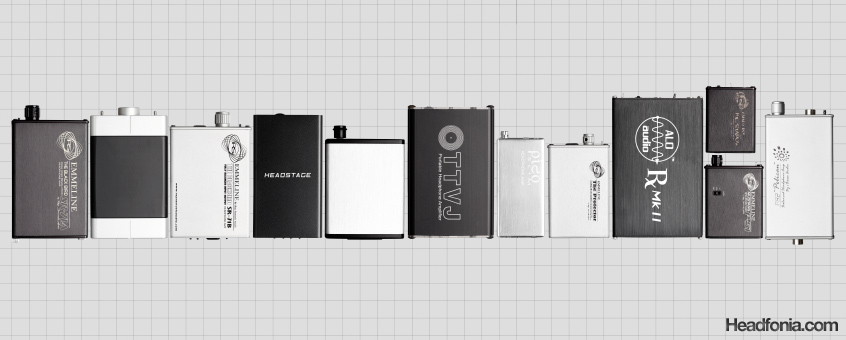
TINY AMPS: RSA SHADOW, RSA MUSTANG, HEADAMP PICO SLIM
The tiny amplifiers are mostly designed for IEMs, with the exception of the Mustang, which has enough voltage swing to drive the typical full size such as the AKG K701 or Sennheiser HD650 to loud levels. If you happen to use a source that has a high line output level (I used the Hifiman HM-601/602, where the output level is noticeably higher than the Ipod), and your recording level is relatively high (most modern recordings are relatively high in output level), then I find that the Shadow and the Pico Slim can still drive a HD650 to good loudness levels indoors, though with very few headroom left in the volume level. In all fairness, if you plan to use the amp with the bigger full size cans, I would strongly recommend you to get the bigger amps as they do the job with more authority.
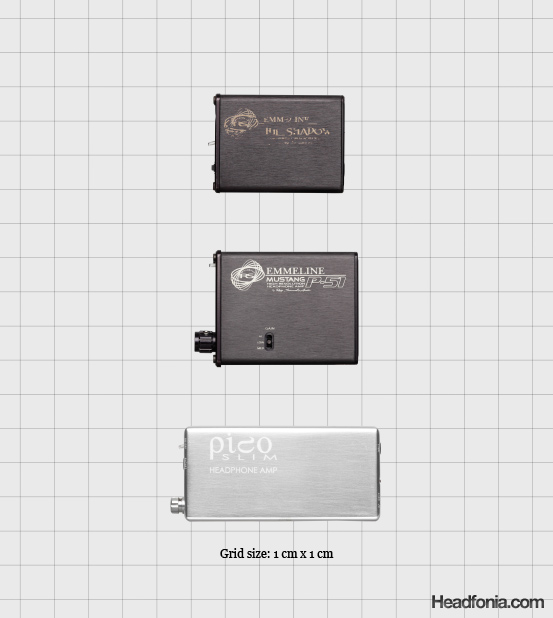
The usual suspects for tiny sized amps: (top to bottom) RSA Shadow, RSA P-51 Mustang, HeadAmp Pico Slim.
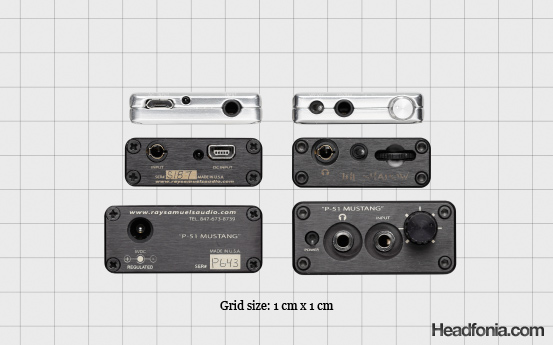
Front and back views.
RSA P-51 MUSTANG ($375)
The earliest entry into this category was the Mustang by Ray Samuels Audio. Ray Samuels had already built a very prestigious brand name in the industry, and when the Mustang was introduced, it was a ground-breaker as this tiny amp had enough power to drive the Sennheiser HD650 headphone to really loud levels. The Mustang practically made all the other portable amps in RSA’s line up almost obsolete with its tiny amps, and with enough power for anything from sensitive IEMs to big full size headphones. It is not quite as weighty as the bigger Hornet or SR71-A models, but given the size and versatility of the sound, I think a lot of people opted to go with the Mustang as opposed to the bigger RSA amps. Aside from the other, more specialized models like the Shadow, the Predator, or the SR-71a, the Mustang is probably the most versatile amplifier in Ray’s line up, and it happens to have a very likable sound as well. The sound generally follows the signature RSA house sound, though it was a little less dark than most of the other RSA sound. The treble remains soft and unagressive, which is signature of the RSA amps. The bass is not quite as weighty as the other RSA stuff, either the older Hornet/SR71A generation, or the newer Shadow/Protector/SR71-B. However, the midrange is probably the best deal with the Mustang, as it remains to be one of the sweetest midrange I’ve heard on portable amps, even besting the TTVJ slim, and just a tad less lush than the original HeadAmp Pico.
Among the three tiny amplifiers, the Mustang is the only one that comes with a three levels of gain, and with more power to drive big full size cans. This is of course a strong selling point, and despite not having the fancier digital volume control, I think some people would still be better off with the Mustang due to the higher power output. Although the Mustang has one of the most pleasant and most likable sound among the amps in this shootout, the introduction of newer amps that offer newer technology seem to have pushed down the popularity level of the Mustang. Quite a pity to see how this great amp loses its luster simply because there are newer, more technologically advanced products on the market. While the Shadow and the Pico Slim are just as great amps, I think the tonality of the Mustang makes it still the most likable amp of the group.
RSA SHADOW ($395)
It’s ironic to see how the RSA Shadow happens to be one of the amplifiers that drowns the popularity of the Mustang. Never ending innovations from Ray Samuels brought us the first portable amplifier with digital volume control, and the Shadow was eagerly anticipated in the market due to the implementation of digital volume control in a portable amp. The dimension, even tinier than the Mustang, is a huge selling point with the Shadow, as it still remains the smallest, high fidelity, portable amp around in the market.
The sound of the Shadow very closely mimics the warm sound that you get from the Mustang. Both amps are well into the range of the RSA house sound, but with some differences. I had difficulty differentiating the sound of the Shadow to the Mustang at first. But now it’s very clear that the Shadow has quite an edge in separation and articulation. These are understandable, as the digital volume control provide higher level of accuracy and is less destructive to the input signal. Soundstage is slightly wider on the Shadow, but the Mustang has better depth, and the overall impression on the soundstage is more spacious on the Mustang. Busy passages are better articulated in the Shadow, especially in the bass, where the Shadow also hits lower than the Mustang. Critical listening aside, the Mustang sounds sweeter and less dark, while the Shadow feels a little drier, mostly due to the difference in midrange.
Out of the abundance of portable amplifiers my friend Peter owns, the Mustang is still his favorite when it comes to vocal reproduction, and I really have to agree with him on this one. The Shadow, on the other hand is less engaging and relatively more sterile in the midrange compared to the Mustang. But where the Shadow does have a superior level of articulation, and so it becomes a choice between the two. With the Shadow you get better articulation and a more compact size, where with the Mustang you get a sweeter midrange and three levels of gain for better loudness level with full size headphones.
HEADAMP PICO SLIM ($399)
The HeadAmp Pico Slim is the latest entry to the tiny amplifiers market. Most of my friends who’ve heard the Pico Slim left feeling cold and unimpressed with the sound that they hear out of it. The original Pico had this sweet lush midrange that’s even better than the Mustang’s, and it still remains one of the most loved portable amplifiers today (Why did I miss including it for this article?). The Pico Slim, however, had a neutral vanilla colored sound to it, and to most who’ve heard it, it’s simply too plain. Actually, vanilla ice cream still have some sweetness to it. Instead, think low fat, low sugar vanilla ice cream, then you’re getting closer. In term of features, it’s quite similar to the RSA Shadow. Both are tiny, though the Shadow is tinier at almost half the size. Both comes with a high resolution digital volume control, and both are limited in gain levels and is optimized for IEMs. But if the RSA Shadow follows the similar sound signature as the bigger Mustang, and relatively to the other RSA models, the Pico Slim is a big departure from the sound of the original Pico. The vanilla color reminds me heavily of the desktop HeadAmp Gilmore Lite amplifier, relatively plain and “as it is”. Among all of the portables in this comparison, I find the Pico Slim to have the least amount of coloration, and closest to the popular adage “wire with gain”.
I realize that the previous paragraph may have sounded like a so-so impression of the Pico Slim. And yet, here is the twist, the Pico Slim happens to be my favorite amplifier of the bunch, and definitely my favorite pairing for my JH customs. I think the words to use for the Pico are articulation, resolution, bass, and soundstage. All impressive words, but I’m not just throwing them out there. When people ask me what the Pico Slim sounds like, those are the words I give them. In fact, people in my local forum probably knows me for being the biggest fan of the Pico Slim (good thing HeadAmp is not our sponsor, though they have good reasons to be one now).
When I was talking about the Mustang and the Shadow, one of the thing I mentioned was how the Shadow, benefiting from the digital volume control, brings up an even better level of articulation over the Mustang. The Pico is similar to that, but to an even greater degree. Simply put, I find the Pico Slim to have the best level of articulation among all the portable amplifiers in this comparison. This is definitely aided by the step less digital volume control on the Pico, though circuit and power supply design also contributes a big deal to the Pico’s overall level of articulation. Most of us today listens to fairly fast-paced, “busy”, and complex music, and articulation is really important when playing those kind of music. Even more, if you’re using a JH16 like me, where the task of controlling those quad-bass drivers becomes quite a challenge to the average quality amplifiers. This is where the Pico Slim really shines. Crisp, tight, articulate, well defined bass, even with the JH16 and the most complex passages. Added to the fact that the Pico Slim can punch quite hard on the bass, though it’s relatively not-dark signature tends to make people think it’s not good with bass. I actually love the bass punch on the Pico Slim. It’s powerful, tight, and articulate, leading to one of the best PRaT factor among the amps here.
Compared to the big portables such as the SR-71A and the i-Qube, I still think the level of articulation and resolution of the Pico Slim to be ahead those two highly touted amps, while closer to the articulation level of the Stepdance. While the SR-71A has one of the highest level of resolution, the Pico manages to match it, and even better it in the area of bass control and articulation.
Compared to the portable balanced amps, the Slim doesn’t sound as impressive, as it doesn’t boost up the lows and widens the soundstage as the balanced amps does. Nor does it have the kind of power output that you get with the portable balanced amps. But as with the case of the comparison with the SR-71A, the case with the Pico Slim is about quality and not quantity. The bass is punch is actually quite good, but it’s the bass definition and detail that beats the balanced amps handily. And though the soundstage is less wide, the overall imaging performance and coherence on the Slim is definitely superior. For IEMs, the Pico Slim is probably as good as an amplifier can get for now, and will remain to be my reference amp to judge the technicality of other portable amps.
I happen to love the Pico Slim very much, not only because it’s amazing articulation, but also the fact that it synergies beautifully with my JH16 IEM. However, I think the low coloration sound of the Pico is mostly what turns people off after they audition one at the meets. Although I find the Pico Slim to have better technicalities than the RSA Shadow, most people would prefer the warmer and darker sound of the Shadow, as a lot of people tend to be allergic to treble these days. The Pico Slim adds a little boost on the lower treble, and while it’s perfect on the JH5/10/16Pro IEMs, most other IEMs have plenty of treble to begin with, and for them I generally would recommend them to go with the RSA sound to give a better tonal balance. If you happen to be a JH user, you definitely need to find a way to audition the Pico Slim.




CccC
Mike! Can’t believe I am the first to comment. 😛 I haven’t logged in yet, but this oughta be one of the more comprehensive recent portable amp reviews I’ve seen! 🙂 Will give it a good read.
Anonymous
Thanks, C!
Adam
Beautiful and comprehensive review. Thank you, Mike!
Anonymous
Thanks, Adam.
Lewis Leong
Thanks for the great write up, Mike. Reading this and Skylab’s 56 portable amps compared thread on Head-fi is really eye opening. It shows just how subjective picking a sound signature is going to be for people.
Do you have any plans to review cheaper portable amps?
Anonymous
Hi Lewis,
Yea, there are a lot of cheaper amps out there. One of the reason I am limiting this article to the more premium models is so that the number won’t go out of proportions. Not that I am against cheaper stuff though.
Let’s see if anything interesting comes up in the future. Just because something is more affordable doesn’t mean that it’s going to be worth buying, and I don’t want to do an article on crappy products.
Cheers.
Anonymous
I’m talking to JDSLabs about reviewing their Cmoys. I think that should be a good article.
Anonymous
JDSLabs Cmoy is on the way.
A lot of my friends build Cmoys and I can always review those, but no point since they aren’t available to purchase commercially. On the other hand, the JDSLabs Cmoy can be bought fully assembled, and good build quality too!
Actually, I’ve listened to so many different Cmoys, and I have yet to find one that sounds bad. Resolution is a bit limited, but for mainstream music you probably won’t be too bothered by it.
Mod33
Just a quick comment, it would really help if you had a metric scale reference in your pictures.
Good stuff as always.
Anonymous
It would, wouldn’t it?
I will try to update the pictures.
Anonymous
Thanks for the excellent suggestion. The pictures are now updated with 1cm x 1cm grids. It won’t tell you to the last millimeters how big the amps are, but it’ll help you get a rough sense of how they size.
Andrew Prasetyo Jo
i’m baffled to see your 8006 words. Impressive roundups.
Anonymous
Thanks, Andrew.
Andrew Prasetyo Jo
I’m planning on getting HD600 soon. What would be the best option ? I don’t need the slimness/tiniest feature of the amp. I need a good solid either amp or DAC-amp. I’m using mac.
So far, you suggest me with yulong u100, but i’m a bit worried with the MAC incompatibility. Other than that, i’m looking at either ibasso PB2/DB1 or ALO Rx MkII/HRT MS2 to start with.
any comments on that?
Anonymous
Simple answer, I would get the TTVJ with DAC option. You plug it into
the Mac and you’re done. When you want to take it out, you unplug the
USB cable and you have a great portable amp.
Anonymous
Of course if you prefer to go with the DB-1/PB-2 or HRT MS-2/ALO rx,
you’re welcome to do so. But then you need to keep the portable amps
charged since they run on batteries — and you need to run an
interconnect from the DACs to the Amps. I prefer simpler set ups.
Source quality wise, the DB-1 and the HRT MS-2 is going to be a better
DAC than the PCM270X based DAC of the TTVJ.
Guest
i’ve finally settled on the amp/dac. I went with DB-2/PB-2 combo.
DB-2 is expected to be released early april. I also use this chance to donate for Japan charity if i made it to the top 10 pre-orders to make my purchase more reasonable :p
Anonymous
Awesome. What headphones will you be using it with?
Andrew Prasetyo Jo
I’ll be using this with ATH AD700, HD555 and HD280pro for now.
i’ll be gunning for the HD600 soon. currently i’m saving up for it. Unless you have better suggestion. AKG 702 perhaps? or maybe HD 25-1? I need something dark that can also be all rounder to counter the treble happy ibasso i think. Another thing i’m worried about is comfort. I’m really happy with my HD555 comfort level since the cups didn’t touch my ear too much unlike the ATH AD700. HD280pro is clamping on my head so i need to rest once in a while from using it.
Anonymous
Go with the HD600. Excellent, reference class, all rounder headphone.
Here is a review of the HD600 in case you haven’t heard it:
http://www.headfonia.com/the-sennheiser-trio-hd580-hd600-hd650/
Also between the Senn house sound and the AKG:
http://www.headfonia.com/old-school-trio-akg-k701-beyer-dt880-sennheiser-hd650/
Andrew Prasetyo Jo
read both of them. thanks for the confirmation.
question though, why not hd650?
Anonymous
Well you told me you were “gunning” for the HD600. LOL
If you’ve read the Sennheiser Trio article, then you pretty much know what my thoughts are on the HD600 and the HD650.
Cheers.
Andrew Prasetyo Jo
thanks again for the reply.
ibasso told me the db2/pb2 shud ship april 6th-10th. i’ll have to wait till next payday to grab the hd600.
Andrew Prasetyo Jo
this is weird. i replied using twitter, but marked as guest…
Andrew Uroskie
Great review, but I was surprised not to see the iBasso T3D, which is 1) much less expensive, 2) very highly regarded, 3) incorporates the digital volume control and 4) is even smaller and easier to use with a portable device. Especially since you review other iBasso products.
I’ve compared the RSA Shadow and the T3D, and I preferred the shadow with JH13s. Nevertheless, I found the differences to be very minute, and the $200 savings was used towards a small desktop unit that’s far better than both.
Anonymous
Hi Andrew,
I heard the Ibasso T3 non D version and was very lukewarm about it. My friend then told me that the D version is just a hair better, and so I didn’t quite have the interest to include it here. However, after what you have said, I will find a T3D to listen to.
Cheers.
jendol
It’s scary to find out that I have 10 amps out of the 12 that you reviewed. I can lend you my T3D tomorrow if you want to
Anonymous
You are quite a monster indeed!
Andrew Uroskie
Cool, thanks – I’d love to hear your thoughts. I’d imagine the T3D wouldn’t be up to the picoslim, but I’d wonder how far off it’d be. The interesting thing is that on Head-fi, it seems like a lot of people think the PicoSlim has too much bass for the JH16. But since the JH13 has a bit less to begin with, it might make a perfect match.
Zuqi
I’ve been waiting for this article for so long, great job!
Anonymous
Thanks, Zuqi.
eugenius
I’m just going to assume the DACport beats all of those.
Anonymous
Good one.
Abcd
you dont make those portable balanced amps sound very appealing. are they worth it? if imaging is off wouldnt that ruin the entire musical presentation?
Anonymous
Hi Abcd,
It depends on the music and the recording. If I am listening to say Prodigy, Coldplay, Kanye, or even John Mayer, most of these mainstream music are recorded in the studio anyway and there is never a proper imaging in the recordings to begin with. Then for these music, I would say that the innacurate imaging is not a big deal. But wih the balanced amps, you do get more bass, bigger soundstage and those are audible improvements.
If you are listening to live jazz, classical, then the imaging aspect is going to be more important.
Cheers.
SoulSyde
Mike, Epic-epic review! You’ve hit every amp that I have considered buying over the years. Well done.
Anonymous
Thanks, SoulSyde
Iamidaho
Great review! I’m curious on where you would put the Fiio e7 with klipsch custom-3 and ath-m50. I’m not a bassbead but do like punchy lows but not at the expense of mids and highs. My musical leanings are toward rock ranging from Pink Floyd and Linkin Park.
Keep up the good work!
Anonymous
The E7’s amp probably can’t be compared to the line up here. But if you want punchy lows, go for the HD25-1, or wait for my Pro700 Mk2 review. The M-50 has decent bass, but it doesnt punch hard enough.
Nikki_girl
For the lack of budget for these great amps, my set up is also with E7/E9 and ATH-M50S. Music range from Classical/Jazz to Rock.
Anonymous
Yeah, the E7/E9 is great. what matters is that you’re enjoying the music.
bb
It is not included here and for some reason does not have any reviews but it is one of the VERY BEST amps out there – Leckerton UHA-4, PLUS it is also a DAC!!! Easily matches if not bests the TTVJ Slim and slaughters it on price and betters it on size (its shorter) PLUS it has Low and High Gain, Cross-feed AND DIGITAL VOLUME CONTROL! Fantastic amp! LECKERTON UHA-4!
Anonymous
Thanks, man.. I will look into the Leckerton. Gosh there are just too many amps these days.
bb
Excellent review though!!!
jnewbbie4
Hi Mike, it’s me again. First of all I want to say I greatly appreciate your recommendation about the HD25-1. I’ve never thought that my listening habit would change just because of that phones. Nowadays, I’m more into Rap, Hiphop, RnB and while the HD25-1 is very at representing the music, I still think that it does not hit as low and the bass texture is not as clear as I would like. So which portable amps you would recommend for the HD25-1? I like the slimness of the Arrow but I’m just wonder if it’s powerful enough for bigger phones like the HD650 as I’m planning to get one.
Anonymous
The Arrow is good, but if you are looking for bottom end impact I think the ALO Rx does it better. Both amps have plenty of power for the HD650.
Regarding bass texture, I think you may need to change headphones. I find the Pro700 Mk2 and Meier Stepdance combo to give a very impressive bass punch, kick, impact, slam, and still great texture.
I am in the process of writing a review on the Pro700. Wait until it is published and see if whay you need is a new cans. The Pro700 doesn’t do so well unamped tho.
Burma Jones
Hi Mike, thanks for the nice review. I just have one question. Which version of the Headstage Arrow did you use for this review? As far as I know there are three versions of the Arrow amps and I think there were some changes affecting the treble of the amp.
Anonymous
I think it’s the 2.2G Version.
.Sup
wow this is gotta be the best review of portable amplifiers overall. The quality images raise the bar of this review even more. It would be nice however if you would photograph and compare amp size against an iPhone for example so you get the feeling how big it is or put measurements next to the amps on the photos.
Anonymous
Thanks for the compliments.
You are so right. I probably should’ve put an Iphone 4 in there so that people can get a good comparison of the look. Anyway, I’m updating the images to have metric grids in there so you can get a rough measurement of how big the amps are. Images should be up soon.
Elgonzalovs
i’m between pico slim and meier stepdance for westone umx3, but also for travel akg 701 or denon’s 5000. Music rock, pop, little classic
Help ¡¡
Anonymous
I think the Stepdance would cover the range better. You won’t get enough voltage swing with the Pico Slim and K701 with Classical music.
Elgonzalovs
i just received the stepdance and i’m really really happy, best amp ever, for me of course.
Thanks Mike ¡¡¡
Anonymous
Superb! Glad to hear that!
shadowz
Wow excellent round up, after reading this and many other portable amp guides I’m still stuck between the RSA P-51 MUSTANG and the newly released Meier StepDance, I’ll be using an iMod 5.5gen 250gb rockboxed through ALO jumbo cyro dock as the source and with Vsonic GR07s and sometimes DT990 (600). I really do enjoy my mid ranges and I hear the RSA is much better on that regard however the Meier StepDance is ranked higher in general purely based on sound quality although your review does not seem to reflect that standpoint. I mostly listen to classic instrumentals, pop and ballads.
Anonymous
The DT990 and the Stepdance is going to be one bright and dry combination. I personally won’t recommend that.
The Mustang will be better, or even more, go for the TTVJ Slim, RSA SR-71A, or Headstage Arrow. Those all will be a better pairing for the DT990.
The Stepdance is a good amp with good detail and articulation. But the sound is quite dry with no mid and low body.
Elgonzalovs
thanks for your quick response and your excellents reviews, gonzalo
Earfonia
Indeed a great and comprehensive review! Thanks for the effort!
Anonymous
Thanks Bram.
Trying to learn a bit from you, you know? 🙂
mike_dice
wow this is a great great review, one of the best, informative and detailed review of amps ive read online. great job.
Aob Max
Hi Mike, I’m really interested in the Arrow amp. Do you think it would work well with two different headphones with different impedance(obviously)? like…dt880 pro and jh5-pro? Thanks in advance.
Anonymous
I think it shouldn’t have any problem with the DT880 and the JH5.
Cheers.
Aob Max
uh…my bad…i mean can I plug in the two simultaneously for something like A-B…would that work?
Anonymous
Hi,
Yes you can plug both in simultaneously without a problem. Here is what
I wrote on the Headstage Arrow review:
——————————-
The best demonstration of the Headstage’s power is when I plugged in
both the HD650 and the HD800 simultaneously and heard no drop in the
sound quality or impact level. Now, when you plug in two headphones with
different impedance ratings (say a HD650 with a ATH M-50), there will be
a change in the sound output. I suspect that this is because the
headphone outputs are connected in parallel without a separate buffer
for each output. Hence the effective impedance of the headphone changes,
and you will feel a difference when you plug in two headphones of a
different impedance at the same time. However, with the same impedance
ratings (in this case I’m using a HD650 and HD800, both at 300 Ohms), I
don’t notice any changes in the sound.
——————————-
http://www.headfonia.com/headstage-the-arrow-amplifier/
Cheers.
Jpperez11
Hi, John nice review. I’m thinking about getting the SR71A or the TTVJ, but before I commit I was wondering if you could do a review on the Zenhead from Decware. I been hearing a lot of good things about this portable amplifier but I haven’t seen any good reviews on it.
Thanks,
JP
Jpperez11
Sorry, I meant to say Mike not John.
Anonymous
Hi JP,
The Zenhead looks like a good amp, but I can’t promise you a review of it.
Jon
Hey Mike,
Could you briefly describe how these portable amps provide an advantage over using the headphone out straight from the HM-602? Dying to know, thanks!
Anonymous
Jon, the first and most important thing you will notice is that adding a separate amp will improve the bass impact simply due to the more powerful amplifier section compared to the built-in HM601/2 amp. This will often raise the PRaT level as well, making the music more fun, engaging, and more toe-tapping.
The amps will also bring their own sound signatures into the game. Often they also improve things like soundstage and instrument separation.
Anaxilus
Hey Mike, great work. I was wondering what happened to the Warbler? Is that incoming?
Anonymous
Hey dude, I was deciding if I should wait a little longer and try to get
a Warbler. But at the end of the day, I decided against it.. been
postponing the article for a little too long.
Besides, frankly speaking, if someone is going to get a new portable amp
these days, I think most would go for the slim amps. I could be wrong
though.
Anaxilus
Hey Mike, great work. I was wondering what happened to the Warbler? Is that incoming?
Dan Z
Haha well that answers my PS from the email I sent you, thanks for the review!
Mampus
Mike, how about Graham Slee Voyager? 😀
Anonymous
Ah. It’s an old, old, amp. Slightly mellow, warm, smooth, but not very
impactful and lacking PRaT.
shrisha das
Thanks so much Mike for a wonderful review! Was really enjoyable reading. I own a Stepdance Amp and you very exact describe my feelings about it. This dryness bothering me quite a lot not giving me to enjoy my listening. Since I trust your ears, I’d like to ask you what you would recommend for me to get with a same great clarity but with nice lush mids? You really make me think about TTVJ amp but I’m a bit afraid to have too tubie sound then. For example my friend have a Sen.600 and he pairing it with a RSA Predator which is good match since Ray designing all his amps around them. 600s being neutral gets more musicality from Predator. But when I plug my Beyers 880 in Predy the sound I’m getting is too dark and bright for my ears. So it’s no go for me. But I didn’t try other RSA amps. May be they are different for Predator. So I’m looking for something with balanced sound, nice sound stage and instrument separation, portable enough but still able to drive at list 300 ohm cans. Stepdance with a TTVJ mids in one body 🙂 Sounds utopic? 🙂 Please recommend me something. There is some nice amps around too, like Pico Amp, not Slim, which you probably tried but I’m not. I will consider them too.
Eager to hear your opinion.
Thanks so much.
Shrisha.
Anonymous
Hi Srisha,
I was thinking about an amp that would suit you, but I didn’t quite get
what you were talking about. Especially on the part where you plug the
DT880 on the Predator, you are hearing it to be too dark and bright?
Dark is the opposite of bright, and I don’t know how the sound can be
too dark and too bright at the same time.
If you try to explain it better, then I might be able to get a better idea.
shrisha das
Hi Make,
Sorry my bad English here. I’m speaking Russian most of the day, please be lenient to me 🙂
I thing here is my bad understanding of what is dark, bright sound is. But I meant they goes bright in mids toward to lows (lowmids) range, if I can say like that. Not in mids and mid-highs section.
Anyway, my point is that Predator coloring headphones in a way that it’s nicely suit 600s but not Beyers since 880s not neutral to my ears like Sehns. So Predator overcoloring them to my taste. Stepdance is really great Amp but recessed mids and midhighs even with 880s known as bright cans makes me thing for alternatives.
Sorry for my mumbling. 🙂
Anonymous
Shrisha,
I still have difficulties understanding what you say, but I’m not trying
to blame you for it, rather please understand ME if I can’t seem to give
you a good advice.
If you don’t like the Predator, then a safe suggestion is definitely to
stay away from RSA amps, as they carry mostly the same signature.
The TTVJ slim doesn’t have an over-lush mids in my opinion. It will give
a good boost in the midrange body which will benefit the DT880, but
since I haven’t tried that combination personally, I really can’t tell
how good the pairing will be.
You can also try the ALO Rx, it’s a great amp with no mid and low
coloration, but again, with the Beyer I fear that the overall sound will
be too thin.
I personally think the RSA SR71a would be one of the best amps for the
DT880. But seeing how you find the Predator to be unpleasant, and since
I can’t quite understand what you’re trying to communicate really makes
it hard to make that recommendation.
Anonymous
Perhaps you can try the Ibasso PB-2. It has a great build quality,
overall good sound, and opamp rolling capability to get the sound
tailored precisely to what you want.
Yes, I think that would be a good recommendation for you.
shrisha das
Hello Mike.
Thanks so much for your answer. Really appreciate your recommendation. One more question if you don’t mind.
I got Stepdance with an idea to have it as portable and desktop amp. Might be that was my mistake. Should I just get nice desktop amp which will suit my big headphones (Beyers 880s 250 and 600 Ohm., Koss 4x) and for IEMs portable one?
As I said you very well describe Stepdance. I’m looking for sound signature which is will looks like Stepdance but TTVJ Slimslike midrange. My preferences in music mostly jazz, classical, blues, hard rock, some metal and alternative rock. I think PB-2 will drive big cans and IEMs with no problem but I just don’t know what sound signature it have. I had D2 Boa from iBasso. Is their amps share the same signature as well, like RSA amps?
Anonymous
Hi Shrisha,
Again I am having a difficulty in understanding here. Stepdance like
soundstage, but TTVJ Slim midrange?
I really can’t comment on the D2 BOA, but if you get the PB-2 you can do
op-amp rolling, so that will help you to get the signature that you want.
shrisha das
Alright I will try PB-2 then. Thanks Mike.
Vladimer Nachkebia
Why did you miss out UHA-4?
Anonymous
Sorry Vladimer, no particular reason. There are a lot of portable amps these days and I can’t possibly cover them all.
I will do a review on the AHA12 perhaphs next month.
lee730
The UHA 4 would definitly be worth looking into ;). Love the sound signature. Very smooth, beautiful mids. A hint of warmness yet it retains it retains neutrality. Seems people are enjoying even the HD650 with this amp, and I bet with the UHA 6 would be a dream as it supply much more power with the same sound signature.
Eagle1776
Awesome article! This has quickly become one of my favorite sites.
I’ve got a broadly related question: How much does the HD25-1 ii benefit from amping? I guess I don’t want to throw more money in the form of an amp at them than they would benefit from. I know with everything there is a law of diminishing returns…what is practical for the budget conscious? Is a cmoy/E7/T3D close to maxing out its potential or is it a good enough headphone to justify a more expensive amp, like those listed here. (I’m listening to mostly lossless from an ipod classic so I’m not up to a dac yet, if that helps)
Anonymous
I probably would not bother with amping the Hd25-1. It benefits very little, it seems, from portable amps, and it is good just as it is from an Ipod.
Eagle1776
Thanks for the advice!
Anonymous
Well, let me know if you still find the HD25 to be lacking after you listen to it.
Andrew Uroskie
Ok, so I decided to do some testing myself, and I’m trying my JH13s with the iBasso PB1, the RSA Shadow, and the HeadAmp Pico Slim (along with my desktop unit, the Audio-gd Sparrow 8471). My conclusions so far agree with yours, except I would rate the Slim much higher than the Shadow across the board.
My question is this: for JH13 ALONE, impedance of 28 Ohms, no other headphones — is the Pico Slim actually going to be better than a decent desktop amp? Say, that of the NuForce HDP or something comparable? Obviously, the desktop would have lots more power, but would it be any better? In at least one respect – the digital volume pot – I’m guessing it would usually be worse. Any thoughts?
Anonymous
I think it does. I hsve tried the JH16 from the Gilmore lite, comparing it with the picoslim, and i think the pico slim still gives better articulation on the bass. The Gilmore had more bass quantity though.
Kunlun
Wow, this has been a very helpful article and you’ve been great answering people’s questions, too!
I’d like your advice, too, if you have a moment. I’m looking to upgrade my slim amp up from the ibasso T3 for my Future Sonics MG6Pro customs and FS MG7 Atrio universals. For the customs, I just want something that has a bit of warmth in the mids and excellent extension below and above to make the most out of their abilities. The universals need a bit more helps as they have a bit of a hump in the lower treble. They need an amp which has a treble that doesn’t focus on the lower treble and lose prominence in the higher treble range.
I was thinking of the ttvj slim, but I’m concerned based on your review. It sounds like they don’t really extend very well in the bass (focusing in the upper/mid bass and lacking in the sub-bass) or in the treble (with emphasis in the lower-treble). Plus the bass is muddy. Have I gotten the right impression?
I’m trying to avoid carrying around something larger than about ttvj slim-size, but is there a better option?
Thanks so much,
Kunlun
Anonymous
Yep, I think you got my impressions on the TTVJ slim correctly.
I am thinking about the particular amp you should go for.. how do you
find the Ibasso T3 to sound? I think the ALO Rx has good low bass and no
lower treble hump. But the mids are not exactly warm. The SR-71A fits
the bill very well. Great low bass, excellent impact, no lower treble
hump, warm mids. Not sure if you’re willing to live with the
non-rechargeable dual 9V batteries though. Oh, and it’s also dark sounding.
I don’t know man, you’re asking for a specific solution here. I think
you may have to go with an EQ to get things precisely like you want it.
How do you find the T3 sounds in terms of frequency balance?
Kunlun
Okay, well, I’m glad I’m reading your impressions correctly.
Thanks for the help. I find that the T3 is warm in the mids, not so clear and doesn’t do so well at extension of either bass or treble. It was okay with an older iem that had great treble extension but was a bit harsh in the highs, but didn’t pair well at all with the aforementioned Atrios–the lower treble sounded bloated without much above it. I don’t want a repeat of that!
A little bit of extra lower treble and mid-bass is okay, but there needs to be something substantial above and below to balance it. Instead of warm mids, let’s go with something that has great PRaT, clarity and spaciousness. So, we can forget the warm mids (but nothing too boring, please!) and go with clarity, space and extension above and below.
Maybe the ALO Rx is the way to go. What do you think? It’s a solid $100 over the ttvj slim, of course.
I’m using this amp for a commute, so I think rechargeable batteries are a must.
I’ve heard great things about the Just Audio uHA-120 in terms of a balanced mid and very good bass and treble extension. Even though a 1″ tall (a bit big compared to the slim amps), maybe I should go for it. Or, if there’s something else, please let me know.
Any comments are welcome, thanks again.
Anonymous
I think the ALO Rx is the one you should go for as well, ignoring the
need for the warm mids. The mids are not cold or thin or anything, it’s
just they are not the typical warm-mid sounding amp.
I have the AHA-120, which I believe is the class-A version of the
uHA-120. It’s nothing like what you want. The sound is great, but it’s
mid-centric.
Sean
Hey Mike,
Interesting article. I’m just about to look around for a cheaper portable headphone amp + DAC combo. Keywords, cheaper as this is going to be used daily and will not be babied. I have always wanted to try the Headroom’s Total Bithead and recently, the price has dropped quite a bit to around $150. Good deal when compared to some of the amps that you have reviewed here. Was just wondering what your thoughts are on this amp?
My headphone collection (you already know some of it):
Alessandro MS1
Sennheiser HD650
AKG K701
Beyerdynamic DT880 (2003 version)
Sony MDR-SA1000
Shure SCL3
Ultimate Ears 5pro
Audio Technica ATH-CM700Ti
Musical genre: Classical (Symphonies, Piano and Violin Concertos, Piano Solo), Jazz vocal. Acoustic instruments.
Any help will be greatly appreciated!
Sean
Sean
Sorry..one more point to my above question, I’m not married to Headroom. Please feel free to suggest any other amps (and it doesn’t have to be that portable) that is great bang for the buck, great sound for a reasonable price. Many thanks in advance!
Sean
Anonymous
Hi Sean,
For now if you want a sub $150 amp for your headphones, I can only
recommend the JDSLabs Cmoy for ~$60.
http://www.headfonia.com/60-pack-of-awesome-jdslabs-cmoy/
I haven’t had any experience with the Headroom Total Bithead (though now
that you’ve asked for it, I’m sending them an email to review it).
Anyway I think the JDSLabs would pair well with a lot of the headphones
in your collection: MS1, HD650, DT880-2003, SA1000. It’ll also do very
well for Classical, Jazz vocal and acoustic instruments.
Sean
Many thanks Mike! I will definitely check out the Cmoy. The only problem is, it doesn’t contain a DAC as well. Going through your site more, I’m getting intrigued by the Yulong U100 as well as the UberMuzik’s tube DAC/amp. Any thoughts on either for my collection of headphones as well as my musical tastes?
Sean
Anonymous
The Uber Muzik has a sweeter midrange (good for Jazz, Vocals) but the Yulong is more detailed and has a better bass impact (good for symphonies). The Yulong is glitchy on OSX though, so unless you’re using Windows I wouldn’t recommend it.
lee730
People seem to be enjoying the Hd650 with the UHA 4 and that pretty amazing considering it’s Leckertons mini amp. You could opt for the UHA 6 which would supply you with a lot more power and still have that amazing sound people seem to be enjoying with the HD650. I love my IE7/IE8 combo with the UHA 4, very smooth and dynamic.
Anonymous
Hi, Lee
Thanks for the input. I really should give this Leckerton amp a try.
lee730
If you do try it out let me know what you think. I’m also on headfi if you care to drop by the UHA 4 thread. Thanks.
Anonymous
Yes,
I will send them an email and see if they’ll send me a sample.
Carlo
Hi Mike,
Great article. May I ask for impressions of the JH5 paired with a RSA Mustang or TTVJ Slim? And which of the amps would benefit the JH5 more?
Thanks!
Anonymous
Hi Carlo,
My favorite amp for the JH customs is the Pico Slim, and that includes the JH5. The TTVJ and the Mustang are good, but I think the Pico Slim works best with the JHs.
Guest
I have HM-801, do you prefer to pair it with pico slim or buy a GAME amp for JH16?
Anonymous
I would just drive it direct from the player. The impressions on the GAME amp was not that good, so I’ll just use the standard amp, unless you are having serious gain problems, then I would get the GAME amp. One box solution is always more practical for mobile set ups.
zerocool
hi Mike,
i am very love music, an for my birthday i decided to to upgrade my portable setup.
so what i think to do is to buy a portable player that be able to play FLAC an hi rez file 24bit/96Khz like hm-602, Teclast T51 or Fiio x3 http://www.head-fi.org/forum/thread/528916/the-fiio-x3-thread-upcoming-fiio-dap
and from the line out connect to portable amp
the earphone will be or 1964-t http://www.head-fi.org/forum/thread/530185/review-1964ears-1964-t or Etymotic ER-4S
then my question is whate amp will be god choice for me ibasso D12 or RSA 71A and how they can handle 24bit/96Khz
Anonymous
I will get the HM-602, out to the ER4P, and be done. It doesn’t do true
24/96kHz though.
If you need an amp, the SR71A is far better than the D12. But personally
I’ll just hook it direct to the HM-602.
James McProgger
would be awesome to see the uHA4 included, one can only dream…
Anonymous
Hi James,
Sorry I am still nowhere close to getting an uHA4. Especially now that
I’m working on another amplifier shootout.
James McProgger
The “Under 100$ shotout” i guess. that will be interesting as well
Anonymous
Yes, the under $100 shootout. I think the amps in this price range can
be just as musical as the more expensive amps.
Swbf2cheater
Amen brotha’
Swbf2cheater
I would have to agree in regards to the SR71A. It was the most musical amp out of the entire crop but was the poorest performer when comboed with a portable source and great headphones like my Edition 8. The TTVJ slim was a noticeably better experience with the colorfly ck4 and edition 8. The sr71a sounded lacking and did almost nothing for it over just using my fuze or CK4 alone. However, the SR71A was much better for desktop amping than the TTVJ slim was via my computer as a source with the edition 8….SIGNIFICANTLY BETTER than pretty much any portable amp I have ever used outside of the SR71B lol! Both are great amps in their own area of expertise.
DodgersKings323
This site cleared up tons of questions i had as a headphile noob 🙂
Anonymous
That sounds good. Thanks 🙂
Reckoncile
Great job! I really enjoyed reading this. Looking forward to the rest of the article.
Reckoncile
Opps, wrong review.
Jason
Hi,
I have already asked you for some recommendations previously and you recommended the Fostex Hpp1 as it’s a good match for Es10. But after I thought about it for a while, the price tag is a bit steep. So now I’m looking for some cheaper amps. I’m wondering if the shadow is a good match to the es10 or you have some other recommendations? Thanks
Jason
How about the P51 and uha120 as well? You probably haven’t heard of the uha120, but I guess it’s a downgraded version of the aha120?
Anonymous
Hi Jason,
Last month I listened to the ES10 with the Stepdance Meier and the synergy is very good. I’d recommend that over the warmer sounding RSA or UHA amps.
emong
Nice review :). What’s better to partner with a shure se535, pico or rsa in terms of sq and balance? Thanks!
Anonymous
I personally think the Shadow but here is what it boils down to:
If you feel the SE535 has a midrange that is too forward, too glaring, then yes get the Shadow. (this is what I feel about the SE535).
If you feel that the SE535 is too warm and needs to be a little livelier, a little lighter, then get the Pico Slim.
mula766hi
Hi Mike…hope you are fine well. Your review is very clear & helpful for my reference
As you was used UM Mage, please advise me what’s your the best portable amply to pair UM Mage. I am very love vocal & detail.
Anonymous
Try the RSA Mustang. The vocal is amazing on that amp.
Andrew V. Uroskie
hope you’re doing ibasso in the new shootout. Having tried several of these here with JH13s, and the best is undeniably the Pico Slim, by a margin, I still find the ibasso T3D quite a contender, esp at the price.
Anonymous
Honestly Andrew, when I did this article I already had the T3D in possession but I didn’t include it because I thought it was really bad. It had a nice black background due to the digital volume control but the soundstage was very narrow and somewhat collapsed, and the tonal balance was a bit odd though, though it pushes the treble out more than the others so that may be why it sounds good with the JH13.
Andrew Uroskie
Thanks for the reply. I agree it’s not really comparable to the Pico Slim or the RSA Shadow, both of which I A/B’d (finding the Slim much preferable.) I also agreed with your assessment of the Balanced Amps on IEMs – I tried the PB-1 and was not impressed.
iBasso has a brand new model out that looks very promising though – the t5 – at least one respected member of head-fi claims he likes it better than the pico slim, so I’m going to have a look. You might want to do the same.
Anonymous
Yes, thanks Andrew.
Brian Schadenfreude Ip
Hi Mike. I’m looking for an amp for my IE8 that’ll sound great with the genres of music I listen to, namely pop, rock and metal. I’m currently looking at the TTVJ slim, RSA Predator and the Pico DAC/Amp. I prefer a somewhat dark, yet refined sound, that has impressive instrumentals, good mids and great bass. I would really appreciate if you could help me out here. Thanks!
Anonymous
Hi Brian,
Sounds like the RSA sound is for you. I don’t know why you shortlisted it to the Predator though. Something smaller like the Shadow would be good, and the digital volume control on the Shadow would give you better bass articulation for your rock and metal stuff.
You can also go with the Headstage Arrow.
Brian Schadenfreude Ip
Thanks Mike. The rationale behind shortlisting the Predator was that I have this old friend of mine that has had his Predator for a while. He’s looking to move on to greater things so he was willing to offload it to me at a lower price. So I thought that perhaps I could do my friend a favour and save some money at the same time. Once again, I thank you Mike for your invaluable opinions, and for helping so many misguided and indecisive audiophiles like me with their purchases. =)
Angel (Gelocks)
Hi Mike.
Here I am again looking for counseling lol 😉
Just purchased a Denon D5000 and connected it to my JDSLabs Cmoy and… I hear distortion!! It seems that the Cmoy cannot actually drive these cans well. At first I thought it was the headphones since I bought them used… But I connected them to my NuForce Icon HDP and they sound great.
so questions, have you tried the Denon Dxxxx series and do you think any one of these portable amps go perfect with them???
Thanks
Sljm
Hi Mike,
Great review there.
I am looking to spend this Christmas for a Amplifier / DAC?(not important) to go with a new headphone which I have not finalized yet.
So basically, my personal preference is:
1) Buget USD$100>
2) I’m a rocker(Avenged Sevenfold) / metal(Bullet For My Valentine) / punk rock(My Chemical Romance) / slow rock(The All-Americans Rejects) / once in a while, trance(Alesso, Le Grande) though very seldom.
3) For a rocker, I enjoy it when blazing fast guitars and thumping drums solos come at me. Screams to be controlled and every instruments to be heard(e.g. Separations between guitar 1 / guitar 2 / drum / lead vocal / back-up vocal to be heard clearly.
4) Portable for outdoor use.
I do know I’m asking for too much, but I’m just trying to make it clearer so that you can help me better. 🙂 I actually got sick reading up reviews for 1 month now, there are definitely not 100% foolproof headphones at the moment but it is really hard to find 1 just for my taste.
Lastly, if these headphones will help:
1) Alessandro MS1i (Rocker Style, in your face, better bass)
2) Grado SR80i (Rocker Style, in your face)
3) Superlux HD660 (Cheapest)
4) Audio Technical M50S (Isolation from closed cupped)
Leaning towards MS1i for having better base now.
Anonymous
Okay, the budget is $100 or greater.
I think you should get the SR-71A. It would rock for the music that you listen to. And it would really rock with the MS1, SR80i, and the HD660 as well. The M50 you can sell as I don’t think it plays your music well. 😉 If you still need a closed headphone then get the HD25-1.
Hope the SR-71A fits your budget — but since you’re asking for a lot of things in the sound quality I just had to propose that one. 😉
Trust me though, the SR71A is still among the best out there.
Sljm
Great information. Thank you. Always trust a professional advice.
Irawan Johan
Hi Mike, will Pico slim sinergized the ACS T1? Thank you.
Irawan Johan
One more question Mike, if I were to choose ttvj slim and headstage arrow for my ACS T1 which one will be? Thank you.
Mike
The headstage is smaller, I probably would go for the headstage because of that. 🙂
But as for sound, hard to say.. the TTVJ is better and bigger sounding.
Irawan Johan
Headstage Arrow or Pico Slim for the ACS T1? Thanks again Mike.
Mike
Pico Slim was best with the JHs. Not sure about the T1.
Irawan Johan
Thank you very much, it’s very helpful!
Tsgillette
I am getting the Sony mdr xb1000 for Christmas I hear ppl say the bass in them is less punchier than the 500s so I’m trying to find a good amp for under $100 to increase bass I listen to mostly hip hop any suggestions?
Mike
Hi,
Try the Fiio E11 or the Digizoid Zo (I have a review on the Zo coming up).
Soyabean
where does the Audinst AMP-HP place?
Dan Herman
I’d like something single ended that will drive the HE500. I currently have the SR-71A, will this be sufficient or will I need the SR-71B or PB2 or possibly the warbler?
Mike
Dan,
Still best to go with a desktop amp for the HE-500.
Dan Herman
Thanks and appreciate your educated feedback but I’d like to be all portable. I am about to pull the trigger on the Continental V2 to pair with the HE-500. I’ve been using the HE-500 with the SR-71A and though I like the sound and it drives it just fine, I feel that I am not getting what the HE-500 is capable of. I know that the Continental or I am also considering the MK-II might not bring it to its potential either but I assume it will do a better job than the SR-71A. Any thoughts you can provide would be greatly appreciated.
Mike
Dan,
Amps like the SR71-B and Ibasso PB-2 have higher level power output, but I don’t think they make a terribly good pairing with the HE-500 either. Sometimes you just have to go desktop, or find another headphone for your portable set up.
Dan Herman
Got it. Looks like I’ll sell the HE-500 and hope the HE-400 will work with what I have. Thanks again Mike.
Mike
Alright Dan.
Paul
Mike,
Great article as usual. What do you think of Musical Fidelity V-Can or V-Can ii ? Paul.
Mike
Paul,
No experience with the V-Cans, sorry.
james74
Hi Mike, Just found this site and thoroughly enjoyed the amp review due to it’s relevance to my situation, so here is a poser for you Mike!
Q: I have the JH16’s with Twag V2 cable with a iBasso PB1 and basically you wrote what I have been thinking about for a while now with the balanced traits and want to go back with a single ended amp (still porta size) and the ALO or TTVJ sounds promising from what I have read but now I have a Sony Z1000 headphone (an efficient 24ohm’s) which is a slight contrast to the JH16’s low bass reproduction and need an amp that will serve both with out over cooking the JH16’s any further or make the Z1000’s any brighter or bass lighter than they are? I like mids to still be prevalent with a good prat. Not sure if the Pico slim can cover both there or maybe the RX/TTVJ or some thing else?
p.s my genres really span across the board; Rock/pop/dance/blues/jazz/OST’s/female vocal.
Mike
Hi James,
So an amplifier to cover both the Z1000 and the JH16. You don’t want the Z1000 to be brighter or bass lighter. First thing that comes to mind is RSA amps, which are dark sounding and always come with plenty of bass. The Mustang should have plenty of power for your Z1000 and JH16, and it comes with a three level gain switch — so that sounds like a good combo. The Shadow would’ve been more precise sounding for your JH16 but I’m not sure if it has enough impact for the Z1000. The mids on the Mustang is one of the best among all portable amps. The Pico Slim, somehow like the Shadow, very precise but I’m not sure about pairing it to the Z1000.
james74
Thanks Mike,
Irony there as before I decided to go balanced it was going to be the Mustang.
Just to follow up quickly the only thing I had heard with the JH16’s was maybe the RSA was maybe a bit to dark with it and not the best for getting the treble from the JH16’s, do you see any issues with the 16’s and RSA relationship?
The only thing I did like the sound of with say the Shadow (noted shadow might not power Z1000 well enough), Rx or TTVJ was the digital volume control for the benefits that brings, is this such a biggie not having this with say the P51?
….lastly (I know I mentioned about the mids been prevalent) but just out of curiosity how would the RX or TTVJ be with both JH16 and Z1000, would they be good suiter’s for both headphones. And if say the TTVJ was a viable option could I kill two birds with one stone with the built in dac or would the DB1 still be the better option to keep, just would need to get my cables re-terminated to work with the SE amp.
To be honest even though smaller the better if possible I will not be using the amp in a pocket on the move, solely for static listening use at home, or when travelling, hotel rooms etc so would not rule out a slightly bigger size for a amp/dac combo if there is one worth considering .
Forgot to mention if it makes a difference my portable source currently is the Sony X1060 which is fairly warm sounding even though it has a digital amp powering it.
Thanks again Mike, this final round should make things clearer in my head!
Mike
True on the JH, that’s why I still think that the Pico Slim makes for the best match. However, since you want one amp for both the JH and the Z1000, I tried my best to find a compromise. The Mustang is the least dark sounding amp in RSA’s line up.
Yes the digital volume control is good to have, and again you’ll have better articulation with those amps with a digital volume control.
I suppose you can get either the TTVJ or the Rx. And yes with the TTVJ you can get the built in DAC option as well, though it’s not going to be as good as the DB1’s DAC.
james74
Thank you Mike for the direction in making things a lot clearer, if it was just the JH16’s I would purely try the Pico slim (maybe still will @ a later date!) but from what you have said and taking into account SQ firstly I think I will be torn between the P51 Mustang and the TTVJ if it can power the Sony Z1000’s just as well. (amp only on your observation vs the DB1 dac).
(things like the P51’s batt life vs the TTVJ’s can play on the mind also! – recap:SQ first!)
Thank’s again ; )
Mike
Well the TTVJ is clearly the bigger sounding amp compared to the Mustang, if that would make decision making any easier.
james74
Sorry Mike,
Forgot to add I have the iBAsso DB1 dac also and wondering will I need to look at a all in one like the TTVJ with built in dac or can I still incorporate any of those other SE amps well with theDB1 without having to worry about getting another dac?
Mike
I think the DAC is fine, James.
james74
Mike 1 day ago in reply to james74
Well the TTVJ is clearly the bigger sounding amp compared to the Mustang, if that would make decision making any easier.——————————————————————————————————————————Thanks Mike, that does make it easier somewhat, in my mind the TTVJ is edging it to be the one. Only trade with the TTVJ is general is the conservative battery life (especially when compared to the Mustang!)Still feel the urge I need to check out the P51 also at some point out of curiosity with everything that has been said about this little amp.
Mike
Alright James, let me know which amp you finally end up getting.
Personally I like the Mustang better due to the small size. But again, the sound is smaller than the TTVJ.
Gio
Hi Mike, such a great, balanced and gifted reviewer you are. I really enjoy your acute competence And clarity. I go to the point: I have the (ushush) beats Pro and I’d like to buy a Portable dac/amp (300-500$) for these cans. I’m amazed by the ttvj slim (based on reviews) but I surely need your suggestion. I own too a pair of In Ear Sehneiser (cant find the model…I paid these 300€, they are detachable and your can regulate the bass trough a small plastic included screwdriver) and klipsh (similarly hi end, for my wife) so maybe I’ll use the amp with these too. Portability is important but sound comes first. The source is iphone ipad2, mainly. Last tip: will an integrated DAC make a difference (for example ttvj slim + dac ?). Thank you anyway for the “sound culture” you allowed me to gain :). gio
Mike
Hi Gio,
Thanks for the compliments. The TTVJ should be great. It’s slim, fairly portable, and the sound is great. As for the USB DAC option, get it if you gonna be listening to music on your computer.
Gio
Thank you Mike for your answer. Of course I just ordered TTVJ slim + USB DAC + Cablepro earcandy lite idoc (i trusted the constructor.. i bought everything from ttvjaudio online). I hope I did not mess dough because I didi not order the Alo low rider..no idea what it is but I hope it’s not a vital part of the DAC). This is a “new beginning” into the hi-fi music; all thank to your passion and that of other audiophiles posting on this wensite; all this contributed in “turn on, again, my passion for the Music”. So long..thankyou again and…I bet I’ll be back ;-).
Gio
Mike
Awesome, Gio. Let me know if you have other questions.
james74
Will sure do, might not be for a month or so, but once I do I will post here………
Andy
Hey Mike,
What do you think would be a better match for the HD25-1 II, the RSA Shadow, the RSA Mustang, or the TTVJ Slim? I’ll be feeding it with an iPod Classic (160gb model).
Thanks.
Mike
Andy,
Either the TTVJ or the Mustang. I think the output level on the Shadow would be a little limited for a headphone.
Andy
Mike,
Which do you think would be best for mainly electronic music and hip-hop?
Thanks.
Jason Brown
Mike,
Which of the tiny amps to match with ACS T1’s?
Thanks
Mike
Jason,
I’ve only had a brief time with the T1, but you can try the RSA Shadow.
Jason Brown
Sorry Mike, it’s one of the slim amps that I’m interested in matching with my T1’s, not the tiny!Which is the best match of these?
Thanks,
Jason
Mike
Either the TTVJ or the ALO.
I’m leaning towards the ALO since I think the T1’s bass can be improved.
Jason Brown
Thanks Mike,
I’ve also been eyeing the JDS Labs C421. Is that almost in the same league as the ALO & TTVJ, for much less outlay, as I’ve read?
I wish that I could try these products for myself, except that I live in London & am not aware of any retailers that stock the product range that you so expertly review (I wish there was such a retail outlet!)
Thanks again,
Jason
Mike
Ah, yes the C421 is very good too and currently is my favorite. I just wasn’t thinking about that since I thought you were asking within the context of this article.
Scottie
Damn, can’t wait to get mine!! (c421)
Kenny
Hey Mike, which amp do you think will be a gd match to improve the W4R? I’ll be using it with an iPhone 4S, and “pocket-a-bility” is important. I’ve shortlisted the pico slim and alo RX. Do you recommend those or anything else? I’m slightly concerned with the RF interfences reports with the alos, or will one of those RF stickers fix that?
Mike
Sorry I’m not too familiar with the W4R, last Westone I listened to was the W4.
Kenny
I think the W4 and W4R are pretty much the same. But thx anyway 🙂
justin biliran
Hi! Which of these amps sir do you recommend to pair with the HD25-1 and/or Marshall Major? Thanks!
Mike
Try the RSA Mustang. It’s small and it got plenty of power for both headphones.
justin biliran
All right thanks! Another question. Regardless of the price, would you still recommend it over the Fostex HP-P1?
Mike
Well the Fostex comes with a DAC so that’s gotta be a plus point, right?
The amp section, however is quite weak.. I haven’t quite compared the Fostex built in amp to the Mustang, so I can’t be totally sure, but my feeling is that the stand alone amp would win to the Fostex amp.
justin biliran
All right sir thanks. I am in no rush to buy as of now. I am happy so far with my current setup. I’m still thinking if I need a new headphone or a new amp.
Mike
Alright, Justin.
MSKrishnan
Hi
I currently use an iPod classic + Algorhythm Solo + FiiO E11 + Westone 4. All music is in Apple Lossless format.
I seek suggestions on how I could improve upon the above setup.
Thanks
Krishnan
MSKrishnan
Hi
My current setup is iPod classic + algo solo + FiiO E11 + Westone 4 with regular cables.
All music on iPod is in apple lossless format.
I seek advice on how to improve the the above.
Thanks
Krishnan
Mike
Improve the amp section. There are plenty of amps to choose from, Krishnan.
MSKrishnan
Hi Mike,
Wanted to put in an update. I bought a ALO RX MK2 to replace the FiiO E11.
The sound now is a whole lot cleaner and crisper.
Thank you for your advice.
Krishnan
Mike
Yes for sure the two amps shouldn’t even be compared, the Mk2 is a much better amp. 🙂
pat carlson
Hi I have se 535 iem and was thinking of getting the cypher algorhythm solo what amp would you recommend for portability
Mike
You should look at the tiny amps which are designed for IEMs: http://www.headfonia.com/the-usual-suspects-12-portable-amps-compared/2/
I am leaning toward the RSA Shadow for the SE535.
addsa sadasdas
Hi I have the JH11 Pro and thinking of getting HP-P1/Algorhythm solo, which amps would you recommend to go with this set up? Preferably, also able to drive the HD 700s too because I have pre-ordered them..
pat carlson
will the RSA Shadow power a set of Swnnheiser HD800
Mike
Not sufficiently.
Empty Void
Hi Mike, my current setup is teclast t51>headstage 3g>westone4 and I’m not satisfied… how can I improve my music…sud i change amp…or dap? or wat is a better setup? thank you for your suggestion.
Mike
What do you feel is lacking?
saeed zolfaghari
hi mike, I recieve my arrow 4G recently, but I found it some dark to my taste
I want to upgrade my IEM.
personally I think about westone 4, do you think that I will be satisfied ?
(I think that I will be satisfied with a natural sound ,clarity and instrument seperations .)
thanks
Mike
If the amp is too dark, why not change the amp?
What IEM are you using now?
saeed zolfaghari
it’s dark to me, I think that ipod touch 3g is better.
I’m using shure se315
I put the amp in my pocket, so the size of amp is very important to me
do you think that I need to change the amp?
ttvj is not so big?
thanks
Mike
It’s probably easier to get a brighter sounding IEM. Say the Fischer DBA-02.
saeed zolfaghari
yes I think about the bright IEMs
do you think that DBA-02 is on of the best choice?
what’s about grado gr10 or ath-ck100? ( I can afford about 400$)
thanks
Mike
The DBA-02 is more popular than the Grado GR10 and the CK100 so I think it’s a safer recommendation. The GR10 is good but somehow lacking any special aspect. the CK100 is quite polarizing, I wouldn’t recommend it unless you can get an audition.
Ryan Sim
Hi Mike-
First off- great article! Really apreciates such insights being available for reference for confused people like myself. 🙂
Question: I have a Shure se535 + a Grado sr325is headphone and am recently taken interest in the RSA amp line-up to get a better music experience from them.
With portability in mind- can you help advice if RSA Shadow or Mustang will be able to drive both output with high efficiency and result?
Thanks and looking forward for your advice! 🙂
Mike
Ryan,
The Mustang if you’re gonna use the Grado. The Shadow is quite limited, afraid you can’t get enough loudness.
Steve Wiser
Time to update since so many great amps have been released or updated.
Mike
Yes for sure, Steve… I will do that when the opportunity comes up.
Jordan Ingram
I’m using the JH11s and I’d really like to audition the Pico Slim, but I have no idea how to make that happen. There aren’t any portable amp retailers in my area, so are there other way to audition things (i.e. a “test drive”)?
Mike
Nothing that I can think of. Find a head-fi meet?
Jordan Ingram
Yeah ok, I figured as much. Guess I’ll have to take my chances on something!
Mike
Good luck, Jordan.
Chaga Jayasuriya
Hey Mike,
I’m looking for a portable amp with DAC to power my westone 4’s. I’m looking to add a tubish quality (warmth) to my music as well as enhance instrument separation and soundstage. Tighter bass is always welcome. I’m quite happy with the mid-high range i get right out of my iPhone or macbook (although it just doesn’t feel analog enough for my taste, if that makes sense). I’d appreciate any recommendations.
james74
HI Mike,
Just to update you on some advice you gave me 6 months ago on amps to use with Sony X walkman – JH16’s & Sony MDR-Z1000’s. Been bit of a delay but have finally picked up the TTVJ Slim from someone I know and is is the non dac version but have to say it was worth the wait as I am currently still without a desktop rig this is the best I have heard my MDR-Z1000’s since I have had them and despite those cans meant to be efficient to drive @ 24ohms they sounded as if they was lacking sonically even with my new Z series Walkman and now the TTVJ Slim has defined to me the Z1000’s are a keeper. The Slim is just what I was looking for and is a tad more fun to listen to than my old PB1/DB1 set up.
So thank you for the past advice/ direction in making an informed decision that has been worth the wait but now I have the Slim (non dac version) I just have to ask one final piece of advice; What external portable dac would suit the TTVJ Slim as a good partnership?
I had the DB1 Boomslang originally and was impressed with that when it was in conjunction with the PB1 but am not sure what other alternatives there are other than the DB2 that have the ability also with both optical & Coax digital input as well as usb for use with my laptop. I am not on a budget as such so just want a dac that has the above digital inputs that can pair well with the TTVJ Slim.
Thanks again Mike ; )
Mike
Hi James,
I’m glad to hear that you are enjoying the TTVJ!
On the topic of portable DACs, what player are you using? You know that the Sony X can’t be plugged in to a separate DAC.
james74
HI Mike,
I should of clarified a bit more clearer, the dac will be for use with my HP Envy laptop which has the el-crappo Beats audio installed and then I will use my Arcam FMJ cd player via Coax which could be a Meridian 24bit G08 player later on. Then you never in the future could go down a Hi-fi Man/ DX100 route….
Mike
James,
A bit confusing there. If you are going to use a Meridian G08, why are you even considering these Ibasso DACs?
james74
Sorry Mike, long day @ work yesterday!, was meant to say I will use it with my cd player (arcam FMJ) until I get a Meridian G08 (not sure when that could be though) but ideally need the dac to have coax/optical as well anyway for if I go for a premium dap later.
But other than the Ibasso DB2 dac I was not sure what else there was to consider that was as good with the same input options in portable form which would go well with the TTVJ Slim as a pairing. Sorry for confusion there ; )
Mike
So this is for a desktop set up yes?
If it’s so I would recommend you to look into something desktop-based like the Cambridge Audio Dacmagic.
http://www.headfonia.com/cambridge-dacmagic-review/
I’ve never tried the DB2 DAC, but from my previous experience with Ibasso portable DACs, I don’t think they are good enough to take on the $300 level desktop DACs.
james74
Hi Mike,
I ideally needed a portable dac for when I take my laptop on my travels but yes I was looking at also getting a nice desktop dac later on with a budget up to £1K. So portable dac wise there is not much to choose from then?. Desktop – Dac magic looks intriguing, have you had experience with the Audiolab M-dac which also has a built in headphone amp also?
Mike
Hi James,
Sorry I haven’t auditioned the M-DAC til now..
james74
Ok, Thanks Mike, I will audition the Dacmagic in the near future anyway along side the M-Dac.
For portable dac I might just have to get a usb only dac to widen the choice that is currently out there. Just need to find one that pairs well with the TTVJ slim. Thanks again for your advice ; )
Mike
You’re welcome James. 🙂
Stephen Loke
Hey Mike,
Which one would you recommend for the Cowon J3 and the Sennheiser
HD25-1 II?
Mike
There’s a lot to choose from, Stephen. I think something small like the RSA Mustang.
Stephen Loke
How about the Sennheiser HD25-1 II with an Ipod Classic? Would that change your opinion on ‘somthing small like the RSA Mustang’? Will the Alo Audio National be better than the Mustang?
I listen to mostly: Pop, Rock & Alternative.
Thanks Mike.
Stephen Loke
Hey Mike,
Which of these would you recommend for the JH5 custom Pro In-ear monitors?
Thanks.
Mike
Stephen,
I like the JHs best with the Pico Slim.
Stephen Loke
Hey Mike,
How about Universal fit IEMs? Would you still recommend the Pico Slim?
Mike
It would depend on the IEM. Some people pair bright IEMs with dark amps and so on.
Stephen Loke
The Westone UM3x?
boonh
Hi Mike,
Now I have the HRT Music Streamer II, which amp would you recommend for the Ultrasone Pro 900?
Thanks!
Mike
Budget? Desktop/Portable?
boonh
Under $500 would be ok. Since I will use it at home, either desktop or portable one would be accepted. From this article, I think SR-71A, P-51 and TTVJ slim are good for pro900 but I’m not sure. So I wanna ask for your recommendation.
Mike
Boonh,
SR71A is best, but no rechargeable batteries if you can live with it. P51 I think doesn’t have enough impact power for the Pro900.
The TTVJ Slim can be a good pairing.
boonh
Thanks Mike!
I will have a chance to try both SR71a and P51 soon. Hope I can also try TTVJ slim in the future.
Stephen Loke
Hi Mike,
Which one would you recommend for the Westone 4R? I listen to mostly: Pop, Rock & Alternative.
Mike
You need bass impact with the 4R right? I’ve only listened to the Westone 4 and I think the main problem is bass impact.
Try the RSA Shadow. Small, precise volume control for IEM, good bass.
Stephen Loke
Hi,
Thanks for reply. Just wondering, are there any other cheaper portable amplifiers that would help the Westone 4R for Pop, Rock & Alternative? Yes, the bass is lacking.
Mike
The Shadow should help, but I doubt it can add that much bass.
What I am talking about here is the bass punch. I find the W4 to have very weak bass punch.
Stephen Loke
Hi,
Are there any other cheaper portable amplifiers that can suit the Westone 4R?
thethirty3rd
Hey,
Which tiny amp would you recommend for the HD25s, the Shadow or the Slim?
Mike
I would use a bigger amp, I’m afraid the Shadow and the Slim won’t have enough gain for the HD25
James Huynh
Hi there Mike,
I’m deciding between the ttvj slim and the pico slim to go with my JH16’s and the Iphone 4s.
I miss the lush mids of the sm3 when i changed to the JH16’s
Do you think the TTVJ slim amp is a better choice?
Cheers
James
Mike
James,
I think you should look into the RSA Mustang. It has a really smooth and lush mids.
Jessie Stevens
Digging up an old article but …..I have a Denon D7000 that I’m happy w/ on my home rig, but I’ve been spending more time away and would like to go portable. Any suggestions on what portable amp that would match up nicely w/ them? I would like to stay under $200 unless there’s something that is just out of that range that would be a good match. They would also be used w/ FS Atrio M5’s if that matters. Music variety is electronic, hip hop and acoustic being paired to an (gasp) iPhone. Thanks 🙂
Mike
Jessie,
There are a lot to choose from. The RSA and ALO portable amps should be a good match, but all the amps on this article are upwards of $150.
If you want something below $100, this article compares such amps. But I have no experience with them and the D7000. http://www.headfonia.com/music-on-a-budget-sub-100-portable-amps-shootout/
George Lai
Hi Mike, Your website is truly amazing though my credit card would disagree. From a technical viewpoint, why can’t someone build a USD100 portable DAC that can take a signal from an iDevice’s LOD and feed it into a portable amp? Right now I use a HRT iStreamer with my headphone amps but I can’t venture too far from the wall wart!
L.
Maybe Fiio one day will, but I think it’s mostly related to the costing price of the apple Certification
George Lai
I’m sure you’re right and if HRT can build that into the cost of their iStreamer, I agree that Fiio can do it for less.
Nick Tam
Go Android. USB Audio support with all Jelly Bean updated devices.
And down goes the pricey CLAS and Fostex HP…
George Lai
Sorry only Apple for me 😉
Mike
Thanks, George.
I really don’t know if that can be done. One thing we don’t have an idea on is the amount of money Apple demands from manufacturers before they get access to tap the iDevices’ digital data. As time goes and manufacturers come out with more affordable solutions, I think we’ll be able to see how low you can build one for.
Mark Edmondson
Hey mike, just wondering your preferences for portable amplifiers for the T70 250 ohm?
Mike
Mark,
I didn’t spend too much time with the T70 250 ohm, but it would probably be something with a good bass weight like the ALO national.
Mark Edmondson
Thanks 🙂 ill have to think about it
Mike
Alright, Mark. 🙂
Alfani Gunawan
still confusing which amp is the best for my HD6500? headstage arrow, RSA 71A, alo rx MKii, Ibasso PB2. can you recommend me with the exception of price and size of the amp.
Mike
RSA SR71A
Justin Q.
How does the DACport feeding 2Stepdance (sonically similar to stepdance) compare against the DACport feeding Leckerton UHA6s MKII?
Kenneth Ong
Which amp would you pair with the JH16 Pro?
Michael
Hello Mike,
Would you please be so kind to recommend anything for Sony MDR-MA900?
Mike
I would go with the RSA or the ALO amps. The portaphile is also good. If you’re on a budget try JDsLabs.
Eli Segal
If I listen at a low to moderate volume, will the mustang be enough for the hd600 or the sr-71a is better on lower volumes as well
Thanks
Mike
The SR71a will still be better.
Marco Cavazzana
Great article Mike! I have a pair of Shure SE535’s, not overly pleased by the fullness / warmth of the bass. What gear would you recommend?
Cheers
M.
Robert Madison
Here is an extremely creditable review about the Creative Sound Blaster E3. Check it out!
Review: http://www.toptengamer.com/creative-sound-blaster-e3-dac-review/