




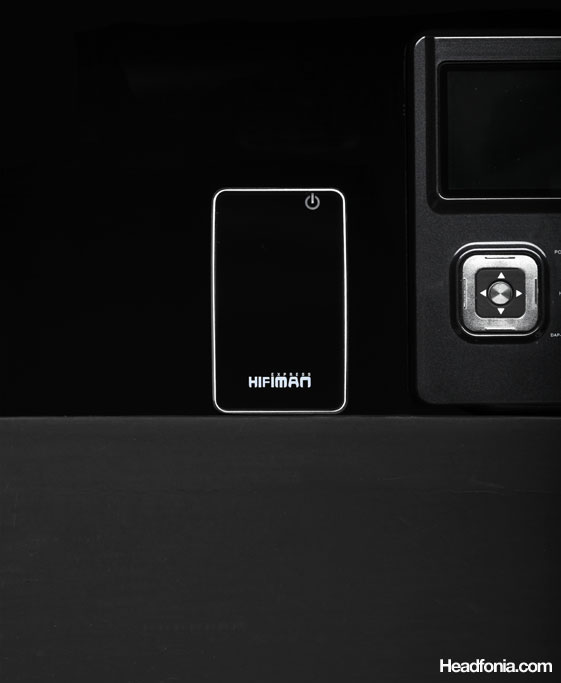
Suddenly everybody seems to be very into entry level USB DACs. After Fiio and Ibasso, next comes another USB DAC from yet another Chinese manufacturer: Hifiman. As the Hifiman brand is synonymous with high-end stuff, they released the Hifiman HM-101 under an Express brand name.
We’re talking about really entry level stuff here. $39 price tag, and the HM-101 comes in a really tiny size, smaller than the Ibasso D-Zero and the Fiio E10, two entry level USB DACs that we reviewed recently. Build quality is pretty good, though nothing exotic about it. The features are as basic as it gets: 16/48 maximum resolution over USB, a USB port on one side and two 3.5mm ports on the other side.
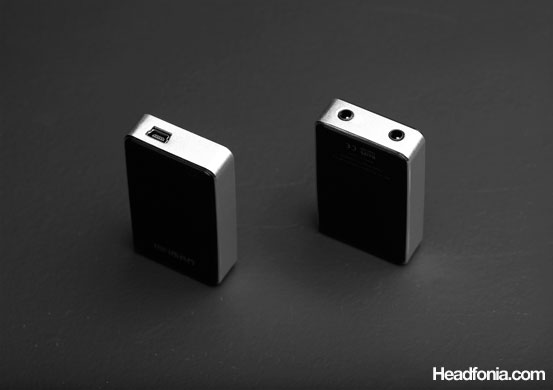
USB in on one side, analog out on the other.
I have big doubts about the performance of the PCM2702 chip, which is used not only for the USB receiver function but also for performing the actual D/A conversion on the HM-101. I’ve listened to many many PCM270X based DACs, and with the exception of the Styleaudio UD-1 DAC which comes with big PCBs and audiophile grade components, none of the other PCM270X based DACs really have anything good about their sound. Yes, I’m serious. Texas Instruments really designed this chip for basic audio devices such as USB headphones (more like USB headsets), USB speakers (those tiny PC speakers that run from the USB hub), or LCD monitors that come with a built in USB speakers. On some applications the PCM270X tend to be used mostly for USB receiver functions (though being limited to 16/48 most newer products these days tend to opt for the 24/96 capable Tenor TE7022 chip). So I was like “what is Hifiman doing with a PCM2702 chip?”
 Good thing that while looking up the PCM2702 and PCM2704/5/6/7 data sheets, I noticed that the PCM2702 had a slightly better numbers on the Dynamic Range, THD and SNR. The PCM2702 also comes with an 8x oversampling filter and a low-pass analog function, something that the 2704/5/6/7 chips don’t have. But at the end of the day, it’s still a PCM270X chip, far from the much more sophisticated Wolfson WM8740 chip used in the Ibasso D-Zero and the Fiio E10, or even the TDA1543 and PCM1704 chip used in the audiophile-grade Hifiman players.
When I first got it, I noticed how simple the operation is. USB input, headphone output. I plugged it in to my laptop, hooked a Senn HD25-1 on the other side, and play some tunes on iTunes and just left it running for a few hours without even listening to it. Then I came back to it, still playing the same album on a loop, and decided to take a listen through the headphones. “Oh wow, this thing sounds pretty good” I thought. I continued to listen. I noticed how grainy and how high noise levels on the HM-101 was, compared to say the black-background of the Ibasso D-Zero and many other DACs I’ve reviewed. But on the other hand the HM-101 does things that the Ibasso doesn’t. The HM-101 had this superb soundstage depth and ambiance that excels anything I hear from the Ibasso D-Zero or the Fiio E10. It’s a bit narrower than the D-Zero, but depth and ambiance was far more real and three dimensional on the HM-101, which leads to a higher overall score on the soundstage performance.
The sound was remarkably analog, and it reminds me a lot of the sound of the HRT Music Streamer DACs. And due to the analog sound signature, I really don’t mind the high noise and grain levels, as it goes really well in the overall presentation, sort of how grain always romanticize film-based photographs, or how pops and noises are an accepted part of the whole vinyl listening experience. The warm and mid-centric tonality is very likable. Not only because it’s warm and mid-centric, but also because you never get a feeling that things are dark and muffled, thanks to the superb, spacious depth of the soundstage giving a very good image of the venue where the recording was taken.
I have no complain with the treble as it was clear enough and wasn’t wrong or bothersome to my ears. The bass, as always, is a bit loose on budget devices, and I’ve learned to accept that compromise as long as it doesn’t go to the boomy category. However the TDA1308 based headphone amplifier lacks the punch in the bass. I think it has enough body in the bass, but just not enough punch and that’s why I’d rather have the signal passed on to a different amp like the Fiio E6 which I already find to improve the bass punch. But obviously that takes out some of the fidelity and the awesome soundstage that I was raving about earlier, and also the beauty of a simple one-box operation. Hence, I would recommend the HM-101 if you don’t mind a slightly less punchy bass section in return for an super-awesome soundstage for only $39.
The headphone amp and DAC section is amazingly free of artifacts as I didn’t pick up anything even listening to the super resolving HD800 and the Beyerdynamic T1. Once again, if the bass was a tad punchier, the HM-101 would have been the perfect device.
Continue to the next page…




Guest
first ! love it mike!
Anonymous
Thanks!
Syakir Zainol
…and i will buy this for my office use.
Алексей YY
is it really better than build-in laptop sound system?
Anonymous
Yes! At least compared to the one on my Macbook Air.
jendol
I have the pleasure of listening to hm-101 through mike’s laptop, and yes, it is definitely better compared to macbook air soundcard sq
Anonymous
I’m listening to Headphonia’s USB cable DAC and I think it’s pretty awesome.
SoupSoup
These things are getting smaller and cheaper by the minute!
I guess the “true” competing product from the Fiio stable would be the D5.
It would be interesting to see how the dac/amp compare.
Anonymous
Yes we missed comparing it to the D5. Still have no idea how the D5 sounds.
deanreed
If there’s going to be a shootout, please include the fiio d3 as well.
clam
Should sounds the same as the d5. The only difference between the two are the inputs I believe (USB vs optical)
Anonymous
Yes since everyone is crying for a Fiio D3 and so I will DEFINITELY make it happen, guys. 🙂
Donunus
I doubt they sound the same as the d5 because I heard the d5 is thin sounding. The D3 sounds rich out of the optical out and even richer out of the coax. I was comparing the d3 with a full size pioneer Elite player
FiiO
D5 is for mass consumer market, which support mic in for skype, msn, gaming , google talk.
Anyway, D5 is used cm108, which also a famous USD receiver+dac chip, used in nuforce icon mobile, and some other brand. and d5 also have a individual headphone amp so the output is quite strong, LOL.
SoupSoup
I guess you need to send a review sample of the D5 to Mike!
It’s starting to be crowded in the sub-$100 portable (i.e. battery or USB powered) DAC/Amp market.
It almost calls for a shootout of ultra-inexpensive audio improvement solutions.
Mike, don’t you love it when your readers give you more work to do? LOL
Anonymous
Bossy readers, I know. 😉
Gold Fish
I have this for 3 weeks. It is not really better than the on-board soundcard; it’s rather a different character. I don’t hate it, but there is nothing to write home about it.
Alfjr Ks
I agree with you Gold Fish, i think it’s just make a different some character of music. if you have file FLAC and speaker out with great EQ 2.0 speaker set, probably you will say nothing different with onboard even with standard driver.
clam
Of the three DACs you compared, which one would be most suited to classical? Just trying to run a pair of IEMs and ATH-ES7 so amping isn’t too big of a deal
Anonymous
It would have to be this one, the HM-101.
Calvin Lam
Just received the HM-101 and listening to it now. The grain and noise is really loud through my UE SF5 Pro but not as noticeable through the Audio-Technica ES7. Mike was totally right about the soundstage, its pretty big considering the price of this little DAC. Actually makes the ES7 more enjoyable with classical than just straight through the headphone jack of my MBP. Good alternative to my full size rig on the go.
Hoping that more burn-in will ease the noise issue (especially with IEMs)
Dan
Hopefully, it is compliant with the new Google phone, Galaxy Nexus under Ice Cream Sandwich.
Anonymous
Really, you can use this with a phone?
Dhani Nugraha
Mike, if I’m not mistaken, the Android Ice Cream Sandwich has USB host capability, thus the ability to control run-of-the-mill USB devices. Think gamepads, USB sticks or external drives, DACs like the HM101… 😉
Erik Wijnands
I have a Nook Color with CyanogenMod7’s custom ROM installed. It has USB Host, thus making driverless DACs work on Android 2.3. In combination with apps like Poweramp or Player Pro you can have a great 7″ portable “audiophile” rig.
Anonymous
Sounds really nice, Erik.
Erik Wijnands
Headstage DAC Cable review? 😀 I have the Headstage Arrow and am hoping the DAC Cable is awesome. That way I can hook the Cable and the Arrow to my Android Tablet and have an awesome portable rig! 🙂
Anonymous
Listening to the DAC cable right now and I think it has just the perfect treble sparkle to pair with the Arrow amp.
Raúl Burgos
Hello there!
Firstly, I have become a big fan of the site. I usually visit it a few times per day looking for updates 🙂
I have a couple of questions: I am looking for a nice and inexpensive dac+amp for work, where I use the Audio Technica ATH-M50. I mainly listen to electronic (not necessarily dance music, mostly stuff like Björk and that kind of artists) and pop music. Between the Hifiman, iBasso and the Fiio, which one would you recommend for the M50 and this kind of music?
I am also looking for a home headphone, up to around $500, that I´ll use with a Matrix mini-i. Any suggestion? By the way, I recently sold my AKG k702 because I found them extremely boring (if that helps)…
Thanks for your help and congratulations for the hard work!
Raúl
Anonymous
Hi Raul,
Thanks! I’m glad you like the site, and I’m sorry about the lack of daily updates. 🙂
I think the Fiio would have the best midrange for the M-50 and that’s probably the best one to go with. The Ibasso is second in place.
As for the headphone, the HE-300 is a very good all rounder. http://www.headfonia.com/hifiman-he-300-the-dynamic-driver/
Evilniek
Hi Mike, first i’d like to say that i really like your site, keep those reviews coming. Btw, are you planning on a review of the HRT Headstreamer?
Anonymous
Yes, but maybe it’ll still be a while since I still have other things planned for now.
Evilniek
No hurry, i already own one, was just curious about your opinion :).
Anonymous
Ah, you should write a short review for us. 🙂
GenericMav
hi Mike, i got a question to ask. i have a ATH-AD300 headphone and Fiio E6 amp, how do you think this would pair with HM 101?
Anonymous
Hi GenericMav,
I think it’ll be a good pairing.
Marc Flore
I’m a bit new to this. I’m looking to the improve the sound of both my work laptop, which has a lot of annoying hiss (I suspect the dock or power supply), and my Zune. It seems that for the Zune, I don’t need a DAC, but I do for the laptop, is that right? I use 2 headphones primarily, Grado SR-60 on the laptop and Etymotic ER6 on the Zune. I have looked at some of the other units mentioned on this site (e.g. Fiio E10, iBasso D-Zero), but they are a little pricier. Are they worth the extra cost? Keep in mind I have a decent ear but I’m no audiophile.
Anonymous
Hi Marc,
Maybe for starters I would just start with the E10 or the D-Zero. Besides they make better and cheaper DACs every year, so it’s also safer from an investment standpoint.
Steve
Mike;
I was wondering if you were going to listen to the HiFiMan EF-2A. It is their tube driven DAC/amp (under $200) and it uses the same Burr-Brown 2702. If you like the soundstage on the HM-101, it would be interesting to hear the soundstage on the EF-2A with tubes.
Anonymous
Hi Steve,
Is this an update on the Hifiman EF2?
Steve
I think it is, but truthfully, I’m not sure what was changed. I have read good things about the EF5 amp and some of their headphones and other products, so I guess I was wondering about your impression of the EF2A as a desktop amp/DAC (or the EF2 for that matter). Again, it uses the same DAC chip as the HM-101 which you thought had a good soundstage and analog feel to it. That sounds like it could be an interesting mix if coupled with tubes as well.
I couldn’t find on the site if you had ever reviewed one before.
Anonymous
Yes, thanks Steve. I probably should check out the EF2A then. Can’t say anything about it at the moment.
Biergourmet
Here is a nice story about PCM2702 development: http://www.eetimes.com/design/audio-design/4009467/The-D-A-diaries-A-personal-memoir-of-engineering-heartache-and-triumph
IMHO it doesn’t read like designed for low quality devices 😉
Mike
Thanks for posting! I saw your post a few days ago but I was working on something else and got distracted. 🙂
Biergourmet
I’m using a Pro-Ject Box USB as source for my headphone amp. I cannot compare to other USB DACs but so far the only problem I have with this unit is that I can hear the noise on the USB 5V rail. Of course only with high volume levels and no music playing. The same noise is on my internal ESI Prodigy HiFi PCI soundcard (connected to my speaker amp), but I never noticed it on my speakers.
Also the noise is CPU/GPU usage dependend.
So either I have to live with it or get an DAC with proper power supply. I’ve already tested an USB hub with external switching power supply, but this made it even worse (it had a constant high frequency tone).
Mike
You know a lot of amps, even high end ones would have noise if you max out the volume. But if it doesn’t get through on normal listening levels AND with music playing, I really wouldn’t worry about it.
Biergourmet
A bit of noise is no problem when I hit the pause button. It’s more the annoying sound signature of that noise, e.g. it stops and starts randomly about 3 times in 5 seconds. This makes it much more obvious than a constant noise.
Mike
Shoot that sounds pretty serious then.
It would be simpler just to try another DAC/Amp unit, even something not too expensive, rather than trying different power supply options.
Fabio Rocks
Hi Mike! I am planning to buy the hd600 as christmas present. Do you think is a good pair with hm 101? Or it’s better to pair with Ibasso d0? I will use it with Macbook air and Bitperfect (thanks to you It’s an awesome program!)
Mike
Hi Fabio,
I’m afraid that you’ll find the HM-101 to lack punch with the HD600. Either go with the Ibasso or the Fiio.
Garysohnxxxxx
How would the synergy be with the JDS cMoy? Perhaps retaining some of the soundstage/ambience while adding a little bass with the switch.
Mike
Yes, totally right. You’ll get a very good soundstage, and the bass too.
Budi Kosanto
just got this stuff, btw whats the different the line out and the headphone out?
i still can adjust the volume both way, i though that a line out supposed to have a fixed volume level?
Mike
Budi,
The line out doesn’t have the driving capability of the headphone out. You should notice that the line out is cleaner and has a lower noise floor, but that bass is very weak on the line out, compared to the headphone out.
Budi Kosanto
i did sense the difference, it just happen that all i know about line out is a fix volume level so i think i was mistaken here.
Mike
Well, since volume control is done on the computer, it would affect the digital signal being sent to the DAC, and so the volume at the line out would follow that as well.
Iletec
does hm-101 have better soundstage depth than hm-601 player?
Przemysław Gast
I get huge noise from HM-101 and my Macbook Pro Unibody when music is not played and box is near laptop. Same with the receiving call iPhone near the Hifiman. Is it normal ? If not can I fix it ? I use shielded USB cable and the one from package, without changes.
Mike
The noise from the Phone is normal, that happens to a lot of audio devices. The huge noise, I don’t know how huge you’re talking about here, but the HM-101 does have some noise.
Przemysław Gast
Thanks for reply. Let me explain noise:
The noise happens when the HM-101 is near laptop (especially near rear side of it), also I’ve had noise when quiet and playing sounds when I was sending a lot data via wifi (802.11g). I am using Audirvana Free and DT880 Pro / Koss Porta Pro. Is there a way to shield this box by myself ?
Mike
I’ve never really had a case that extreme. I mean, Wifi interference? I use the HM-101 very close to a wifi router and doesn’t have that problem. I don’t know, it’s not going to be easy to add shielding, since you need a metal box, and you need to hook up the ground on the circuit to the metal box.
Prakhar Yadav
Hey Mike
Thanks for all the questions of mine youve answered. I’m spending a decent amount getting a large amount of equipment and your advice is really helping me out.
If I paired this with the ZO would I get a bassy signature with a good soundstage?
*Crosses Fingers*
Mike
Hmmm… I haven’t really tried that. It may work.
Prakhar Yadav
So if you amp out of a DAC then will the amp muddy the clearer signal or will it just add to the properties of a DAC.
If I decide to go to a higher level DAC (Like the D-Zero) then will the improvements be apparent (even with MP3 320 kbps music)?
Thank You
Atriya
Would this pair well with a HE-400?
Mike
Not enough power.
This one would drive the HE-400 better:
https://www.facebook.com/photo.php?fbid=483358901708812&set=a.283848904993147.77118.145341288843910&type=1