




This is my second take on a wireless headphone, and like the RS180, this one is also a Sennheiser. With the recent abundance of Sennheiser articles on Headfonia (and on the upcoming ultra-portables shootout, there’ll be three Sennheiser models), you must wonder if they pay me a lot of money for writing their articles. I know that some local friends, Hadi included, often called me a Sennheiser fanboy. I sure wish that Sennheiser was paying me money, unfortunately that is not happening. And as I’ve said previously, this is just a matter of product availability. I’d love to try out Bluetooth headphones from the other manufacturers, but just I haven’t seen them around that much.
Being mostly an audiophile who enjoys big complicated set ups for a rewarding music experience, press releases of Bluetooth based headphones don’t really excite me (Who does, anyway?). One day, Tino, a local Sennheiser guy showed me the PX210BT, and I listened to it just to be polite. I was totally floored! I had compared nine of the most popular closed headphones a few months ago, and at that time was working on a comparison of ultra portable headphones, so I know what the competition in the wired world is like. The PX210BT still comes out as a very strong contender, even neglecting its wireless handicap. I told him that the PX210BT sounds really great, and that it’s a pity that it’s not getting the attention it deserves among the enthusiasts — probably mainly due to the wireless status. “Someone needs to write about this headphone!”, I told him.
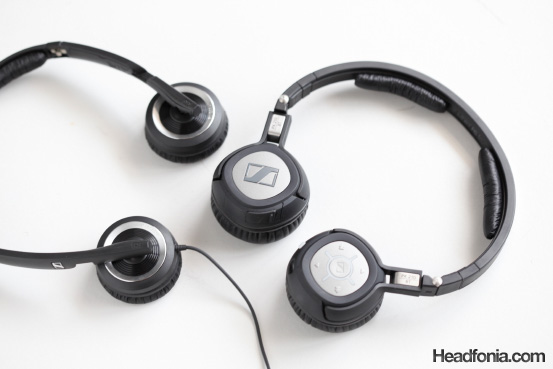
I contacted a friend at Sennheiser Singapore, but he ran out of sample units (he probably didn’t expect an enthusiast site like this to be interested in a portable bluetooth headphone). Thanks to my buddy, Sem for the PX210BT loaner. Free promotion for Sennheiser, but what the heck, it’s a great product!
When I wrote the RS180 article, I was quite surprised to hear how the wireless full size headphone from Sennheiser had a sound that’s more fun than any of the wired full sized ones, including the HD650 and the HD800. Although still inferior in the technicalities, the RS180 had a far more engaging sound than any of the wired models. It was the most perfect balance between the traditional laid back Sennheiser sound and yet with a forward and engaging midrange. Now, I don’t know what Sennheiser’s strategy is, because they also had endowed the PX210BT with one of the best tonal balance I’ve ever heard on any portable headphones. Don’t even compare this with the PX100-II or the PX200-II, or even the HD238, because the PX210BT is more than that. Instead, take some of the more serious wired portables like the HD25-1, the ATH M-50, ATH ESW-9, or the Beyerdynamic T50p and the PX210BT is still a very strong contender in that group (even discounting the wireless capabilities).
For instance, take the HD25-1, which has always been a crowd favorite. The PX210BT is able to stand up to the HD25-1’s audio performance, and even better it in some ways. A fuller midrange, a fuller bottom end, still the same engaging sound, smoother and more refined than the HD25-1’s outdated driver. The HD25-1 still has a stronger bass punch and better PRaT, but other than that, the PX210BT does everything better than the HD25-1, even top and bottom frequency extension. And the PX210BT has quite a punchy bass too, just not as much as the HD25-1.
Next, take the T50p from Beyerdynamic. Yes, the Tesla driver from the T50p still has a superior edge in technicalities and resolution, but I really had problems with the midrange areas and the bass areas. Midrange transition was quite abrupt and a little recessed, and I can’t seem to get a good low bass performance out of the T50p. The PX210BT, on the other hand, has a much more full midrange and low bass, resulting in a much more musical sound. I also need to add that the PX210BT fits much better than the T50p did on my head! (And I’m still not talking one word about its wireless capabilities here)
The PX210BT shares some similarity in terms of tonal balance with the ATH M-50, which is still my favorite all rounder closed headphone. The PX210BT can’t match the M-50’s soundstage size, and I also suspect that the M-50 is still superior on the frequency extension. But the PX210BT is more forward and engaging in the midrange, while not losing the treble and bass balance. Bass punch is also tighter in the PX210BT than it does in the M-50. So, despite being a wireless model, we do have quite a contender here. The technicalities, soundstage, and separation of the PX210BT is surprisingly very good. Although, being stuck with a mediocre source, I couldn’t really see how well the PX210BT does with better quality source.
Seriously, the only problem that I have with the PX210BT is the quality of the Blackberry phone I use as a source (especially after weeks with the HM-602 Hifiman).




Mike
It's time to go Wireless, guys! Woohooo!
tisb0b
Just out interest will you be reviewing the Meier Corda stagedac and concerto as I am rather curious on your thoughts.
Mike
No plans for the stagedac, but a friend just bought a Concerto which he plans to bring over for a match. I should be able to write something about it soon.
Mike
Heard the concerto today.. we had a few amps laying around for a comparison. It was a good amp, though quite lean on the mids and bass. Even compared to the 2-ch Beta22, which is not a thick mid & bass amp, the Concerto noticeably has a leaner sound signature. I opened up the casing and saw 6 AD797 opamps. No wonder, the sound signature is very typical of AD797 — very good treble but not so much mid and bass body. Compared to the M-Stage, for instance, the M-Stage has significantly more mid and low end, though not excessively. The Concerto's resolution and refinement is far ahead of the M-Stage though, and more closer to the Beta22. Another thing that I felt the Concerto to lack is voltage swing, as on high gain setting, we were up to 2-3 O'clock on the volume control, while on the M-Stage and the Beta22 we were on 9-10 O'clock.
iyayy
you.. sennheiser fanboy you..
lol. jk. 😀
Mike
If Sennheiser read that, they may consider becoming a main sponsor of my site. Dear Mr. Sennheiser, I can always change the logo to a HD800… 😛
Jose
you already have on tweeter 😉
Mike
I know… they don’t seem to respond though 😉
cansman
Hi Mike,
I have the PXC310BT (noise cancelling version) and I agree with you that Sennheiser has produced a great series of high quality bluetooth enabled range of cans that are not getting enough attention they deserve!
And I am listening to them right now through my CEntrance DACport – sweet!
However, another headphone racism to REALLY overcome is the Bose around-ear (AE) headphones! They, in my opinion, sound even better than the PXC310BTs! The AEs have angled drivers, sound spacious and have very little driver resonance for a closed set of cans.
Just treat the AEs like any other good set of cans – at least 200 hours run-in; and the sound really opens up, with great smoothness!
You might want to try them at some stage. I think you will be suitably impressed!
Cheers,
cansman
Mike
Hey Cansman, thanks for writing.. yes I do think that there is a lot of discrimination happening in the world of headphones. I'll be on the lookout for the Bose AE headphones, I'm sure the local Bose shop has them.
Earfonia
Good to know wireless technology is advancing to satisfy audiophile demand!
Thanks Mike!
cansman
Hi Mike,
Just when we were talking about the Bose AE headphones – guess what has just been launched – the AE2 headphones! Here's the link:
http://www.bose.com/controller?url=/shop_online/h…
It looks physically larger than the original AEs – this is good because I found the originals a bit too fitting. Changes from what I can tell include memory foam earpads and angled ear-pieces. In terms of physical design, the AE2s address all the design quirks I found in the original. It should now fit very comfortably like the QC15s (which I also own – did I tell you that they sound good too 🙂 – they incorporate what many headphones don't have – active equalisation! In my opinion, this is the way to go for the future of headphones, in addition to your point elsewhere about them being wireless. Perhaps the good sound you experienced using the RS 180s and the PX 210BTs might be due to some form of signal conditioning and not just them being self-powered, i.e., active equalisation – I don't know, I haven't verified this!).
Anyways, back to the more conventional AE2. I am looking forward to hearing them myself. I hope they have slightly more bass extension and smoothness at the top end. The website actually says improvements in sound include "smoother audio throughout the entire frequency range, from full lows to clear highs".
Thanks again for the always enjoyable read at your website!
Cheers mate!
cansman
Mike
Hi Cansman, thanks for the notice. I’ll be on the lookout for the AE2 on the local Bose shops. Hopefully they’ll let me demo it. 🙂
What other headphones have you compared the AE to?
cansman
Hi Mike,
I have compared the AE to my HD650 and PXC310BT.
🙂
cansman
Mike
Very interesting. Any impressions of the AE to the HD650 and PXC310BT?
cansman
Hi Mike,
Sorry for the delay in my response :). I find the AE sound balance rather similar to the HD650 minus the deeper low end that the 650s are able to produce. The AEs are surprisingly transparent although it is certainly less refined than the 650s. However transient response is very good, almost matching the 650s in my opinion. It also has good PRaT like the 650s (only if the 650s are amped properly!). However decay is slightly too quick but it doesn’t detract from the music. The HD650s are of course world class cans! But the AEs are of sufficient high fidelity to enjoy them even after listening to the 650s!
The 310BTs have a surprisingly good soundstage for such small earcups and are better than the AEs in my opinion. However, because the AEs have angled drivers, they sound less “in your head”. To me, the 310BTs have more midrange resonance than the AEs. I think the AEs are less coloured and more neutral. The 310BTs have a rather good bass punch and presence. The AEs in contrast is slightly light in the bass. However, the AEs have better overall coherence and PRaT – which makes them more enjoyable long term.
From the description of the new AE2s, it looks like Bose has worked on the shortcomings of the original AEs. I look forward to hearing them when I get the chance.
Hope my comparisons between the cans are clear enough.
Cheers,
cansman
Mike
That is a superb impression. I get a fairly good idea of how the AEs would sound. The AE would probably have a little more midbass than the HD650, I guess?
cansman
Thanks Mike! Yeah, the AE has a little more midbass presentation than the 650s. Of course, the 650s dig much deeper in the low frequencies. In contrast, there’s not much low bass in the AE.
b3dz
Yo Mike,Do you hve experience abt Ultrasone ED8?
If yes, Which is better between Jh 16 & ED8 ( hve wider sound stage & decent bass)?
Mike
Sound signature is different, and so you can't really say which is "better" The ED8 has a typical Ultrasone house sound, though with fuller mids than most of the others, the JH16 has a typical Jerry Harvey house sound. One is an IEM, the other a headphone. Here is my Edition 8 review: http://www.headfonia.com/ultrasone-edition-8/
b3dz
I was messed up.:) Actually, I'm abt comparing The ED8 with HD800.
Hve any idea?
Mike
No problem, b3dz. Still with the HD800, more or less the same argument applies. The Ed8 can't really compete with the HD800 in terms of technicalities, but the two headphones have very different uses as well. The HD800 is more demanding of the set up, and is more suited for a home set up. The Edition 8 can be used portably and is a closed design.
b3dz
Interesting. That was really helpful.
Thx for ur info tho.
Chai Ilaik
Hey
Can you please compare these Sennheiser with the Grado RS60i and the AKG K450. Im still not sure wich of these 3 I should buy.
Thank you so much!!
Mike
Chai, don't know about the K450, but the PX210BT is one of the most balanced, funnest portable headphone I've ever encountered. Not to mention its wireless capability.
I'd take the PX210BT over the Grado SR60i anytime of the day. Of course, you really need to know your preference, your music, and not take my statement as an absolute.
Bank
great review mike 😉 Now I'm planning to buy a new pair of portable headphones, but still hesitate between beyer t50p and px210bt. I've tried t50p and love its performance with female vocal and treble,but the model I tried wasn't burn-in yet. So, here is the question: will the SQ improve significantly after burn-in? and do you have any suggestion on which portable should I go for if I listen mostly to bossa nova, vocal jazz, and pop. Thank you in advance: D
Mike
Hi Bank, the T50p is more refined than the PX210BT, but the tonal balance is a bit weak and not as good as the PX210BT. Ultimately I wasn't able to enjoy the T50p despite its refinement, and so does many other people. The PX210BT, on the other hand is very well balanced and may be one of the best portable headphones around.
Denimhead
Better my soon-to-be model, the ATH-es10 for a portable headphone? SHENANIGANS! They're expensive, though, I'll give you that. But for $300 USD shipped brand new, (I will not tell you how or where =]) I think the ATH-es10 is still the best.
Mike
That's cool, Denimhead. I'd love to be able to hear the ES10 again when I have the chance. 🙂
Gordon Shumway
Very nice read! I need a new pair of headphones and was considering the AKG 450 because my brother says only good things about them. But I think I’ll be going wireless with these Sennheiser’s now.
Can these headphones pair to two devices? I’d love to be able to listen to them at my computer and with my 4th gen iPod touch. (If not, I guess I can use the wire with my computer)
Anonymous
Hi Gordon,
I think you have to un-pair it from your Touch before you can pair it to
your computer.
Please also read the other article about the bluetooth dongle.
http://www.headfonia.com/sennheiser-px210bt/
Anonymous
oops, I mean this:
http://www.headfonia.com/it-could-have-been-great-sennheiser-btd300i-wireless-dongle/
Gordon Shumway
I just read the manual online, and supposedly they can save up to 8 (!!) bluetooth device profiles. Not sure how it selects between two that are in the same area, but still, very impressive!
I should be fine without the adapter; I have heard that the 4th gen iPod touch works with bluetooth controls. And my macbook pro has Apt-X BT :). Thanks again for the article.
Anonymous
That’s awesome Gordon. Actually I was going to warn you about the
Bluetooth adapter as volume level seem terribly limited when using that
adapter.
blub
Hi Mike,
Hi Cansman,
Thanks for the review and impressions on the PX 210 and PXC 310!!
Could you give more info/your experience on the sound-isolation-properties of these headphones? (blocking outside noise & amount of leakage)
This e.g. in comparison to the HD-25 or TMA-1, which are considered as very good passively isolating headphones.
Could you also give your opinion on them with regard to sound-quality and presentation for listening to rock (both electric and acoustic), classical music, jazz, pop ?
I’m looking for good travelling-headphones, for use also on public transport. So I’m considering the PXC 310 (BT), which should sound the same as the PX 210, but with active noise cancellation. But I’m doubting about their isolating capabilities (passive & active) and about their fitness for the music-genres I mentioned above.
If the HD-25 or TMA-1 isolate as well for use on public transport, but purely passively, I might as well go with either one of those…or just stick with my Sony MDR 7506 which do fold but remains quite big… 🙂
blub
Hi,
I forgot a third question 🙂 :
As these can also be used cabled, is the plug of the cable on the headphone-side a standard ‘jack’-plug?
I ask this as I also read you’re thread on the after-market cables for theHD-25 and I wondered both if it would also help the PX-210/PXC-310/… and if it would need a ‘proprietary’ plug or a standard one.
blub
Hi!,
does anyone has some insights or experience to share on these aspects (see post above) of the sennheiser px-210 (pxc-310) [ musical presentation // isolation // cable-options ] ?
(Sorry for this kind of ‘bump’!)
thanks in advance!!
Neonomide
I actually lost my BT210s almost a year ago and decided to upgrade to the high-end model MM-450-X (Apt-x ready), since it’s comparatively pretty cheap where I live (Scandinavia) and had mics and sound cancellation (and singer Seal hyped them on Youtube :). I hped it would be the “ultimate solution” for a moving person like me. Interestingly, I found my BT210 a few weeks ago and now have had a wonderful opportunity to compare the two within my iPhone 4G.
Overall, I think BT210 beats 450-model hands down on many criteria. It feels easier to find a proper ear position, it feels better on head and 210 is far better at bass, resolution and representing different (worse) quality recordings. Wire doesn’t seem to change things either. I feel 210 feels relaxing, fun and interesting overall in comparison, even though I still think HD-25 trumps it overall, but I should compare them more closely like I did with 450 and 210.
Obviously, there are differing design features between the models too. MM-450 is less thick, more sleek and looks better with metal parts and one more LED button. Sound cancellation and mics are great features too and I mostly used 450 for podcasts anyway. The comeback to 210 is mesmerizing for me, I can’t imagine going back to 450 for my (re-born) musical needs and it makes me sad for 450.
I must also admit that I haven’t used the usb-dongle yet in my comparison so that may change(?) something. I was thoroughly satisfied with dongle + 210 combination (I guess my favored volume level is less than others), but never used 450 with it. So I may update my thought soon.
I really feel the cheapest model trumped the flagship this time around. The thing is, I like to use headset even when not listening since they warm my ears (it’s really cold here during winters) and wireless is simply the only way to go for me now. I just feel sad how these models seem so different with nice non-music use (450) and music use 210. Just wanted to express my thoughts.
Mike
Thanks for posting that! I actually still hasn’t got the chance to listen to the 450
rayner sierra
wich ones sound better the PX210BT or the august EP650? does it worth spende the money difference?