




It was in 2008 that we started hearing about the SPL Phonitor, a high end headphone amplifier developed by professional recording equipment company SPL in Germany. SPL coined a nice name for the stereo imaging issue that plagued virtually all headphones, even the K1000: the super-stereo effect. What we mean by super-stereo effect is that with headphones, the left ear hears only the sound coming from the left transducer and the right ear hears only the sound coming from the right transducer. Well, isn’t it supposed to be like that? Apparently not, because even in stereo loudspeaker set ups, some of the sound coming from the left speakers would be captured by the right ear, and vica versa. Pictures would explain better:
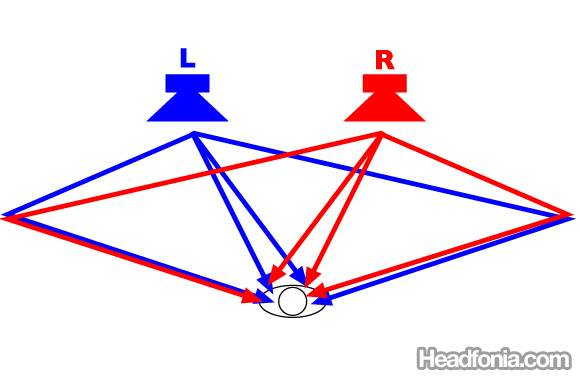 This is a loudspeaker set up. Both ears actually receive direct and indirect waves from both left and right speakers.
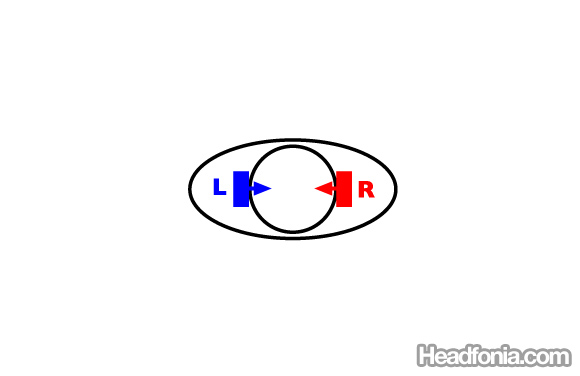 This is a headphone set up. The left transducer sends waves to the left ear, and the right transducer sends waves to the right ear. There is no mixture of the soundwaves like what we get with speakers, thus the super-stereo effect.
We are all aware of the super-stereo problem created by headphones, and there have been a lot of different techniques developed to help attenuate the problem. Before the introduction of the Phonitor, Dr. Meier’s crossfeed circuit was probably the most widely known answer to headphone enthusiats. Even the Grace m902 amplifier utilizes Meier’s crossfeed, and though it was a very good crossfeed circuit, there are no adjustment capabilities built into it. For headphone enthusiasts, we may think that crossfeed is really not that necessary. After all, many fine headphone amplifier comes without any crossfeed circuitry. Not to mention purists who fear that adding more circuitry will introduce distortions and sound degradations. Besides, we have adjusted to the super-stereo effect, and most of us resort to other techniques such as a technically superior headphone or a better DAC to give us better imaging. So, we simply ignore the super stereo effect and accept is as a fact of life.
For recording engineers, the existing solutions were not enough. While monitoring speakers technology is constantly getting better, headphones are still best for “zooming in” into a particular mix. Hence, they want to be able to use headphones for mixing. Here is an excerpt from the Phonitor User Manual:
On one hand the analytical headphone monitoring is like working with an acoustic magnifier but without external room influences; on the other hand, as with loudspeaker monitoring, forgoing the microscopic effect, but with room ambiance.
Working with the magnifier effect on headphones has the advantage of safely hearing clicks or similar defects and helps in fine tuning crossfades or to judge tonal problems in individual tracks.
On loudspeakers such analysis is much more difficult, as such problems just are not as apparent as when working without being able to “zoom in” aurally.
So, there has got to be a better way to deal with the super stereo effect. Again, from the Phonitor’s User Manual:
Traditional headphone reproduction produces 180-degree stereo width in the middle of the head, and it is exactly this which creates the very problematic-to-impossible headphone mixing environment. An essential reason for such unnatural ambiance is the complete separation of the channels, which does not exist either in natural hearing or in stereo loudspeaker reproduction. This makes it nearly impossible to judge tonal balance, a stereo image and the phantom centre level. Panorama adjustments as well as related EQ settings that one attempts with headphones, typically just do not function on loudspeakers.
In short, the Phonitor was created in an attempt to give the most complete control over recreating a proper loudspeaker imaging.




YpoCaramel
I’ll be honest and say that the Phonitor’s VU dials almost had me sold right away 😉
Ivan Nadeau
Do you recommend OPPO CD player???
When the upgraded HiFiMAN 801 will be available??? …I mean the one with a upgraded amp.
How with it sound with HD800 & JH16???
From your personal choice which desk top amp would you recommend for an optimized HD800 listening ???
Thank you your site is great
Ivan
Mike
Hi Ivan. The Oppos are supposed to be good for the price, but I never really tried them myself.
I believe the HM801 with the GAME amp is already available, and the amp is optimized for IEMs. Please contact Hifiman about that. The HM801 combo with the HD800 and JH16 sounds very good and will challenge many desktop systems.
As for a desktop amp, wait for the Burson HA-160 review, perhaps you will like it. 🙂
Cortes
Mike,
how do you compare the Auditor/Phonitor with the CEC HD53n ?.
In particular for pop, jazz, and female voices what would be your take?. thx.
Mike
Hi Cortes,
Pop, Jazz, and Female voices, I would take the CEC HD53N over the Auditor/Phonitor. The CEC is tuned to be colored in a pleasing way, where the Auditor/Phonitor is a very neutral colorless amplifier.
Mike
Hi Victor,
Unfortunately I don't have the Phonitor anymore. It's a very neutral amplifier. What headphone are you using it with currently, and how do you like the combination?
The LCD-2 is a very easy to like headphone, and I feel you can enjoy it with the neutral sounding Phonitor. Just make sure that the Phonitor can do a good job of driving the orthodynamic driver.
yoav tzfati
Hey mike, great review. Since I don’t have enough money for the Phonitor, what crossfeed plug-ins would you reccomend for use on a Mac? Windows?
Thanks.
Anonymous
Hi Yoav,
I’m mostly a Mac user, and for Mac I use the Canz3D. The amount of
control you have with that plug in is quite in depth, perhaps even more
in depth than the Phonitor.
http://www.midnightwalrus.com/Canz3D/
Harj
Hi Mike,
Could you tell how the auditor paired up with hd800? I’m getting mixed views from a different forum.
FYI
I will be using the cambridge audio 840c (similar to dacmagic) as my source.
Thanks in advance.
Harj
Anonymous
Hi Harj,
The Phonitor and Auditor amp has what I would call an ultra-colorless, sterile in nature sound. It would be perfect for monitoring, but usually music listeners would like a little more color in the bass, in the mids, and would find them too flat. Pair it with the HD800 which is also semi-colorless, semi-sterile, and you’re looking at a very flat presentation.
The Cambridge 840C, if I am not mistaken uses an AD1855 (or AD-something chip), rather than the WM8740 in the Dacmagic. I may be wrong though.
Steve
I now own this unit and the Senn. HD-800. These are a great combination for me.
Mike
Awesome, Steve.
Sickdrummer182
Hey, can you let me know if the Auditor has enough power to drive the Hifiman HE-6 to high volume without clipping?
Zombie_X
Yo,
The Auditor does not have enough output current to drive them well at all. I’d recommend something like the Schiit Audio Lyr or Violectric V200.
Mike
Yes or a speaker amp.
Zombie_X
I own the Auditor and it’s an exceptional amp with the most neutral sound I’ve ever heard out of a headphone amp before.
Mike
Have to agree @Zombie250:disqus
Jaro
Hi Mike,
would you recommend SPL Auditor for AKG K702?
thank you in advance
Mike
Jaro,
If you are looking for a super-neutral set up, then yes. Otherwise it may lack a little musicality for music listening.
Jaro
Hi Mike,
sorry I forgot to be more specific. I meant in term of driving them properly. If I am not wrong Auditor output impedance is quite high, so I am worring about damping factor.
Mike
Sorry it’s been so long since I did the review. All I can remember is that the Phonitor / Auditor amp is extremely neutral. Good for monitoring but not really my favorite for music listening.