




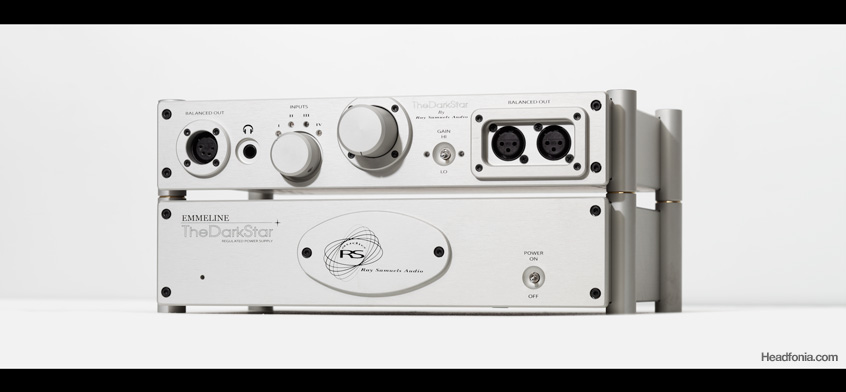
The way Ray describes the Dark Star on his website is pretty menacing:
In SE output it can easily swing close to 80 volts P-P., but the Dark Star Amp is a fully true balanced amp from input to output with quad independent gain stages and buffers. In balanced mode the voltage swing is double of that in SE. You can literary make your HE-6s sound like a speaker from a distant of 12 feet or more. There is no limit to how loud you can drive the hardest to drive headphone like the HE-6s.
But I was not convinced. On the contrary, those words have the opposite effect to me. Balanced: I very much prefer single ended. High power: low power is usually more refined. Prior to its arrival, I already have biases that seriously challenge the Dark Star’s credibility. Even more, these are biases that I developed up over my time spent reviewing numerous amplifiers, so I was a solid believer in them.
Pre-Review Biases
Let’s talk some more about the pre-review biases. The biggest bias that I have against the Ray Samuels Dark Star is my love for tube amplifiers. The last solid state headphone amplifier that I praised highly was AMB Labs’ Beta22, but other than that I’m convinced that only tube amps deserve the high end status. The Beta22 was an amazing amplifier on certain aspects such as power output, soundstage width, detail, articulation, and bass performance. However, it also lacked certain factors like a good soundstage depth coherence, and ambiance, and as a whole, it just didn’t sound so musical to me. Tube amps, on the other hand, tend to have a superior soundstage reproduction that thrives on recreating the ambiance on live music recordings, and most of them passes the musicality test with high numbers.
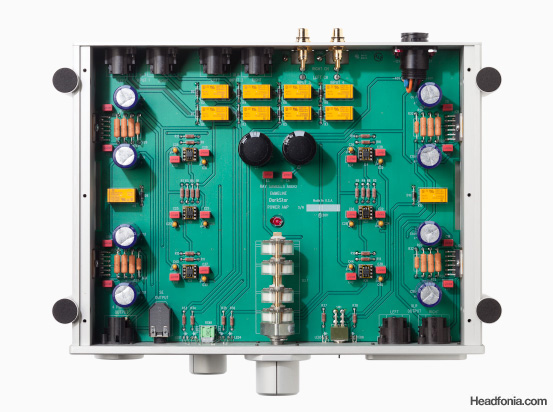
Another pre-review bias that I have was based on my impressions of previous high powered, balanced output amplifiers. I wrote on the Usual Suspects article that I wasn’t such a big fan of the balanced SR-71B amplifier, especially when comparing it to the single ended SR-71A. Likewise on the case of the Beta22: everybody would say that the balanced model with up to 50Watts RMS into 8Ω is the ultimate solid state amplifier for headphones. What I found, however, is not so clear-cut. While balanced would offer a wider soundstage than single ended, things that really matter to me like soundstage depth, imaging, and center image actually suffers when compared to the same amplifier in single ended. Thing is, when you have four individual amplifiers to handle the balanced stereo signals (L-, L+, R-, R+), each having a complex, high parts-count discrete design, it would undoubtedly create tiny variations in voltages on the four boards which ultimately affect the stereo balance and the soundstage image. So in this case, I actually like the single ended Beta22 better than the 4-channel. Interestingly, as the Dark Star is based on chip amps, the variations on each of the balanced signal are quite minimal when compared to an all-discrete design, hence the Dark Star manages to suppress the variations in the four channel to create an ultimately more realistic picture of the soundstage. And this brings up the next point in our pre-review biases: the question of chip amps versus discrete amps.
Personally, I have no biases against chip amps. I know that some people, being convinced on the superiority of discrete design, may sneer at the thought of a $3,500 chip amp. These same people would feel that an amplifier’s price should be somewhat related to the number of parts in the circuit. For instance, when I built my 4-channel Beta 22, the parts cost alone was roughly in the $1,000 mark. There were four amplifier modules, each containing somewhere around 30 transistors, and even more resistors, diodes and capacitors. But as it would turn out, these complex, lots-of-parts builds are not necessarily better than the minimalist amps, as the famous 9-parts per channel, 47Labs Gaincard amplifier has already proven.
Continue to the next page…





Anonymous
That thing looks beastly as heck. Excellent and thorough writeup as always, Mike.
Mike
Thanks Q!
Victor Halgaard
If you still read these: How does this amp hold up to todays standards? (Like Cavalli and Schiit).
Cheers 🙂
Joel
hi mike,
is the darkstar as dark as lets say a lcd2?
Mike
Definitely not that dark.
Rūdolfs Putniņš
Good to hear that you found something that stole your heart!
Still the question remains- can one weld or at least solder with a Darkstar?
Mike
Solder? Weld? Too much beer, my friend? 😉
Rūdolfs Putniņš
With such power ratings soldering shouldn’t be too hard for that amp! Depends on the source material of course.
And I don’t drink beer, just rum!
Erik Wijnands
Absolutely stellar photography in this review. Your cropping and white balance really suits the design. The lighting is soft and delicate. Ray should give you one for free just for taking these promoshots. 🙂
Mike
Thanks, Erik.
blankdisc
Mike,
one day you must share with us your secret for getting such beautiful picture. Personally i like this Silver DS. Black one seems to be a little dull.
Mike
Thanks!
It’s a bit like shooting models and cars. Easy to make good pictures if you are photographing good looking subjects. 🙂
Anjo
If you contact ray samuels like I did there is no Silver DS
Les1
agree, nice pictures and must say the white DarkStar looks great 🙂
Mike
Yea I think I like the white better too, though from the name, black seems to be a more fitting choice.
Themiddlesky
Awesome product in awesome review Mike 😀
Mike
Thanks 🙂
Sorry for the spelling mistakes, not very good with typing from the Ipad’s screen.
John
Mike,
Thanks for your review, I have a query though;I cannot fathom the difference you describe between the Dark Star and the Beta22. Contrary if I had to wager a bet I would have thought the Class A amp would have blown the RSA amp out of the water. I’m not convinced your Beta22 is in a healthy state, if your hearing a channel imbalance there’s clearly something wrong with it. Your matched devices may be out of whack, did you the match jfets idss within 10% +- etc?RegardsJohn
Mike
Thanks John
The Dark Star actually runs at class A. I suppose the Beta22’s status has become so legendary that it’s hard to fathom it being matched let a lone beaten by a chip-based amp.
The impression is not based solely on my Beta22. I had three different ones (one built was my own creation), and I also have three other Beta22s that belongs to my friends, all from different builders.
John
Thanks for your reply Mike,
Class A runs very hot, looking at the DS I see the choice of sink in the chassis itself, how hot does it get? I cannot find any literature stating that the DS does run in class A or distortion figures.I’m a Beta22 fanboy, I admit that. The amps been around for a long time for a reason, I’ve never seen a review where it’s so clearly knocked of it’s perch… until now.CheersJohn
Mike
Hi John,
When I built my Beta22, I was convinced that it was going to be the ultimate amp ever, even before the built is finished. Now I wonder, how did I get that conviction? By reading posts on the internet that claims the Beta22 to be the best solid state amplifier there is. In another word, I took people’s word for it, and I really believed that it was the ultimate amp even before I had a listen. It’s funny because now that I look back, it made me realize how naive I was at that time.
No amplifier is truly perfect. There are strong points, and there are weak points. Likewise the Dark Star, if you want the ultimate low bass, it’s still the Beta22. If you want the best upper & mid bass punch, it’s still the Burson. So again, the Dark Star is not a perfect amp. I just happen to find it to have a lot of strengths, especially the fact that it plays very well with any headphones plugged to it. Today I tried the Dark Star with an Grado MS1000 mod with the big bowl pad, and that headphone too sings very well with the Dark Star. This is where the Dark Star truly sings. I have never found another amp that works well with so many different headphones as the Dark Star is.
John, a lot of things in the headphone world are believed to be perfect because of words that’s been said over and over again, putting ideas in people’s head even before they begin to listen to it. The Stax Omega2, the Grado HP1000, the AKG K1000, to name a few. The reality is that every single one of those headphones have glaring weaknesses that people tend to omit when heaping praises about them. The O2 have no bass impact, the K1000 have obsolete drivers, and the HP1000 really is just a headphone with below average technicalities that happen to have good midrange and upper/mid bass punch.
What I’m saying is, you just have to take time to listen and compare these things for yourself. Don’t let other people put ideas into your head.
I appreciate you taking an open-minded view into this topic. I realize that what I wrote about the Dark Star, especially contrasting it to the Beta22, would be pretty controversial. You’ve got to wait for my AKG K1000 review. It’s going to be a pretty brutal review.
Please don’t take this as an anti AMB post. As I’ve always said, it is in our best interest as a review site to maintain objectivity since nobody is going to read the words of a biased writer.
Now the Dark Star’s Class-A and the heat factor. The chassis uses roughly a 6mm thick aluminum panel all around, with the front panel perhaps 8mm thick. The power op amps are bolted to the chassis for heat dissipation. That can probably account to the low heat, not to mention that the enclosure has a lot of empty space for plenty of air circulation.
John
Hi Mike, no worries. I’ve not taken your review as anything anti AMB at all,
It’s not just high praise by a lot of people that own and have heard the Beta22, it’s also the lab measurements and simulations that in effect back up its performance.
Thanks for the info regarding the Dark Stars class A thermal solution, as I say I cannot find the source of you information that does indeed state that this is a class A amp, if you could pass that on I’d appreciate it. Kind Regards, John.
Mike
Hi John,
Interesting to hear that it was not posted on Ray’s website, but this is what he told me:
“The amp will continue in class A if it is not pushed beyond it’s capability. The DarkStar is so powerful that it is just almost impossible to cross from A-B class.”
Indeed I can’t differentiate any difference in the sound whether I’m just running a single Beyerdynamic T1 (600 ohms – very low current req) or driving a K1K-HE6, T1 all simultaneously. The dynamics, dynamic range, transients, are all consistent so I suppose the amp never really does leave class-A.
John
Hi Mike,
Thank you for taking the time to answer all my queries, much appreciated.
I look forward to hearing the Dark Star one day soon.
Cheers
John
Mike
You’re welcome, John.
USAudio
Was your previous reference the Apex Peak+Volcano?
If so, does the Dark Star replace the Peak or is it just your new “solid state” reference?
Mike
Hi USAudio,
I still tend to put the Peak into the tubes category, despite it being a hybrid.
Among all the different high end amplifiers I’ve tested, most of them are tubes (or hybrids like the Peak), and each of them does things slightly differently and have different strengths that can’t be duplicated. The Dark Star right now is the only solid state that I would rank on the same level as those high end tube amps. Except that the Dark Star plays well with any headphones, while the tube amps tend to have a bias for high impedance dynamic headphones.
Natalie
Hi Mike,
One part of your review puzzles me, you say the amp runs cool. The problem with Class A is heat and lots of it, an amp this powerful would run extremely hot, you’d need better sinking than the chassis itself for proper dissipation, otherwise the components would be cooking in the fry pan so to speak.
Mike
Hi Natalie,
Please refer to this comment:
http://www.headfonia.com/voltage-monster-ray-samuels-dark-star/#comment-391418239
Brian V
Hi Mike,
In your opinion, for rock/electronic music and paired with an LCD-2 or -3, would the Dark Star knock the Burson 160D off the top as a good solid state recommendation?
Mike
Hi Brian,
Not sure about the LCD-3 (haven’t heard it) but even though the Dark Star is very good with the LCD-2 I would still go with the Burson for Rock and Electronic. The PRaT of the Burson for Rock is just the best.
Darmawan Hadisuryana
this thing simply blows me out of the water,
a truly great sounding amp.
the thing that impresses me the most are the MS1 wood mod, sounds so beautiful out of these,
the etymotics sounds amazing, open and very great to listen to.
Mike
It sounded good with everything.
Brian Fu
Yikes, are those op-amps that I spy there?
Nick01
Hi Mike,
The title of this review is called Voltage Monster. So then may I ask which amp in your opinion would be considered Current Monster?
Mike
Current Monster…
Maybe one of these Krell monoblocks: http://www.msshifi.com/crazy-super-insane-sales/power-amps/monoblocks-multi-channel/krell-evolution-900e-monoblock-amplifiers.html
“This is a pair of monoblocks that are capable of delivering 3600W per channel into 2ohm yet with a sonic purity of the best tube amps that have come through our door, a busy door that over $100mil of stereo gear have come in and out in the past 13 years.”
Oh yeah!
Nick01
Haha good one, but I was meaning more along the line of headphone amp 🙂
Mike
Lol.. I’m not so sure at the moment
Marc_D26
Hi Mike,
Considering its monstrous power, do you think the DS might able to drive speakers using a ¼” or XLR to speaker adapter cables to achieve the connection? Do you think there will be any technical drawbacks and will it have sub-par sound quality compared when I’m using dedicated speaker amp? I’m afraid either the amp or speaker might blown-off by doing so. Thanks.
Mike
Of course you can, if the speaker is sensitive enough and the room is small enough. I however don’t think it’ll be a $3,000 speaker amp.
Rūdolfs Putniņš
I wouldn’t be that hasty to recommend a headphone amp to drive speakers, at least not in the stock form. As far as I know- driving a pair of 4-8 Ohm loads is a bit different than driving high ohm loads that are headphones. Most of the high powered SS amps like balanced Beta 22 and Dynahi recommend a modified power supply. The stock PSU is not recommended due to heating issues.
Mike
Yes, Rudolfs is right. I think you should just stick to speaker amps. Even $60 A/V receivers would do.
Marc_D26
Alright, thanks for the input guys! I asked Ray yesterday, he said that the DS primarily to drive headphones, but he also said it’s possible to drive speakers using such cable. However, your advice makes sense in my opinion, I will re-consider my plan of looking for headphone + speaker amp capable to drive Hifiman and Audeze.
Rūdolfs Putniņš
I wouldn’t be that hasty to recommend a headphone amp to drive speakers, at least not in the stock form. As far as I know- driving a pair of 4-8 Ohm loads is a bit different than driving high ohm loads that are headphones. Most of the high powered SS amps like balanced Beta 22 and Dynahi recommend a modified power supply. The stock PSU is not recommended due to heating issues.
Seungwon Victor Eo
Hi, Mike. Thank you for the nice review. I have a question. What do you think about the difference between Dark star and Apex peak/volcano? Do both amps have huge difference on clarity or other aspects? I know that there is a huge price gab btw these two amps, but I’m just curious.
Mike
Seungwoon,
If you are looking for ultimate clarity, the Apex Peak + Volcano combo would give you that. Not that the Dark Star is not clear, but the Peak is better on that.
Seungwon Victor Eo
Thank you for the tip. One of my hobby is reading your reviews. Please keep on writing awesome reviews!!!! Have a nice day
Mike
Thanks, Seungwon. 🙂
Bret Spangler
Hey Mike, not to be a grammar Nazi, but your use of ” technicalities” kind of threw me, I was mentally replacing the word with “technologies” which seems to be the correct use, but in this ever changing world, words tend to morph over time.
I’m a big RSA fan, enjoyed your review, I’m the proud owner of an RSA Predator DAC/Amp, which is currently in transit back to me after I had the battery replaced. I am planing on getting Rays “The Raptor” Tube amp, have you had the chance to listen to it ? Was hoping you might have some impressions of it you could share.
Thanks again for the review, enjoyed it immensely, Ray in my humble opinion is a design genius, his gear is top of the line kit.
dalethorn
My understanding of technicalities is the sound itself – the dynamic range, the speed, resolution etc., whereas technologies refers to the circuit designs and embedded software.
Mike
Hi Bret,
Yes what dalethorn said, it really is technicalities rather than technology.
The raptor, I’ve been wanting to listen to it but I haven’t had the chance.
I think Ray is one of the most consistent amp maker out there, regardless of the negative bias some people have.
Bret Spangler
Hi Mike
Appreciate the reply, I love it when I can add a new twist to my vocabulary.
Ya, Rays Amps are nice kit, a bit Dark, but my Predator mates up wonderfully with my SR 325i’s, I have the anniversary Gold versions with an upgraded 8 conductor cable from the GS1000i, Grado only charged me $45 to re-cable them, was happy to pay it.
I’m going to order my Raptor asap, perhaps after I get it broken in I might consider sending it your way for a few weeks so you can do a review on it. We can discuss the technicalities and see if we have similar tastes. I do find it very helpful if I can have a point of reference as far as SS likes and dislikes to base future purchases on.
Cheers Bret
Mike
Thank you Bret! Would love to take up to your offer on the raptor but I have plans to get one for the store. 😉
TMAC
Well, I know this is an old thread, but I ordered my Dark Star last week and its in the 100 hour burn in phase as I type this. So likely be ready to ship to me by the first of next week. I have balanced T1’s and LCD-2’s waiting for its arrival. Will be driving it with a balanced tube output Ayon CD-1 player thru Acoustic Zen absolute silver balanced interconnects.
L.
Each time I see the DS I fall in love again. You’ll have a great setup. Enjoy it and do report back on what you think of it
Andrey Z
The sound quality of the Beta 22 depends on the component on which it is collected (resistors, capacitors, potentiometers, internal wiring and cabling, etc.). I gathered Beta22 where the signal path is entirely built on foil resistors Vishay VAR Z-Foil and others, Khozmo potentiometer with the same signal-through foil resistors, high-quality cabling based on single-crystal copper and silver wires and stuff. And got a completely different sound Beta22 a result, in comparison with classical Beta22 collected by Vishay Dale resistors and similar to them in construction and other standard accessories. The sound is much cleaner (no extraneous background noise in the signal), detailed and most importantly a more balanced across the frequency range. It is now a very different Beta22.